What Is AI Role Play and How Does It Work in Team Training?
AI role play is a training method in which a person practices a work conversation, such as a sale, a complaint or an audit, by talking with a character played by artificial intelligence. The character answers in real time, raises objections and reacts to what you say; when you finish, you get a report on what you did well and what is still missing. Here is how it works, how it differs from a chatbot, which conversations it suits and how to start with your team.
In this article
- What is AI role play?
- How does a session work, step by step?
- How is it different from a chatbot or an online course?
- What makes the character feel real?
- Which workplace conversations is it good for?
- How is it scored, and how do you measure improvement?
- What does AI role play not do?
- How do you get started with your team?
- Try it for two minutes, or build it around your case?
What is AI role play?
AI role play is a role-playing exercise in which the other party is not a colleague or an instructor but a character simulated with artificial intelligence that talks with you by voice or text. You play your real role (salesperson, agent, leader, auditee) and the character plays theirs: customer, employee or auditor.
You will find it written in several ways: AI role play, AI roleplay, AI role-playing or conversation simulator. They all name the same thing. The underlying idea is not new either: role play has been used in training for decades because difficult conversations are learned by having them, not by reading about them. What changes with AI is that you no longer need to gather the group or find someone to act: the character is available at any hour, does not get tired and lets you repeat the exercise as many times as it takes.
How does a session work, step by step?
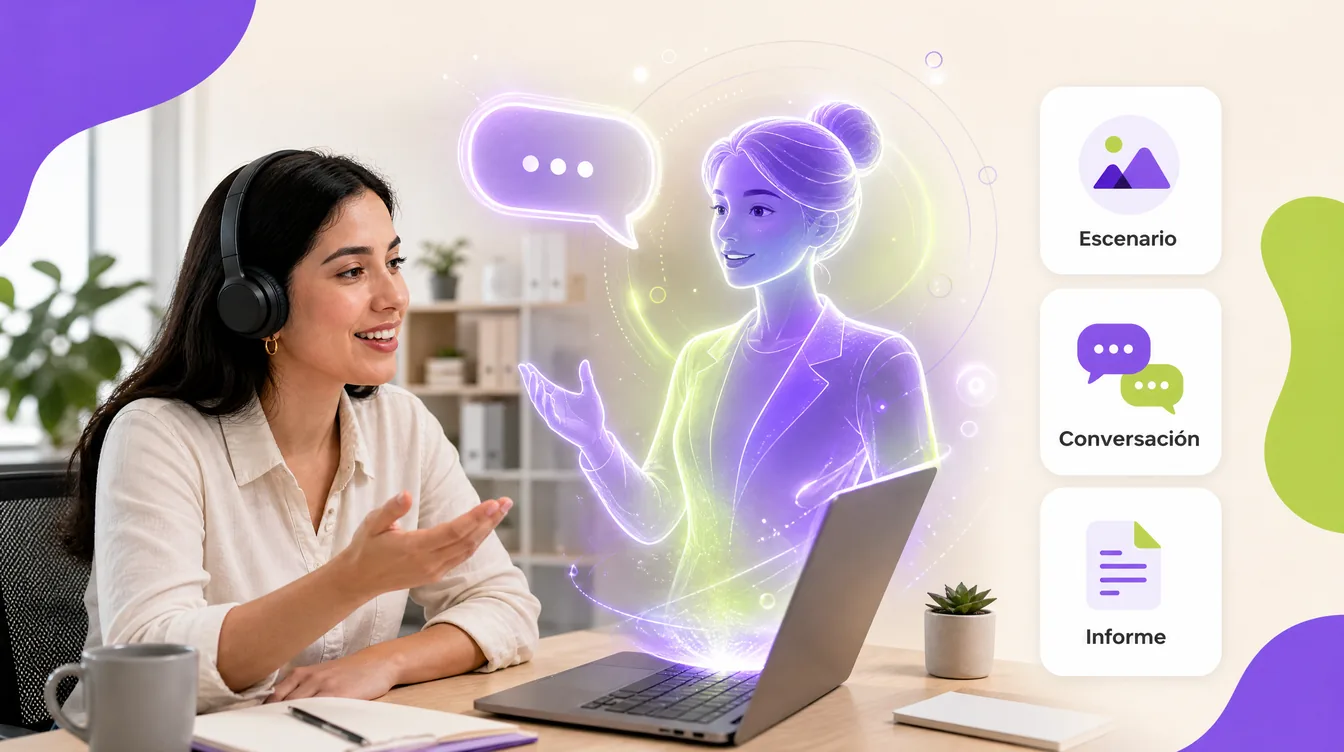
An AI role play session works in five steps: you choose a scenario, talk with the character, get help during the conversation if you want it, receive a report with a score per criterion and repeat to improve. Everything happens in the browser, with nothing to install; it only asks for permission to use the microphone.
- Choose the scenario. Each scenario defines a situation, a character with a personality and a goal. You can adjust the difficulty level and the duration.
- Talk with the character. The conversation is by voice and in real time: the character interrupts, hesitates, gets annoyed or is persuaded depending on what you say.
- Get live help. In practice mode, a coach gives you discreet on-screen hints when you get stuck. In exam mode there is no coach.
- Review your report. A score for each rubric criterion, strengths, areas for improvement, the key moments with their timestamps and the full transcript.
- Repeat and improve. The report compares your attempt with the previous one, so progress shows up in numbers rather than impressions.
That is how Geedle RolePlay works: it is Geedle's voice conversation simulator, and we will use it as the example throughout this guide.
How is it different from a chatbot or an online course?
The difference lies in who leads the conversation and in what is left at the end. An online course explains things to you; a general-purpose chatbot answers whatever you ask; a role play simulator puts you in front of a character with goals of their own, who makes you resolve a situation and scores you against a rubric.
| Aspect | Online course | General-purpose chatbot | AI role play |
|---|---|---|---|
| What you do | Read, watch videos and answer a quiz | Ask questions and get answers | Lead a conversation toward a goal |
| What the AI does | Nothing or very little | Helps you and agrees with you easily | Plays a character who pushes back |
| Channel | Screen and reading | Text | Real-time voice, with an avatar; also simulated phone, messaging or text |
| Assessment | Multiple-choice test | None | Criteria-based rubric, report and comparison between attempts |
| What it measures | Whether you remember the content | Nothing | Whether you can apply it with someone in front of you |
| Control for the company | Progress and grade | None | Assignments, exam mode, team reports |
It does not compete with the course: it completes it. Theory is learned in a training course or in microlearning capsules; practice happens in the simulator. It is the difference between knowing closing techniques and having closed twenty times with a customer who says no.
What makes the character feel real?
The character feels real because it does not follow a fixed script: it has a personality, information it only reveals if you ask the right questions and a mood that shifts with your answers. That forces you to listen and adapt, which is exactly what a real conversation demands.
- Personality and difficulty. Hostile, skeptical, rushed, indecisive, kind but firm, or a rigorous auditor, with five difficulty levels.
- Emotional thermometer. You see the character's willingness rise or fall depending on what you say.
- Hidden information. The real budget, the underlying reason for the complaint or the missing record only come out if you ask the right questions.
- Objections and forbidden phrases. The scenario defines which objections will come up and which phrases you must not say, such as promising something the company cannot deliver.
- Unexpected events. Halfway through, a call comes in, a condition changes or a new fact appears.
- On-screen evidence. If you show a document, the character reads it and reacts to what it contains.
- Lip-synced avatar. The character has a face and gestures; you can also practice in phone, messaging or text mode.
Which workplace conversations is it good for?
It works for any conversation that has a clear goal, a counterpart who may resist and a cost if it goes wrong. For a company, the clearest uses are in sales, customer service, leadership and human resources, contact centers and preparing for ISO audits.
- Sales. Prospecting, needs discovery, negotiation and closing. See sales role play and the article on AI sales role play for objections.
- Objection handling. "It's too expensive", "let me think about it", "I already have a supplier". Details in objection handling.
- Customer service. The upset customer, the complaint that escalates, the bad news that has to be delivered. See customer service role play and contact center.
- Leadership and HR. Difficult feedback, conflicts between team members, interviews. See leadership and human resources.
- ISO 9001 audits. The auditee rehearses their interview with a simulated auditor, and the internal auditor practices with difficult auditees. See ISO 9001 audit role play and how to answer an ISO 9001 auditor.
If your critical conversation is not on that list, it can be built: custom scenarios with your procedures, your product and your real objections.
How is it scored, and how do you measure improvement?
Improvement is measured with a rubric: a list of observable criteria, each with its own score, applied the same way to every attempt and every person. The report shows the result per criterion and compares it with your previous attempt and with your team's average.
Whoever runs training gets three more tools. Assignments set which scenario each group practices, with a deadline, a number of attempts and a minimum score. Exam mode removes the coach and locks the rubric so the score is comparable; in addition, the transcript and the score are generated on the server, not on the user's device. And the reports include a heat map of competencies, such as listening, empathy and objection handling, that shows who needs reinforcement and in what.
The recommendations in the report do not come out of nowhere: each one cites its source, drawn from an openly licensed evidence library. And if you also upload your company's documents, the character consults them during the conversation and detects when you say something that contradicts them.
What does AI role play not do?
AI role play does not replace the facilitator or the group experience, and it does not guarantee business results on its own. It is a tool for individual practice: it multiplies repetitions and provides data, but the judgment to choose what to practice and to support someone who gets stuck is still human.
It also has practical limits: it needs a microphone and a place where you can speak out loud, and the quality of the exercise depends on how well the scenario is designed. A generic character teaches less than one built around your product and your customers. The full comparison, including what is better kept in person, is in AI role play vs traditional role play.
How do you get started with your team?
Start with a single critical conversation, the one your team struggles with most or the one that moves the most money, and set up a pilot with a small group. Measure the first attempt, let them practice for two weeks and compare. With that result you decide whether to extend it to other areas.
- Identify the conversation. If it is not clear to you, a training needs assessment will point to it.
- Try a voice demo. Two minutes are enough to know whether the format suits your people.
- Define the rubric. What the person must do for the conversation to count as a good one. The guide is in how to design a role play scenario.
- Choose the tool with clear criteria. Use the checklist in what to evaluate in an AI conversation simulator.
- Connect practice with the rest. Course, simulator and follow-up from the leader; if you already use other AI agents for business, role play is the training piece.
Try it for two minutes, or build it around your case?
The fastest way to understand AI role play is to have a conversation. Start with the sales role play with a simulated customer: a free two-minute voice demo in your browser, no account needed. To see the full Geedle RolePlay product with scenarios for your area, request a demo and we will walk through it with your case. And if the scenario your team needs is not in the catalog, we build it with you, using your procedures, your product and your real objections: see custom role-play scenarios. Full product details are at Geedle AI role play.