How to Design a Custom Role Play Scenario: Character, Goal and Rubric
Designing a role play scenario means deciding, in writing, which conversation your team will practice, with whom and how you will know whether it went well. Most exercises fail right there: the case is vague, the character puts up no resistance and the feedback stops at "that was fine". This practical guide takes you through seven steps, from the situation to the rubric, with a template ready to fill in, and it works just as well for an in-person role play as for an AI simulator.
In this article
- How do you design a role play scenario?
- What is a custom scenario, and when is it worth it?
- How do you choose the situation and the goal?
- How do you build the character?
- Which objections, events and forbidden phrases should you include?
- How do you write the rubric?
- What should the scenario sheet include?
- How do you test and fine-tune it before launch?
- Do it yourself, or shall we build it with you?
- Try it for two minutes, or build it around your case?
How do you design a role play scenario?
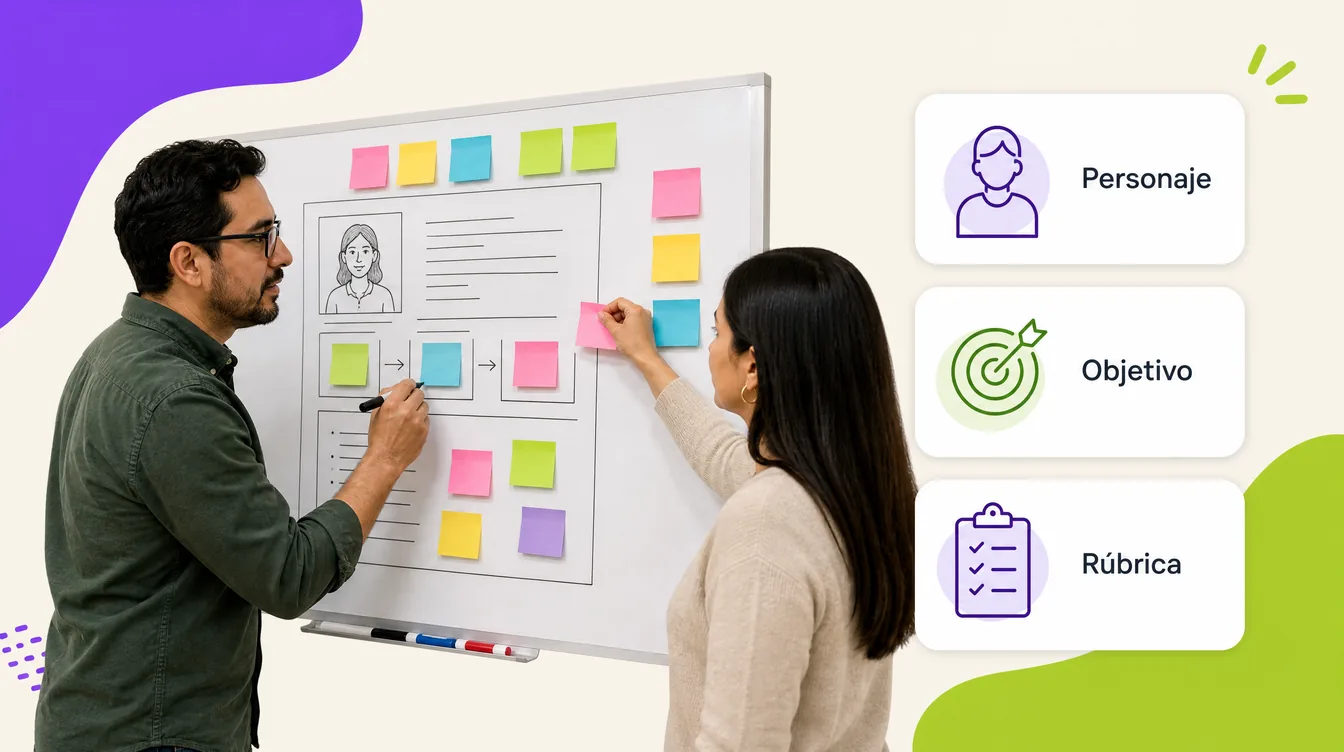
To design a role play scenario, follow seven steps: choose a real, frequent situation, set the goal for the person practicing, build the character, define the information it hides, list its objections and the unexpected events, write the rubric with observable criteria and test the scenario with a small group before launching it.
- Situation. A specific conversation, with a place, a moment and a background.
- Goal. What the person must achieve by the end of the conversation.
- Character. Who the other party is, what they want and how they behave.
- Hidden information. What the character knows and will only say if asked well.
- Objections and events. The resistance they will put up and what can change halfway through.
- Rubric. The criteria used for scoring.
- Pilot. Test, adjust and launch.
What is a custom scenario, and when is it worth it?
A custom scenario is a role play case built from your company's reality: your products, your procedures, your customers and the objections your team actually hears. It is worth it when the conversation is critical to the business and a generic case would teach answers that do not apply in your operation.
A catalog case, such as "upset customer at the front desk", is useful for training the general skill. But if your returns policy has three exceptions, or your auditor is going to ask for a form that only exists in your company, the practice has to include them. One clarification: here we are talking about training, that is, preparing your people for their jobs, not about exercises for hiring.
How do you choose the situation and the goal?
Choose the situation that meets three conditions: it happens often, it is expensive when it goes wrong and your team handles it in very different ways. Then write the goal as a result that can be observed at the end of the conversation, not as a general intention along the lines of "serve the customer well".
To find the situation, ask supervisors which conversation keeps new people up at night, review recent complaints and findings or rely on a training needs assessment. Then narrow it down. "Complaint handling" is a topic; "a customer calling for the second time because their order arrived incomplete and they were already promised a solution that was not delivered" is a situation.
The goal is written with a verb and a result: "keep the customer with a solution the policy allows, without promising a date that does not depend on you". If you cannot say in one sentence what counts as success, the scenario is not ready yet.
How do you build the character?
The character is built from five pieces of information: who they are, what they want to achieve, how they behave, what mood they arrive in and what they know but will not say up front. With that, it stops being a colleague acting and becomes a counterpart with motives of their own, who reacts differently depending on how they are treated.
- Identity. Job title, how long they have been a customer and their relationship with your company. Do not use the names of real customers.
- Motivation. What they need to solve today and what worries them underneath.
- Personality. Hostile, skeptical, rushed, indecisive, kind but firm or, in an audit, rigorous.
- Starting state and difficulty level. Whether they arrive upset or neutral, and how easily they give way.
- Hidden information. The fact that changes the conversation: they already got a quote from another supplier, their boss is pressuring them, the record the auditor is asking for does exist but sits in another department.
Hidden information is what separates a good scenario from a flat one. It forces people to ask and to listen, because someone who only recites their script never uncovers it. In an AI simulator it is complemented by an emotional thermometer: the character's willingness rises or falls depending on what you say.
Which objections, events and forbidden phrases should you include?
Include three to five real objections, one or two unexpected events and a short list of forbidden phrases. Objections provide the resistance, events test the ability to adapt and forbidden phrases mark what your company never wants to hear, whether because of policy or because of risk.
- Objections. Take them from operations, in the customer's words: "that's what I was told last time", "the other supplier is cheaper". Textbook objections sound fake.
- Unexpected events. Halfway through, the boss calls, the system shows a different figure or the customer asks to speak with a supervisor.
- Forbidden phrases. Promises you cannot keep, blaming another department, "it's company policy" with no further explanation.
- Evidence. If the conversation depends on a document, such as a quote, a policy or a record, include it so the character can read it and react.
How do you write the rubric?
The rubric is written with four to six assessment criteria, each described as an observable behavior with clear performance levels. Its purpose is for two evaluators, or the simulator on two different attempts, to score the same conversation the same way. Without a rubric, feedback depends on the taste of whoever is watching.
| Criterion | Insufficient | Acceptable | Outstanding |
|---|---|---|---|
| Listening and diagnosis | Offers a solution without asking | Asks what happened and confirms the details | Uncovers the underlying reason with open questions and summarizes it |
| Handling emotion | Argues or makes excuses | Acknowledges the annoyance with one sentence | Acknowledges, takes ownership and lowers the tension before proposing |
| Adherence to policy | Promises something the company does not allow | Offers the standard solution | Chooses, among the permitted options, the one that best solves the case |
| Closing and commitment | Ends without agreeing on anything | Agrees on a solution | Agrees on a solution, a date and the next contact, and checks that the customer is satisfied |
Two tips. Avoid criteria that cannot be seen, such as "having a service attitude"; translate them into what the person says or does. And decide the minimum passing score in advance, especially if you are going to use the scenario as an exam. If the team lacks the basics, the rubric also tells you which course to reinforce before practicing, for example customer service or active listening.
What should the scenario sheet include?
The scenario sheet brings everything above together on a single page. It is the document you hand to whoever will play the other party in an in-person exercise, or what you enter into the simulator. Use this template as a starting point and fill it in with your own case.
| Element | What to define | Example |
|---|---|---|
| Title | A short name that describes the situation | Second complaint about an incomplete order |
| Role practicing | Who does the exercise | Customer service representative |
| Situation | Context, channel and background | The customer calls for the second time; on the first call they were promised a replacement that never arrived |
| Goal | Observable result | Keep the customer with a permitted solution and a commitment with a date |
| Character | Identity, motivation and personality | Parts buyer at a repair shop, a frequent customer, rushed and skeptical |
| Hidden information | What they will only say if asked | They have a vehicle held up by the missing part and already asked another supplier for a price |
| Objections | Three to five, in their words | "That's exactly what I was told on Monday"; "I'd rather cancel everything" |
| Unexpected event | A change halfway through | Asks to speak with a supervisor |
| Forbidden phrases | What must not be said | Blaming the warehouse; promising same-day delivery |
| Evidence | Supporting documents | Original order and the note from the first call |
| Rubric | Criteria and minimum score | Listening, emotion, policy and closing; minimum agreed with the leader |
| Duration and difficulty | Time and level | Short conversation, medium difficulty |
How do you test and fine-tune it before launch?
The scenario is tested with a small group that includes someone experienced and someone new. If the expert solves it effortlessly, it needs more difficulty; if nobody passes, it has too much; and if both get the same score, the rubric is not distinguishing what it should.
In the pilot, check three things: that the character sounds like your customers, that the hidden information can be uncovered with good questions and that the report explains the score with specific moments from the conversation. Adjust and test again. The same rules hold for other industries: a service cancellation in a contact center, a comparison of quotes at a car dealership, a customer audit at a manufacturing plant or a late delivery at a logistics company are ideas for situations that are built the same way.
Do it yourself, or shall we build it with you?
You can do it yourself with this guide or ask us to build it with you. Geedle RolePlay offers three do-it-yourself paths: duplicating a template and adjusting it, generating the scenario from your documents or generating it from the recording of a real conversation, which is anonymized and requires the corresponding consent.
If you would rather not do it alone, the custom scenarios service follows five steps:
- You tell us the situation. Which conversation you want to train and for which role.
- You share your material. Procedures, scripts, policies and real objections.
- We build it. Character, hidden information, objections, events, evidence and rubric.
- We fine-tune it with your team. A pilot to adjust difficulty and criteria.
- You roll it out. With assignments, a deadline and team reports.
The same method applies to an audit interview: there the sheet starts from your procedures and your records, as we explain in the two-week ISO 9001 mock audit plan. If you are still comparing tools, review what to evaluate in an AI conversation simulator and AI role play vs traditional role play; the full picture is in what AI role play is and on the AI role play page.
Try it for two minutes, or build it around your case?
You recognize a good scenario by talking with it. Start with the sales role play with a simulated customer: a free two-minute voice demo in your browser, no account needed. To see the full Geedle RolePlay product with scenarios for your area, request a demo and we will walk through it with your case. And if the scenario your team needs is not in the catalog, we build it with you, using your procedures, your product and your real objections: see custom role-play scenarios. Full product details are at Geedle AI role play.