First tourist visa
People applying for the B1/B2 for the first time who want clear answers about the trip, their job and their ties.
- B1/B2
- Tourism
- Express practice
The US visa interview lasts a few minutes and is decided by how you answer: clear, short and consistent with your DS-160. With Geedle RolePlay you practice out loud with an AI consul who asks what the consular officer asks (purpose of the trip, who pays, what you do, what ties you to Mexico), asks you to be specific when you ramble and scores you against a rubric at the end. It is training only: Geedle does not process visas or guarantee approval.
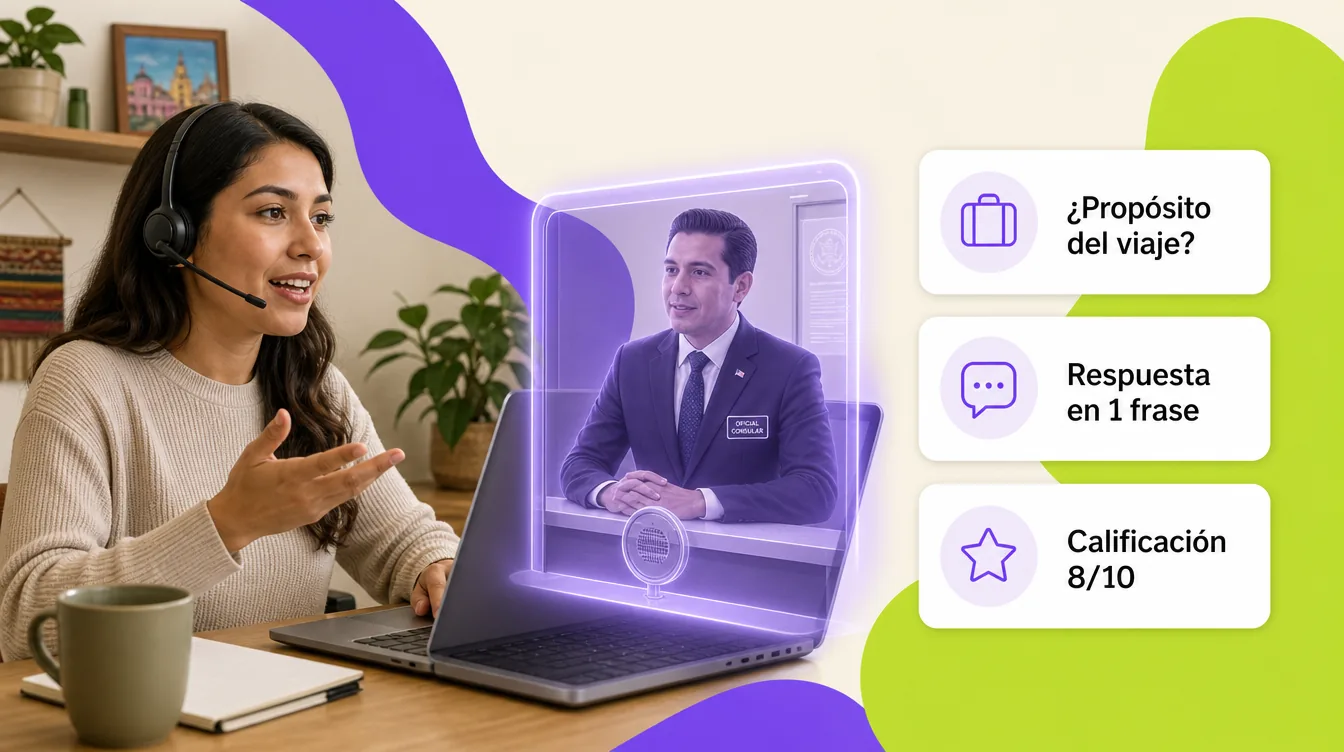
It is a voice mock of the consular interview: an artificial-intelligence character plays the officer, asks the usual B1/B2 or F-1 visa questions, reacts to vague or contradictory answers and scores you at the end with strengths and areas to improve. It is training: it does not replace official information or guarantee the outcome.
A short path that combines official information with practice out loud. Each step has a Geedle RolePlay scenario or a concrete task.
Read your full DS-160 and write on one sheet, one sentence each: why you are going, for how long, with whom, who pays, what you do and what brings you back to Mexico. That sheet is your script: everything you say in the interview must match it.
Six-sentence scriptDo the three-minute practice with the AI consul: purpose, duration, companions, who pays and occupation. The report tells you whether you over-explain, hesitate or contradict your script.
First reportPractice the full scenario that applies to you (first-time tourism, business, F-1 student, visiting relatives or renewal) with the coach on. Repeat until your consistency and brevity scores go up.
Scenario masteredTrain how to explain your ties to Mexico (job, family, studies, property) in one or two sentences, without memorizing paragraphs. The character follows up exactly where you sounded rehearsed.
Answers on tiesSwitch the coach off and run a session in exam mode, like the real appointment. Then organize only the documents that support what you said; at the window they rarely ask for all of them, but they must match your story.
Exam-mode sessionThese are the 6 consular interview scenarios available in Geedle RolePlay. Each card shows the role you practice (always the applicant), who you face (the consular officer) and the difficulty level. The questions adapt to what you answer.
You practice as: ApplicantFacing: Consular officer
Difficulty 3 of 5
You practice as: Applicant sent by their companyFacing: Consular officer
Difficulty 3 of 5
You practice as: Renewing applicantFacing: Consular officer
Difficulty 2 of 5
You practice as: Admitted studentFacing: Consular officer
Difficulty 4 of 5
You practice as: Applicant with family in the USFacing: Consular officer
Difficulty 4 of 5
You practice as: ApplicantFacing: Consular officer
Difficulty 2 of 53-minute express
We build it with you, using your procedures, your product and your real objections.
Custom scenariosSix differences compared with “most common questions” lists and rehearsing with a relative.
Purpose of the trip, duration, who pays, occupation and income, family in the United States, previous trips and what brings you back: you hear them and answer by speaking, which is how it happens at the window.
If you over-explain, it cuts you off; if you are vague, it asks you to be specific; if you contradict what you said earlier, it points it out calmly. Rehearsing with a relative does not give you that.
The report flags where your answer drifted from your own script. Inconsistency between the form and the interview is one of the costliest mistakes.
The rubric scores whether your answers fit in one or two sentences. In the real interview there is little time and talking too much opens topics nobody asked about.
Practice in the language you feel surer in, or alternate. If you want to rehearse in English, the consul switches language and subtitles support you.
At any time, before the appointment and without embarrassment. Every attempt is compared with the previous one so you can see your progress.
A report per session with the same criteria on every attempt. You know what to fix before your appointment and you do not depend on the opinion of whoever listened to you.
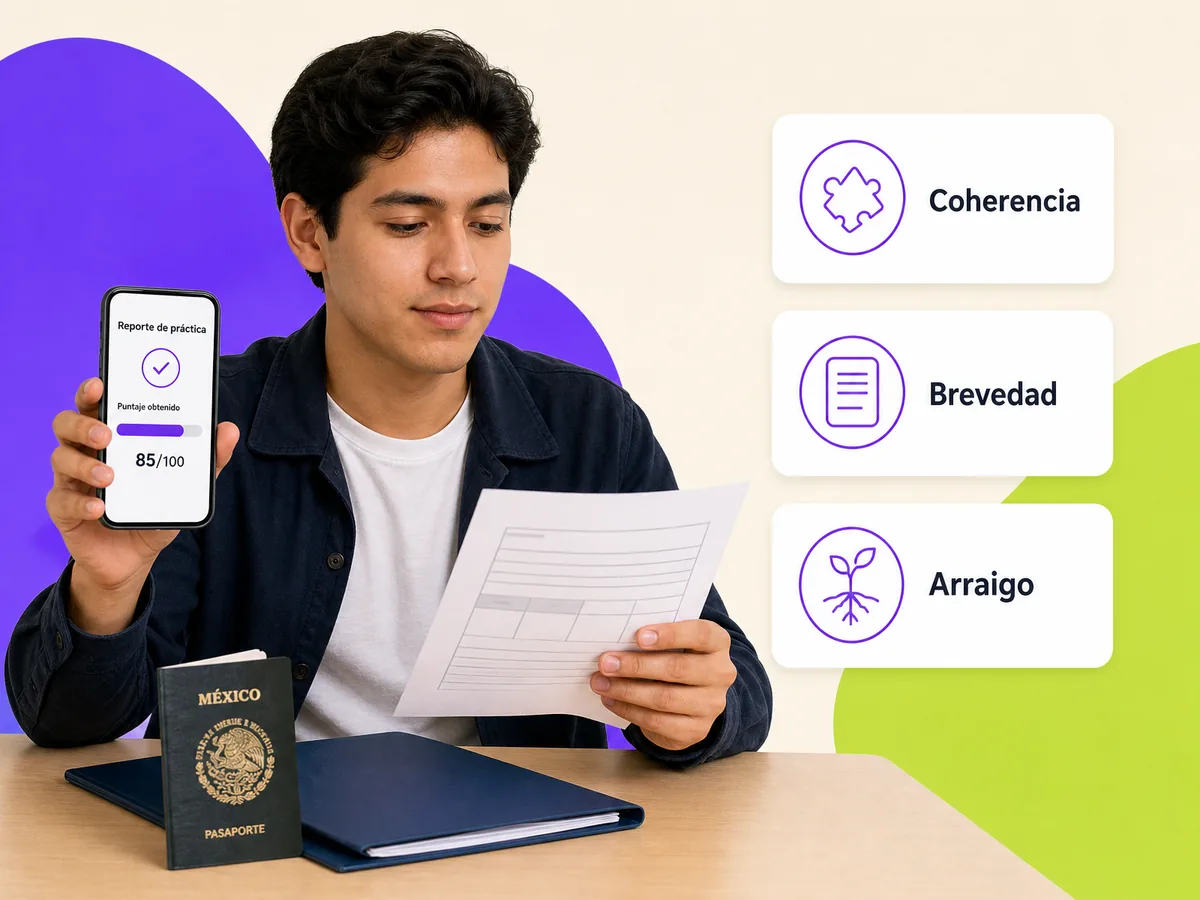
The questions revolve around four topics: the reason for and length of the trip, how you pay for it, what you do for a living and which ties bring you back to Mexico. The consular officer combines them according to your case and decides in a few minutes while reviewing your DS-160. There is no fixed questionnaire, which is why practicing how you answer matters more than memorizing answers. The “first-time tourism” scenario covers the base questions; the business, F-1 student and visiting-relatives scenarios add the ones specific to each case (who pays for the trip, the study plan, your relatives' situation in the United States).
The most common refusal relies on section 214(b) of the US Immigration and Nationality Act: the officer was not convinced you will return to your country. That is assessed mostly in the conversation, not in the folder of documents. Long, nervous, memorized answers, or answers that contradict the DS-160, raise doubts even when the file is complete. The role play trains exactly that: stating your real situation clearly and in few words. If you already received a refusal, the renewal and ties scenarios help you prepare a more consistent interview; the final decision always belongs to the consular officer.
It does not book your appointment, fill in your DS-160, review your documents or give an opinion on whether you will get the visa; it also does not ask for, nor should it receive, real passport, account or address data. It is communication training with an AI character. Requirements, fees, appointments at the Applicant Service Center (ASC) and at the consulate, and any change in the process are at travel.state.gov and the US Embassy in Mexico. For a complex case (previous refusals, records, status changes) consult an immigration lawyer.
For anyone with an appointment who does not want the first time they hear the questions to be at the window.
People applying for the B1/B2 for the first time who want clear answers about the trip, their job and their ties.
Those who received a 214(b) and want a shorter, more consistent interview without memorized speeches.
People admitted to a US school (F-1) or employees sent by their company (B1) who must explain plan and funding.
Agencies and advisors who prepare their clients, and companies sending staff to trade shows or training in the United States.
Try two free minutes with the AI consul and hear the questions out loud. If you want the full path with the 6 scenarios, the coach and the report, write to us and we tell you how to start today.
All three help. The difference lies in how many realistic repetitions you get and how objective the feedback is.
| Criterion | Role play with an AI consul | Rehearsal with a relative | List of frequent questions |
|---|---|---|---|
| What you train | Answering out loud, under pressure and with follow-ups | Answering out loud to someone who knows you | Knowing what they may ask |
| Reaction to your answers | Follows up, asks for specifics, points out contradictions | Depends on the relative's patience and judgment | None |
| Feedback | Report with a rubric and exact sentences from the transcript | General opinion | None |
| Consistency with the DS-160 | Measured against your six-sentence script | Only if the relative knows your form | Not applicable |
| Language | Spanish, English or alternating | Whichever your relative speaks | The list's |
| When | Any time, as often as you want | When you both can | When you read it |
What does it cost? There is a Free plan with 15 credits to try it, and one-time-payment plans from $59 USD ($999 MXN) valid for 12 months. Prices subject to confirmation. See plans and credits
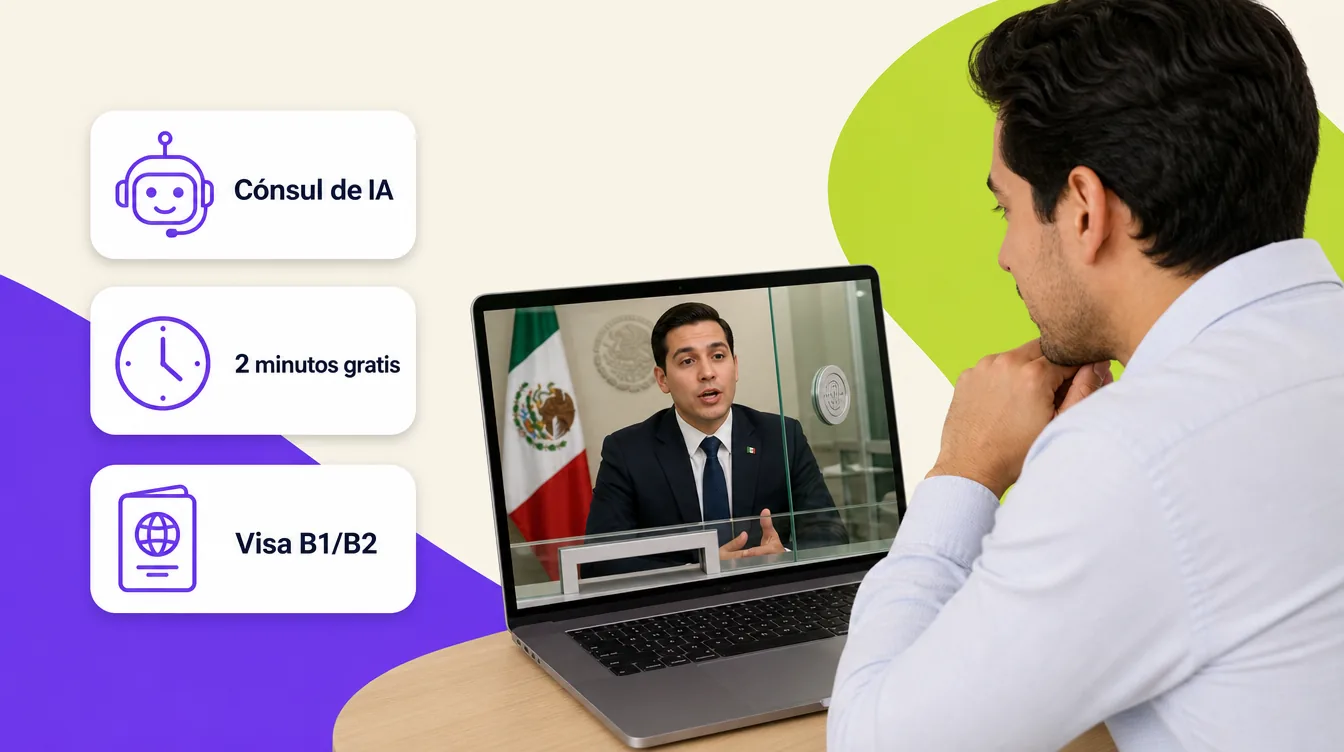
A two-minute simulated consular interview: real B1/B2 visa questions, short answers and feedback.
No account. Voice and a real-time face in your browser; to continue past two minutes it asks for your name and email.
If you are also job hunting, presenting to management or your team serves customers, each page gathers the scenarios and the practice path for that topic.
Read the US visa interview questions and how to answer them, why visas are denied: section 214(b) and ties, how to practice the interview with a step-by-step mock and the mistakes that cost the most at the window.
Practice two minutes with the English teacher with avatar to learn your level and gain fluency, and see the business English courses if your trip is for business. The AI consul can also interview you in English.
If you prepare several people, Geedle RolePlay gives you a dashboard to assign scenarios, see progress and download reports; and if your clients have particular cases, we build the scenario to order. See how Geedle AI role play works and the voice agents with avatar you can already try. And if you also want your travelers to get the itinerary, payment reminders and a per-tour survey on WhatsApp, see the AI agent for travel agencies.
Real projects told with facts, not promises.
Train crews spread across restaurants in several Mexican states and the United States with the same standard — and give every employee a clear view of how to grow inside the company.
Read the full caseBring an operation that lives on the road under a quality management system that meets the new ISO 9001:2026 and passes the certification audit.
Read the full caseImportant. Geedle is not an immigration firm or a law firm, is not affiliated with the Government of the United States or its consulates, does not take part in your application and does not guarantee the approval of any visa. The role play is communication training with an artificial-intelligence character. The decision belongs only to the consular officer. Check official requirements at travel.state.gov and the US Embassy in Mexico. Never enter real passport, DS-160 or bank data during practice, and never lie in the real interview.
Try two free minutes with the AI consul or tell us your visa type and appointment date: we reply the same day with the practice path that suits you. Training only, no promises about the outcome.