Team leaders and supervisors
Managers, department heads and line supervisors who have to give feedback, set expectations and listen before answering, often without ever having practiced it.
- Poor performance
- Active listening
- Expectations
- Follow-up
The poor-performance conversation gets postponed for weeks because nobody wants to have it badly. Geedle RolePlay lets your leaders rehearse it out loud with an AI team member who reacts like a real person: justifies themselves, shuts down when attacked, opens up when heard and asks “so what exactly do you expect from me?”. Every attempt is scored against an evidence-based rubric (facts, impact, listening, agreements) and ends with a report that shows the minute the conversation turned into a scolding. The same goes for the candidate interview, the bad news in a hospital and the meeting with a dissatisfied parent.

Effective feedback is given in private, on time and about facts: you describe the specific situation, the behavior observed and the impact it had, you listen to the employee's side and you agree on next steps with a date. You do not pass judgment on the person, you do not pile up six months of examples and you do not end without an agreement. The sequence is well known; the hard part is holding it when the employee gets defensive, cries or goes silent. That is what gets rehearsed here.
This is the model the Geedle RolePlay rubric measures in the poor-performance scenario, backed by the evidence library on feedback and deliberate practice. The AI team member reacts to every step, for better or worse.
Two or three specific examples, with dates, not a list of grievances. In private, unhurried and not at the end of a bad day. In the scenario, the leader has the employee's file at hand and the rubric penalizes opening with generalities (“you haven't seemed committed lately”).
Step 1One sentence that says what the conversation is about and what for: “I want to talk about the deliveries of the last three weeks and agree on how we fix them”. No five-minute preamble and no praise sandwich that muddles the message. The live coach warns if the leader takes too long to get to the point.
Step 2What happened, what the person did or failed to do and what consequence it had for the team or the customer. No adjectives about their character. The AI team member shuts down and their emotional thermometer drops when they hear judgments; they stay open when they hear facts.
Step 3Ask what is going on from their side and let them finish. This is where the character's hidden information lives: an unevenly shared workload, a personal problem or a contradictory instruction the leader did not know about. The rubric measures how much the leader talked compared with the employee and whether they built on what they heard.
Step 4What is going to change, how it will be measured and when you sit down again. Clear expectations, in writing if needed, and a close that leaves the relationship intact. A conversation that ends without an agreement or with a “just try harder” is recorded in the report as an incomplete close.
Step 5These are the 5 leadership, HR, healthcare and education scenarios ready to assign: feedback on poor performance, the express listening practice, the candidate interview, breaking bad news to a relative and the dissatisfied parent. Each card shows the role practiced, who they face and the difficulty.
You practice as: Team leaderFacing: Team member
Difficulty 3 of 5
You practice as: LeaderFacing: Team member
Difficulty 1 of 53-minute express
You practice as: RecruiterFacing: Experienced candidate
Difficulty 3 of 5
You practice as: PhysicianFacing: Patient's relative
Difficulty 4 of 5
You practice as: TeacherFacing: Parent
Difficulty 3 of 5
We build it with you, using your procedures, your product and your real objections.
Custom scenariosTell us the conversation that costs you the most and share your procedures, your product and your real objections. We design the character, the hidden information, the rubric and the evidence, pilot it with your team and leave it ready to assign.
Six things a one-day leadership workshop cannot provide and AI role play can.
They justify themselves, interrupt, go silent or ask what exactly you expect. Their emotional thermometer is visible on screen and responds to the leader's tone and words, not only to the content.
Upload your performance review policy, your internal regulations and your job descriptions. The character knows them and the report detects when the leader promises something HR cannot back up.
During the rehearsal, the coach suggests on screen how to turn a judgment into a fact or when to stop talking. In exam mode it is switched off, and the score comes from the server for the internal certification of leaders.
Facts, impact, listening, agreements and close, scored by criterion. Every recommendation shows its source in the evidence library on feedback, structured interviewing and breaking bad news.
Three minutes to listen before answering, difficulty 1, ideal for the new leader or for the one whose one-on-one is in half an hour. The phrases that cost points become flashcards.
HR assigns scenarios by leadership level, sees the heat map by competency (listening, clarity, agreements) and exports the training evidence. Each leader sees only their own report; nobody rehearses in front of their peers.
A private report for every session, with the same criteria for every leader in the organization. HR sees the aggregate progress; each leader sees where the conversation got away from them.
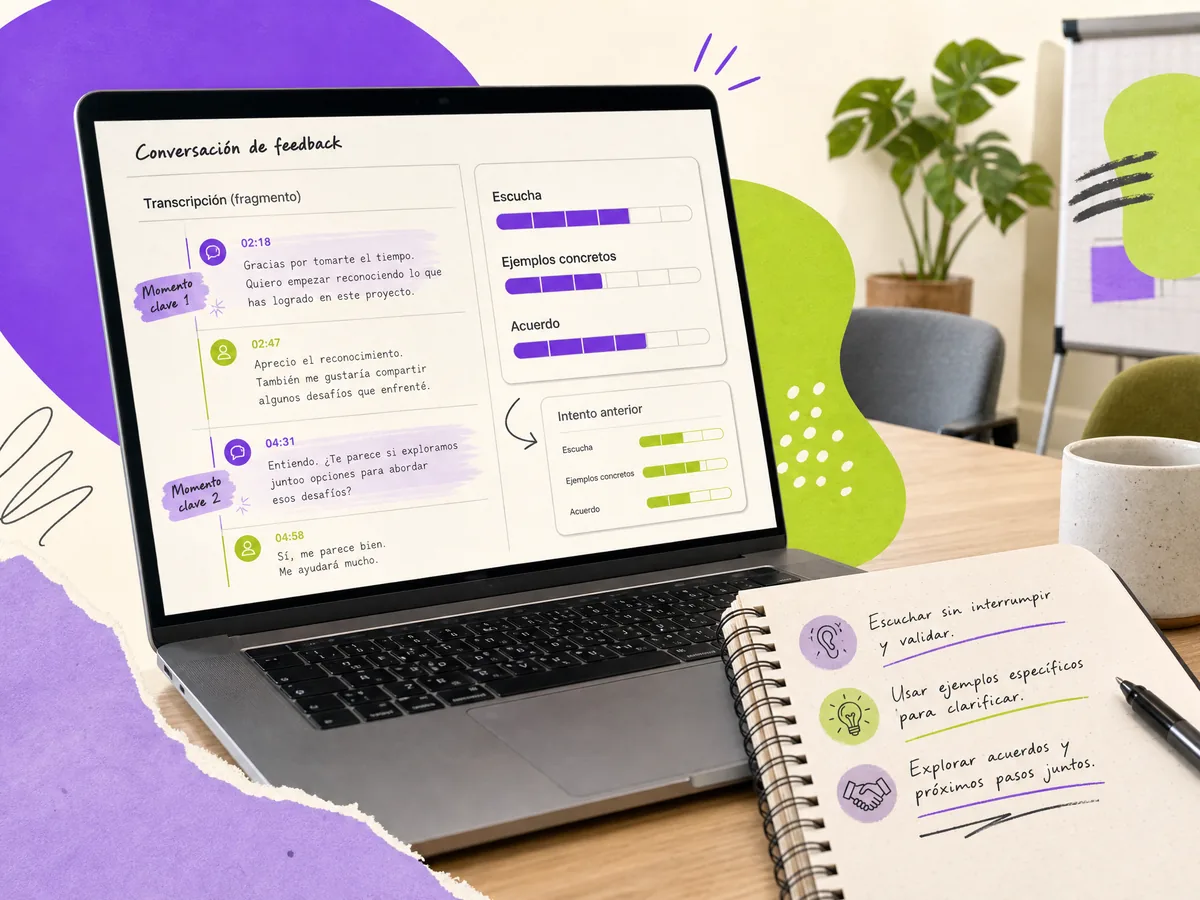
Because the last time it went badly: the employee got defensive, the leader raised their voice or ended up softening the message so much that the person left without understanding there was a problem. After an experience like that, the next conversation gets postponed, the problem grows and, when it finally happens, it arrives loaded with six months of examples. The result is a scolding, not feedback, and sometimes a resignation. Leadership and active listening workshops teach the model and practice it once in the classroom, in front of the other managers, with a colleague who plays the employee kindly. AI role play provides what is missing: a private place to fail five times and a rubric that says exactly at which step. For HR there is an additional link: Mexico's NOM-035 requires workplaces to identify and prevent psychosocial risk factors, among them negative leadership and workplace relationships. Training how your leaders give feedback is a concrete action in that direction, although the simulator by itself does not certify compliance with the standard.
A team leader calls in a team member whose deliveries have been late or incomplete for three weeks. The character comes into the conversation on the defensive, with a justification ready, and their emotional thermometer reacts to the leader's first sentence: if they hear a judgment (“you don't seem committed”), they shut down and answer in monosyllables; if they hear a dated fact and its impact on the team, they stay open. They hold hidden information they only share if the leader asks and listens: a workload that doubled when a colleague left and a contradictory instruction from another department. If the leader reaches that information, the conversation shifts from “your problem” to “how we solve it”. There are forbidden phrases that cost points, such as comparing the employee with someone else or closing with “just try harder”, and a possible unexpected event: the employee asks whether their job is at risk, and the rubric measures whether the leader answers honestly without threatening. Difficulty 3 of 5. The rubric measures facts, impact, listening, agreements and close, with each person's share of talking time. The guide how to give feedback to an underperforming employee walks through the conversation step by step.
Two of the scenarios in this group leave the office. In “Breaking bad news”, a physician must inform a patient's relative of a serious result: the character moves from denial to anger to questions with no easy answer, and the rubric measures preparing the setting, clarity without jargon, pauses, the response to emotion and the plan for next steps, based on the evidence on breaking bad news. Difficulty 4 of 5. In “Dissatisfied parent”, a teacher meets a parent upset about a grade or a sanction: the character arrives with their child's version, interrupts and asks to speak to the principal, and the rubric measures listening, facts from the record, firmness without confrontation and a follow-up agreement. Difficulty 3 of 5. Both pair with the patient communication and soft skills for teachers courses, and with Geedle's teacher training program. The conversations specific to your institution (informed consent, a patient upset about the wait, a student at risk, a meeting with the principal) are built as custom scenarios.
For anyone whose job includes a conversation they would rather not have.
Managers, department heads and line supervisors who have to give feedback, set expectations and listen before answering, often without ever having practiced it.
Recruiters who run competency-based interviews and HR generalists who support performance, conflict or exit conversations.
Physicians, nurses and care staff who deliver difficult diagnoses, explain a wait or respond to an upset relative.
Teachers and coordinators who meet dissatisfied parents, support a student at risk or hold a tense meeting with the principal.
Book a Geedle RolePlay demo for HR: we show you the AI team member, the evidence-based rubric, the leader's private report and the dashboard with the competency heat map. If your conversation is not in the catalog, we tell you how we build it.
The conversations that get postponed the most, the most common mistake in each one and the criterion they are scored against. Those not in the catalog are built to order with your policies.
| Conversation | Most common mistake | What the rubric measures |
|---|---|---|
| Feedback on poor performance | Opening with judgments about the person and piling up months of examples | Dated facts, impact, listening, agreement and close |
| One-on-one: listen before you answer | Interrupting with the solution before understanding the problem | Listening share and open questions |
| Interviewing a candidate | Hypothetical questions and deciding in the first two minutes | Competency-based questions, behavioral evidence and avoided biases |
| Breaking bad news (healthcare) | Jargon, rushing and leaving no room for emotion | Preparation, clarity, pauses, response to emotion and plan |
| Dissatisfied parent (education) | Arguing with the child's version or giving in to end it | Listening, facts from the record, respectful firmness and follow-up |
| Denying a raise, conflict between team members, termination | Improvising without HR and without a script of facts | Built to order: with your policy and your rubric |
What does it cost? There is a Free plan with 15 credits to try it, and one-time-payment plans from $59 USD ($999 MXN) valid for 12 months. Prices subject to confirmation. See plans and credits
If your organization also sells, serves customers or answers auditors, each page gathers the scenarios and the practice path for that topic.
Feedback does not sound the same on a plant floor as in a contact center or a hospital. Each page grounds the scenarios in the cases of your sector.
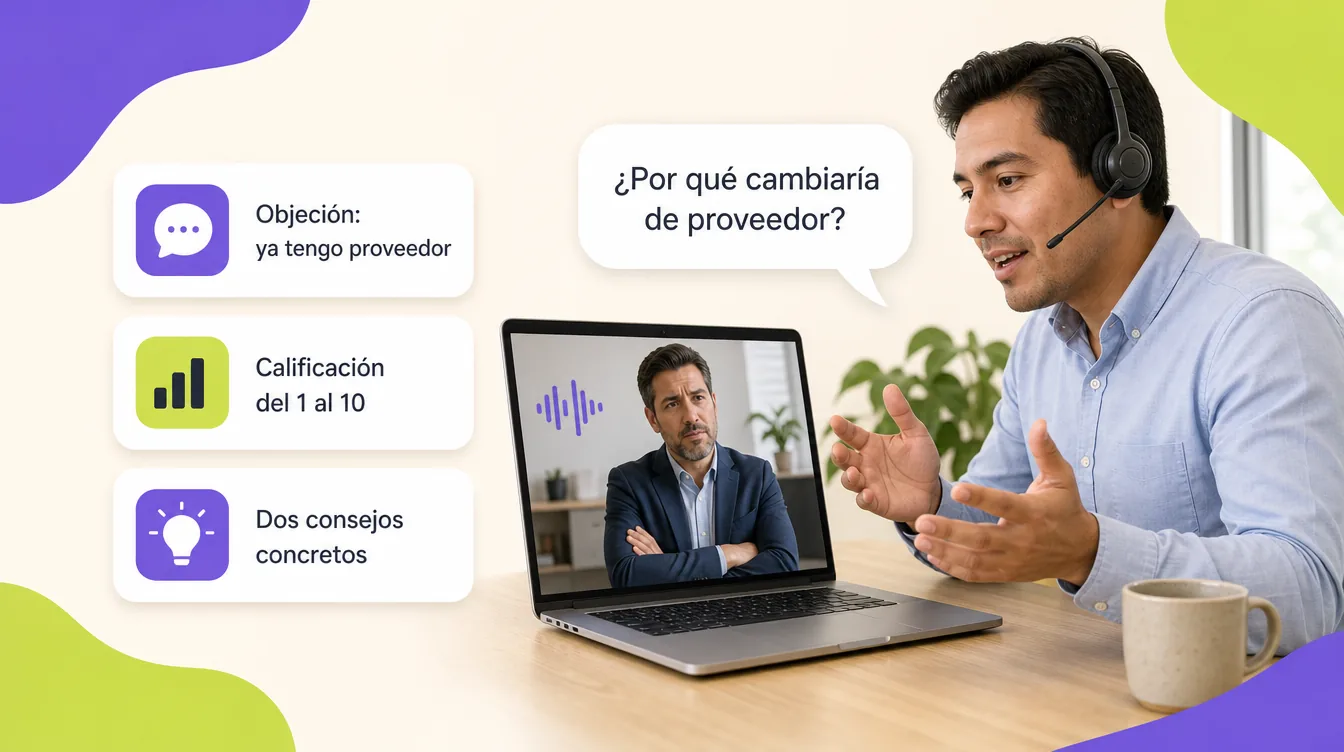
A skeptical purchasing manager raises real objections; you handle them and get a score.
No account. Voice and a real-time face in your browser; to continue past two minutes it asks for your name and email.
The model is learned in the leadership and active listening courses of the corporate course catalog, and team trust is built with team building. Role play provides the repetition the workshop cannot.
Mexico's NOM-035 requires identifying and preventing psychosocial risk factors, among them negative leadership. Rehearsing feedback is a concrete action on that factor; Geedle's free assessment helps you see where to start. The simulator by itself does not certify compliance with the standard.
The bad news and dissatisfied parent scenarios pair with the patient communication and soft skills for teachers courses, and with teacher training. Whatever is missing is built as a custom scenario.
Read how to give feedback to an underperforming employee and what AI role play is. In the glossary: what role play is and what an AI coach is. To try the voice today, Geedle's voice agents.
Real projects told with facts, not promises.
Train crews spread across restaurants in several Mexican states and the United States with the same standard — and give every employee a clear view of how to grow inside the company.
Read the full caseBring an operation that lives on the road under a quality management system that meets the new ISO 9001:2026 and passes the certification audit.
Read the full caseTell us which conversation keeps getting postponed in your organization: poor performance, the interview, the bad news. We reply the same day and schedule your Geedle RolePlay demo with that scenario.