Contact center and help desk
Agents who handle complaints, retention and support over the phone, with call metrics and a supervisor who cannot listen to every call.
- Phone mode
- First response
- Escalation
- Recurring failure
Knowing what to say to an angry customer is not the same as saying it in a steady voice while they raise theirs. Geedle RolePlay puts your service team in front of an AI customer who complains about a late delivery, interrupts, threatens to cancel and only calms down when they feel heard. The practice is spoken, with an emotional thermometer that shows the customer's mood live, a coach that suggests what to say and a rubric-based report at the end. Don't let the first time your agent hears “I want to speak to your supervisor” be on a real call.

A difficult customer is handled with calm, active listening, facts and a concrete solution, in that order. First you let them speak without interrupting, then you acknowledge their frustration in clear words, then you verify the facts with questions and only then do you propose a solution with options and a next step with a date. What fails in practice is not the sequence, which any manual explains, but keeping it when the customer shouts. That is trained by repeating it with someone who really gets angry.
The sequence the Geedle RolePlay rubric measures in the service scenarios. The AI customer's emotional thermometer rises or falls depending on how well each step is executed.
The upset customer needs to get the whole complaint out. Interrupting, even to apologize, lowers the character's emotional thermometer. The rubric measures how much the agent talked in this stretch and whether their tone stayed steady when the customer raised theirs.
Step 1“I understand you have been waiting three days for the order and nobody let you know” works; “calm down” and “that's company policy” are among the forbidden phrases that cost points. Empathy is measured by how specific the acknowledgment is, not by the number of apologies.
Step 2Order number, promised date, what they were told before. The character holds information it only shares when asked the right way, and sometimes its version does not match the record: the agent has to clear it up without contradicting them head-on.
Step 3Two realistic alternatives within company policy, with what can be done today. If the agent promises something your policy does not allow, the report flags it. If the customer asks for the supervisor, the rubric measures whether the agent tried to solve it before escalating.
Step 4Summarize what was agreed, confirm the frustration was addressed and leave a next step with a date and an owner. A scenario that ends with the customer hanging up without an agreement is recorded as unresolved, even if the agent was polite the whole time.
Step 5These are the 4 service scenarios ready to assign: late delivery, recurring failure, the first response to a complaint and the upset customer at the front desk. Each card shows the role your team member practices, who they face and the difficulty level.
You practice as: Service agentFacing: Upset customer
Difficulty 4 of 5
You practice as: Support technicianFacing: Customer with a repeat failure
Difficulty 3 of 5
You practice as: Service agentFacing: Upset customer
Difficulty 2 of 53-minute express
You practice as: ReceptionistFacing: Upset customer
Difficulty 3 of 5
We build it with you, using your procedures, your product and your real objections.
Custom scenariosTell us the conversation that costs you the most and share your procedures, your product and your real objections. We design the character, the hidden information, the rubric and the evidence, pilot it with your team and leave it ready to assign.
Six things the manual, the video course and classroom role play cannot give a service team.
The character complains, interrupts, raises their voice and threatens to cancel. Their emotional thermometer is visible on screen and reacts to what the agent says and how they say it. Nobody in a classroom acts like that in front of a colleague.
Upload your returns policy, your delivery times and your service scripts. The AI customer complains with your cases and the report detects when the agent promises something the policy does not allow.
Phone mode hides the avatar and sounds like a real call, just like on the contact center floor. Messaging mode trains the complaint by chat, with response times and “typing…” according to the customer's personality.
Every session is scored with the same criteria for the whole team: calm, acknowledgment, facts, solution and follow-up, with the source behind each recommendation. The supervisor compares agents with a single yardstick.
From the upset customer at difficulty 2 to the one who has already spoken to three people and does not want to hear a fourth, at difficulty 4. Difficulty rises when the agent passes, so nobody keeps practicing with the easy customer.
“That's not my department”, “calm down”, “that's company policy” cost points on the spot. The live coach suggests how to rephrase; in exam mode it is switched off and the score comes from the server, ready for internal certification.
A report for every session that shows them, minute by minute, when the customer calmed down and when they lost them again. The supervisor receives the same for the whole team.

Because the service manual describes the upset customer in the third person and the past tense, and the call happens in the first person and the present. When someone raises their voice, the body reacts before the script: some agents go quiet and repeat “yes, sir”, others get defensive and argue, and the newest ones escalate to the supervisor at thirty seconds. None of the three responses is in the manual; all three show up in the first week on the floor. The customer service and phone and call center service courses teach the right sequence; AI role play turns it into a reflex, because it lets the agent fail ten times with a customer who really gets angry without costing a real customer. Every attempt is measured, so the supervisor knows who needs more repetitions and at which step. The post training to handle difficult customers: from the manual to the simulator explains how to put that program together.
A service agent takes a call from a customer whose order is several days late and who was never told. The character opens already upset: the emotional thermometer starts in the red and the agent's first sentence decides whether it goes down or up. If the agent asks for the order number before acknowledging the frustration, the customer interrupts and asks whether they are even listening. If they let them finish and acknowledge the situation in concrete words, the thermometer starts to drop and the customer gives the details. They hold hidden information, such as having already spoken to someone else who promised a date that was not met, and only share it when asked what they were told before. Halfway through, an unexpected event may occur: the customer asks for the supervisor or threatens to leave a review, and the rubric measures whether the agent tried to solve it before escalating. Forbidden phrases cost points on the spot. In phone mode there is no avatar, only call audio, as on a contact center floor. Difficulty 4 of 5. The rubric measures calm, acknowledgment, facts, a solution within policy and a close with follow-up. The guide how to calm an angry customer on the phone walks through the phrases that work on this call.
Five, and all of them appear among the simulator's forbidden phrases. Interrupting to apologize before they finish: the customer feels unheard. Saying “calm down” or “don't get upset”: it names the emotion as the customer's problem and makes it worse. Hiding behind “that's company policy” or “that's not my department”: it passes the problem on instead of solving it. Promising what the policy does not allow in order to end the call: it buys calm today and a worse complaint tomorrow, and the report flags it as a promise outside policy. And escalating to the supervisor without having tried to solve it: the rubric records it as a premature escalation. The sixth mistake belongs to the training program, not the agent: teaching the list without providing somewhere to practice it. That is why this page is part of a complete silo: Geedle AI role play, with sales and objection handling scenarios for teams that sell and serve at the same time.
For any team that serves an upset customer over the phone, by chat or at the counter.
Agents who handle complaints, retention and support over the phone, with call metrics and a supervisor who cannot listen to every call.
Service executives who explain a delay, an incomplete delivery or a damaged shipment to a customer who has already received a broken promise.
Receptionists at branches, clinics, hotels and dealerships who meet the upset customer face to face, with other people watching.
Technicians who handle a failure that keeps coming back and hear “you have already been here twice and it's still the same” before they can ask anything.
Book a Geedle RolePlay demo with your service team's cases: we show you the upset AI customer, the emotional thermometer, the agent's report and the supervisor's dashboard. If your type of complaint is not there, we tell you how we build it.
Six profiles that show up in any service team, with what works for each one and what the simulator's rubric measures. The character in each scenario can be configured with these personalities.
| Type of difficult customer | What to do | What the rubric measures |
|---|---|---|
| Upset about a broken promise | Let them finish, acknowledge the concrete fact and give the solution with a date | Calm in the first minute and specific, not generic, acknowledgment |
| Aggressive and raising their voice | Keep a steady tone, do not react to the provocation, set limits respectfully | That the agent was not drawn in and the thermometer dropped without escalating |
| Demanding to speak to the supervisor | Try to solve it first, explain what you can do and escalate only if needed | That they did not escalate before attempting a solution |
| Has already spoken to three people | Do not make them repeat everything, recover the facts from the record and take ownership | Use of the information in the record and continuity of the case |
| Threatening social media or cancellation | Do not negotiate with the threat, return to the problem and offer real options | That they offered a solution within policy and did not over-promise |
| The repeat tech-support caller | Acknowledge the accumulated frustration, clarify what changed and set realistic expectations | Verified technical facts and a next step with an owner |
What does it cost? There is a Free plan with 15 credits to try it, and one-time-payment plans from $59 USD ($999 MXN) valid for 12 months. Prices subject to confirmation. See plans and credits
If your team also sells, answers auditors or leads people, each page gathers the scenarios and the practice path for that topic.
An upset customer does not complain the same way in a contact center, at a dealership or on a loading dock. Each page grounds the scenarios in the cases of your sector.
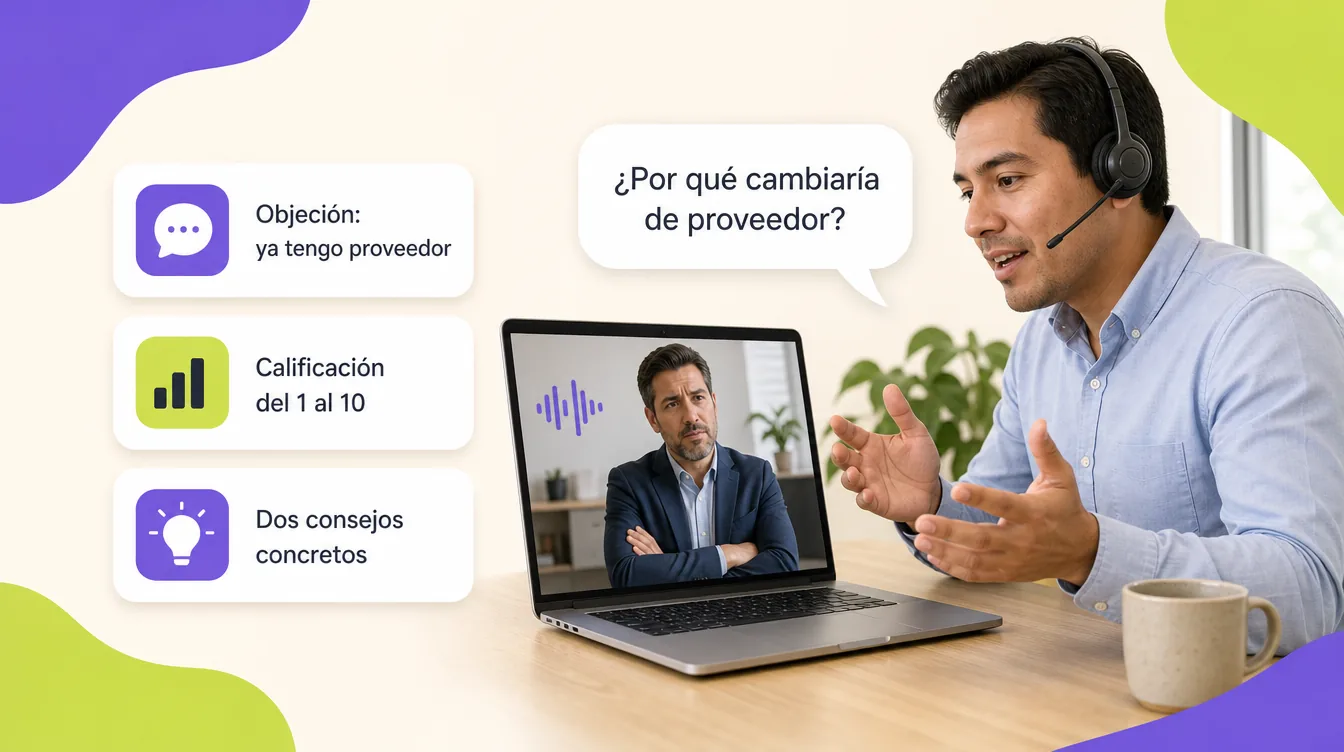
A skeptical purchasing manager raises real objections; you handle them and get a score.
No account. Voice and a real-time face in your browser; to continue past two minutes it asks for your name and email.
The sequence is learned in the customer service and phone and call center service courses of the corporate course catalog; it is reviewed with microlearning and becomes a reflex with role play.
The contact center role play and logistics and transportation role play pages ground these scenarios in the language of each sector. If your typical complaint is not in the catalog, we build it with you as a custom scenario with your policies and your real cases.
Talk for two minutes for free with one of Geedle's voice agents with avatar, such as the sales role play, and hear how an AI character reacts to tone. To see the emotional thermometer and the supervisor's dashboard with your team, request a demo.
Read how to calm an angry customer on the phone and training to handle difficult customers: from the manual to the simulator. In the glossary: what role play is and what an AI coach is.
Real projects told with facts, not promises.
Train crews spread across restaurants in several Mexican states and the United States with the same standard — and give every employee a clear view of how to grow inside the company.
Read the full caseBring an operation that lives on the road under a quality management system that meets the new ISO 9001:2026 and passes the certification audit.
Read the full caseTell us which complaint keeps coming back in your team: the late delivery, the failure that returns, the customer who demands the supervisor. We reply the same day and schedule your Geedle RolePlay demo with that scenario.