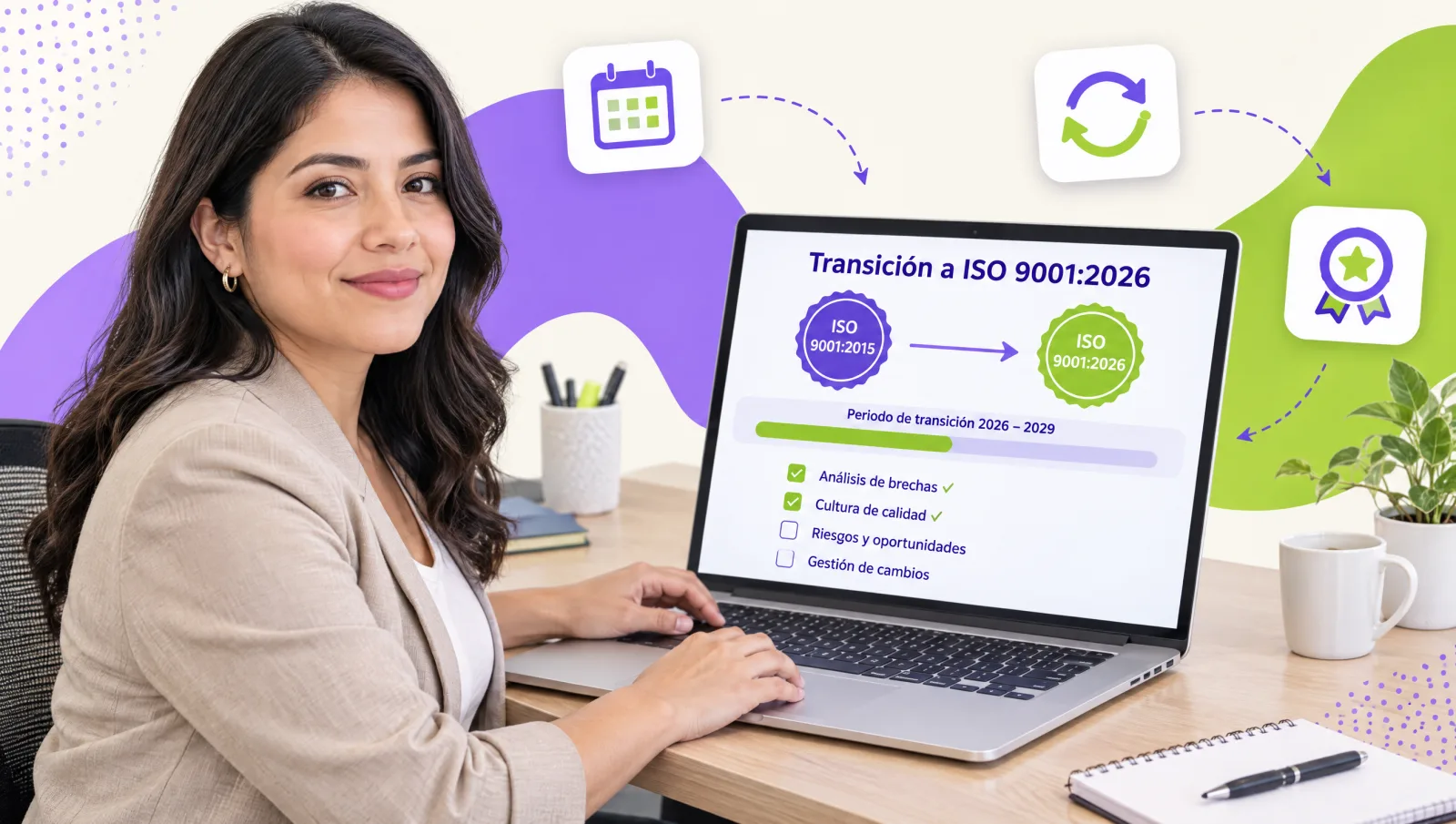
The new ISO 9001:2026 has a confirmed publication date: 16 September 2026. We help you make the transition without rebuilding your quality management system: gap analysis against the new requirements, updating what actually changes, training your team and an internal audit against the new version before your transition audit.

It is the process by which an organization certified to ISO 9001:2015 adjusts its quality management system to the new edition of the standard and demonstrates it to its certification body in a transition audit. It is a moderate revision, not a new standard: the ten clauses, the process approach and the PDCA cycle remain. What changes is the emphasis on quality culture and ethical behaviour, the separation of risks and opportunities, and a more demanding management of change. Updated 21 September 2026.
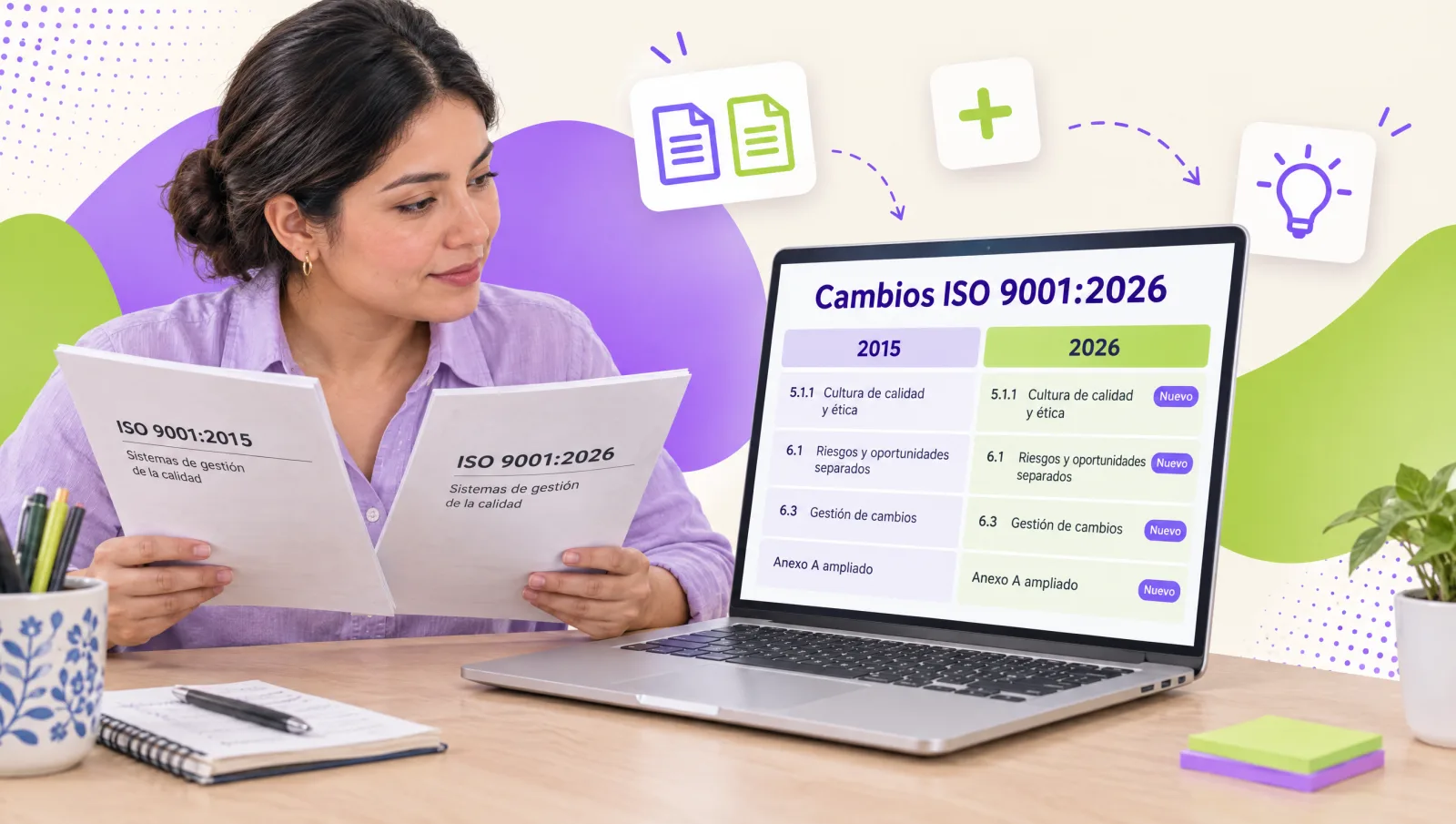
The changes confirmed in the final draft (FDIS). There are no artificial intelligence or digital transformation requirements, despite what circulated during the revision.
Top management must promote a quality culture and ethical behaviour, and demonstrate it. This is the core change of this edition.
People must be aware of the quality culture and ethical principles of the organization, not only the policy and objectives.
Risk is defined as a negative effect. Actions for risks (6.1.2) and for opportunities (6.1.3) are planned separately.
Three new requirements: communicate changes, monitor their effectiveness and review their results.
You must determine which interested-party requirements will be addressed (4.2 c), and changes in them feed the management review (9.3.2).
The standard now includes key definitions, merges continual improvement (10.3) into 10.1 and expands Annex A with clause-by-clause clarifications.
A well-planned transition touches few things. Before rewriting procedures it pays to know what stays exactly the same.

The order we follow so the transition happens within your normal audit cycle, without a parallel project.
We compare your current system with ISO 9001:2026 clause by clause and prioritize what really needs work.
Deliverable: gap report and transition planWe define with top management how quality culture and ethical behaviour are promoted, communicated and evidenced.
Deliverable: leadership and communication evidenceWe split the risk matrix from the opportunity register and adjust the management of change procedure.
Deliverable: updated matrices and procedureAn ISO 9001:2026 update course for process owners and internal auditors, with training records.
Deliverable: trained staff with evidenceFull internal audit against the 2026 version and management review with the new inputs.
Deliverable: system ready for the transition auditWhat is confirmed and what is still a forecast. The IAF and accreditation bodies formalize the rules after publication: always confirm dates with your certification body.
| Milestone | Date | Status |
|---|---|---|
| Climate change amendment (ISO 9001:2015/Amd 1) | February 2024 | In force |
| Final draft (FDIS) ballot closed | July 2026 | Completed |
| Publication of ISO 9001:2026 | 16 September 2026 | Confirmed date |
| Transition period | Three years from publication | Expected; to be formalized by the IAF |
| End of validity of ISO 9001:2015 certificates | Around September 2029 | Forecast |
Ask for the gap analysis: within days you know which clauses affect you and how much work it means, with three fixed-price scopes.
You can hire the full support or just one part: the ISO 9001:2026 gap analysis, the update and internal auditor courses, the ISO 9001 internal audit against the new version, or management system maintenance on retainer. If you are not certified yet, our ISO 9001 consulting already implements the 2026 version.
ISO 14001:2026 was published in April 2026 and the ISO 45001 revision is under way: all three share the harmonized structure, so it is a good moment for an integrated management system. On the blog we explain the ISO 9001:2026 changes clause by clause and the step-by-step transition plan.
The same transition plan, applied to the industry of each city.
Start with the gap analysis: we tell you what changes in your system, how much work it is and in which audit it makes sense to transition.