AI Role Play vs Traditional Role Play: Differences, Costs and When to Use Each
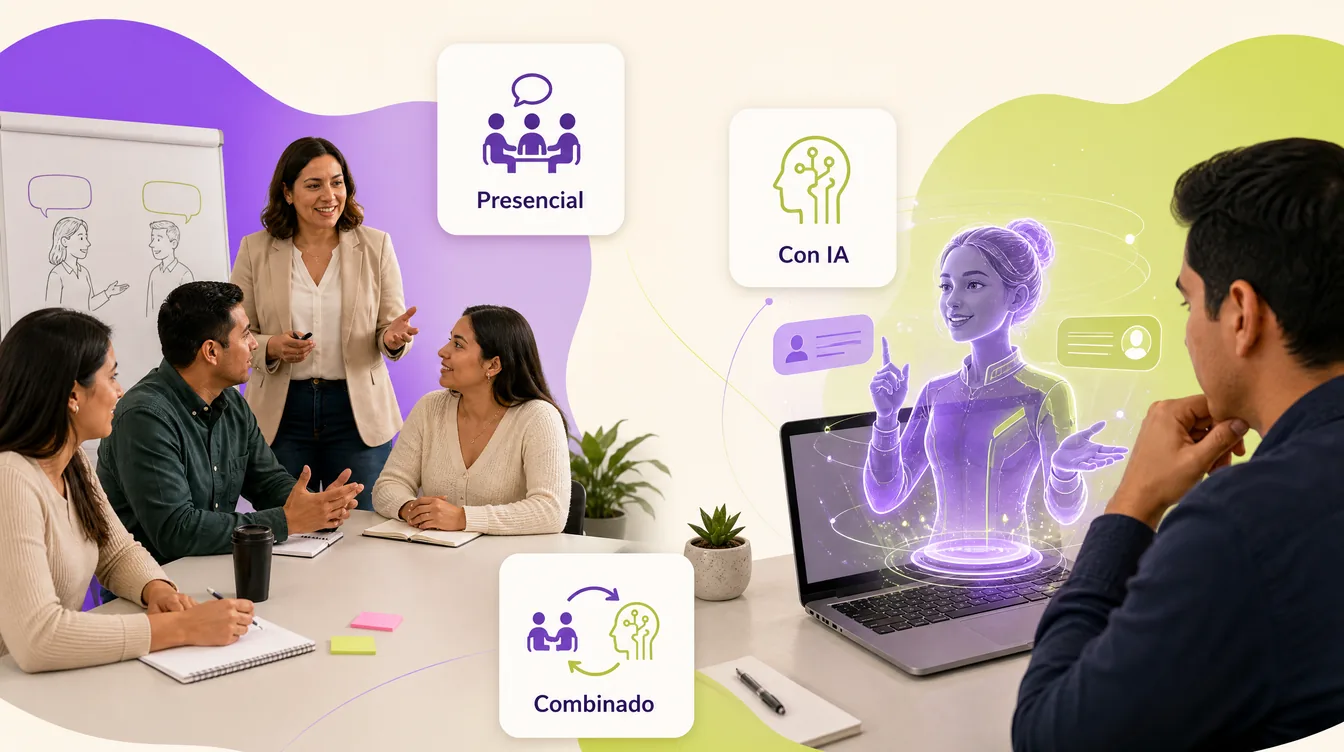
AI role play vs traditional role play is not a fight with a single winner. In-person role play, with a facilitator and colleagues watching, is still valuable for certain things; the simulator with artificial intelligence solves others the classroom never could, above all repetition and measurement. This comparison reviews what each format does better, what its cost depends on, without inflated figures, and how to combine them in one training program so your people practice more and better.
In this article
- What is the difference between AI role play and traditional role play?
- How is a traditional role play exercise run?
- How do they compare, point by point?
- What does traditional role play do better?
- What does AI role play do better?
- What does the cost of each format depend on?
- When does each one make sense?
- How do you combine them in one program?
- Try it for two minutes, or build it around your case?
What is the difference between AI role play and traditional role play?
The main difference is who plays the other party and how many times you can repeat. In traditional role play it is a colleague or a facilitator, in a group session with a fixed schedule. In AI role play it is a simulated character, available at any hour, that also scores every attempt against the same rubric.
Every other difference follows from that: practice time per person, consistency of feedback, what it costs to organize each session and the data the company keeps. If the concept is new to you, start with what AI role play is and come back to this comparison.
How is a traditional role play exercise run?
A traditional role play exercise is run in a group: the facilitator presents a case, hands out the roles, two people act out the conversation in front of the others and at the end everyone comments on what they saw. It is a classic training technique for sales, service, leadership and human resources.
- Case. The facilitator describes the situation and the goal of each role.
- Roles. One person plays their real job; another plays the customer, the employee or the auditor. The rest observe.
- Performance. The conversation lasts a few minutes.
- Feedback. Observers and facilitator comment on what went well and what did not, ideally with assessment criteria defined beforehand.
- Rotation. Roles change for as long as time allows.
The format has two well-known weaknesses. In a group of fifteen people and a two-hour session, most act once and observe the rest of the time. And the colleague playing the customer rarely puts up the resistance of a real customer: they either exaggerate or help.
How do they compare, point by point?
Point by point, traditional role play wins on human presence and group learning, and AI role play wins on repetition, availability and measurement. Neither wins on everything. The table summarizes the criteria that weigh most when designing a training program.
| Criterion | Traditional role play | AI role play |
|---|---|---|
| Who plays the other party | A colleague, the facilitator or an actor | A simulated character with configurable personality and difficulty level |
| Practice per person | One or two turns per session | As many as they want, whenever they want |
| Realism of the resistance | Depends on who is acting; it tends to be too kind or exaggerated | Constant: objections, hidden information and events defined in the scenario |
| Feedback | Rich in nuance, but it varies with the facilitator and the observers | Uniform: criteria-based rubric and a report on every attempt |
| Body language | Observed live, in front of people | Optional, with camera analysis in the browser; it does not replace a facilitator's eye |
| Social pressure | High: you perform in front of the group | Low: you practice alone, in a safe environment |
| Learning by observation | Yes: you watch others solve the same case | Limited: you can watch a demonstration, not your colleagues |
| Data for the company | The facilitator's notes and attendance lists | Scores, transcripts and reports per person and per team |
| Availability | A date, a room and the whole group | Any day, any time |
| Fit to your company | The facilitator adjusts the case on the fly | Scenarios with your documents, your product and your objections |
What does traditional role play do better?
Traditional role play is better at everything that depends on having real people in the same space: reading full body language, learning by watching others, discussing a case in all its nuance and building trust within the team. A simulator does not replace that part, and it is worth saying so from the start.
- Physical presence. Posture, distance, eye contact and use of space in front of a flesh-and-blood person.
- Learning by watching. Seeing how your most experienced colleague solves the same case teaches things no report contains.
- Group conversation. "And what would you have done?" opens discussions about judgment and decision-making.
- Sensitive topics. A dismissal, a bereavement or a serious conflict between team members calls for a facilitator who can hold the room and support people.
- Cohesion. Practicing together is also spending time together; that is why role play exercises show up in team-building programs.
What does AI role play do better?
AI role play is better at what depends on repeating and measuring: many practice runs per person, at any hour, with the same standard and the same rubric for everyone. It also takes the fear of embarrassment out of practice, because the first attempts, the bad ones, do not happen in front of the group.
- Repetition. Fluency comes from the tenth attempt, not the first, and the character does not get tired.
- Consistency. The same scenario demands the same in Tijuana and in Merida, from the new salesperson and from the veteran.
- Safe environment. Making mistakes alone is cheaper than making them in front of colleagues or in front of the customer.
- Data. A score per criterion, comparison between attempts and a heat map of competencies per team.
- Customization. The character can know your catalog, your policies and your real objections if you upload your documents.
- Exam. A mode with no help and a minimum score, to confirm someone is ready before they face customers.
That is what Geedle RolePlay offers, with scenarios for sales, customer service, leadership and human resources and ISO audits.
What does the cost of each format depend on?
The cost of traditional role play depends mostly on people's hours: the facilitator, the participants away from their jobs and, if travel is involved, the trips. The cost of AI role play depends on the tool and on scenario design, and it barely grows when someone repeats the practice.
| Cost factor | Traditional role play | AI role play |
|---|---|---|
| Facilitator hours | Paid in every session and for every group | Concentrated in designing the scenario and reviewing results |
| Time away from operations | The whole group, for the whole session, even though each person acts for a few minutes | Only the minutes each person practices |
| Travel, room and expenses | Yes, when the team is spread across several cities | Not applicable |
| Repeating the practice | Costs another full session | Costs the additional use of the tool |
| Case design | Prepared by the facilitator | Catalog template, a scenario generated from your documents or a custom service |
| Technology | Nothing special | License or credits, a computer with a microphone and internet access |
We are not going to give you an "average saving" because there is no honest one: it depends on how many people you train, how spread out they are and how many repetitions you need. What we can give you is the Geedle RolePlay data: there is a Free plan with 15 credits to try it and one-time payment plans from $999 MXN, valid for 12 months. Prices are subject to confirmation and the full table lives at Geedle RolePlay pricing.
When does each one make sense?
AI role play makes sense when the challenge is volume, dispersion or repetition, and traditional role play when the challenge is judgment, team bonding or sensitive topics. If your team is small, works in one place and practices a few times a year, a good in-person exercise may be enough.
- Choose AI if you have many people in the same role, high turnover, branches in several cities, shifts that do not overlap or a conversation that must always come out the same, such as a collections script or an audit interview.
- Choose in-person if you want to bring a new team together, work on body language, discuss ambiguous cases among leaders or address a topic that needs human support.
- Choose both if the skill is critical to the business, as is often the case in sales and service.
How do you combine them in one program?
You combine them by leaving individual practice to AI and keeping for the classroom what only happens in a group. The sequence we recommend is brief theory, practice with the simulator, an in-person session focused on what the data showed to be weak and, at the end, an exam in the simulator.
- Theory. The conversation model is taught in a course; for example, one of the sales training courses or the catalog of corporate training courses.
- Individual practice. Each person makes several attempts in the simulator before the group session.
- In-person session. The facilitator arrives knowing which criterion the team fails on and spends the time on that, not on everyone acting for the first time.
- Exam. One attempt with no coach and a minimum score.
- Reinforcement. Short practice sessions over the following weeks so the skill is not lost.
If you are choosing a tool, review what to evaluate in an AI conversation simulator; if you are going to write your own cases, the guide is how to design a custom role play scenario. To see the format applied to sales, read AI sales role play for objections.
Try it for two minutes, or build it around your case?
The comparison makes more sense after trying both formats, and one of them you can try right now. Start with the sales role play with a simulated customer: a free two-minute voice demo in your browser, no account needed. To see the full Geedle RolePlay product with scenarios for your area, request a demo and we will walk through it with your case. And if the scenario your team needs is not in the catalog, we build it with you, using your procedures, your product and your real objections: see custom role-play scenarios. Full product details are at Geedle AI role play.