



- Sales
- Service
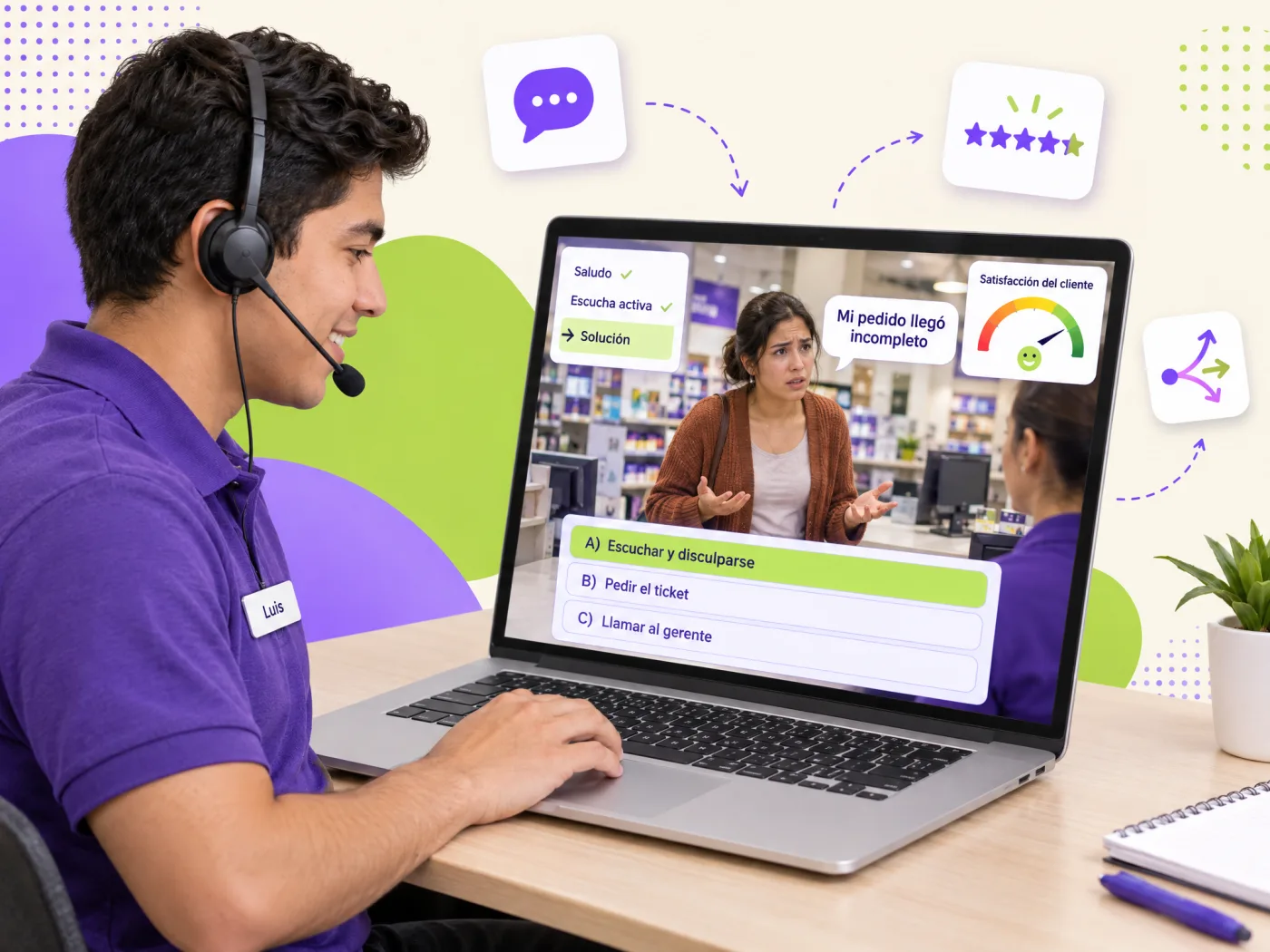
Customer service role-play
A difficult customer, three possible answers and a satisfaction meter that reacts to every decision.

Platforms
Course production
Online course production
From content to SCORM, in your city
Instructional design for courses
Objectives, script and storyboard
Course content design
Writing, scripts and graphic design
Gamified courses
End-to-end SCORM production
Interactive videos
Decisions and assessment in video
Learning objects
Interactive micro-content
Moodle Plugins
Artificial intelligence
ISO 9001 — Quality
ISO 14001 — Environmental
ISO 45001 — Safety
ISO services
Formats
Learn
We design the part that decides whether a course teaches or merely informs. For companies, universities, and schools in Monterrey: needs analysis, measurable objectives, sequencing, instructional script, storyboard, and assessment — ready for your team or ours to produce.
Instructional design is the process that turns a topic into a learning experience: it defines what a person should be able to DO at the end, in what order they learn, which activities they practice with, and how the result is verified. Monterrey is Mexico's industrial capital: steel, auto parts, appliances, and large local corporations, boosted by nearshoring and top-tier universities. We work with your experts and deliver the script and storyboard before a single screen is produced. The full service lives in instructional design for virtual courses.
In manufacturing it is not enough to "know the procedure": it has to be executed well. For Monterrey companies we start from a task analysis — what a competent operator or supervisor does, and against which performance criteria — and objectives, practice, and assessment follow from there. The result is a competency-based program that can be audited.
We serve San Pedro Garza García, Apodaca, Santa Catarina, Escobedo, and Guadalupe: on site when the project calls for it — capturing content, filming, working sessions with your experts — and remotely for everything else. The three services can be hired together or separately: in Monterrey we also offer online course production in Monterrey and course content design in Monterrey. If you do not have a platform yet, see LMS platforms in Monterrey. For instructor-led delivery, see corporate training in Monterrey.
Six deliverables your team — or ours — can produce without guessing.
The gap between what people do today and what they should do, and which part of that gap a course can actually close.
Performance objectives written with observable verbs (Bloom's taxonomy), one per lesson: if it cannot be verified, it is not an objective.
The full sequence by role, level, or subject: what comes first, what depends on what, and how long each part takes.
Content rewritten to teach: explanation, example, practice, and feedback, in your organization's tone.
Screen by screen: what is seen, what is heard, what the learner does, and what happens when they get it right or wrong.
Items aligned to each objective, cases, and performance rubrics — the evidence that learning happened.
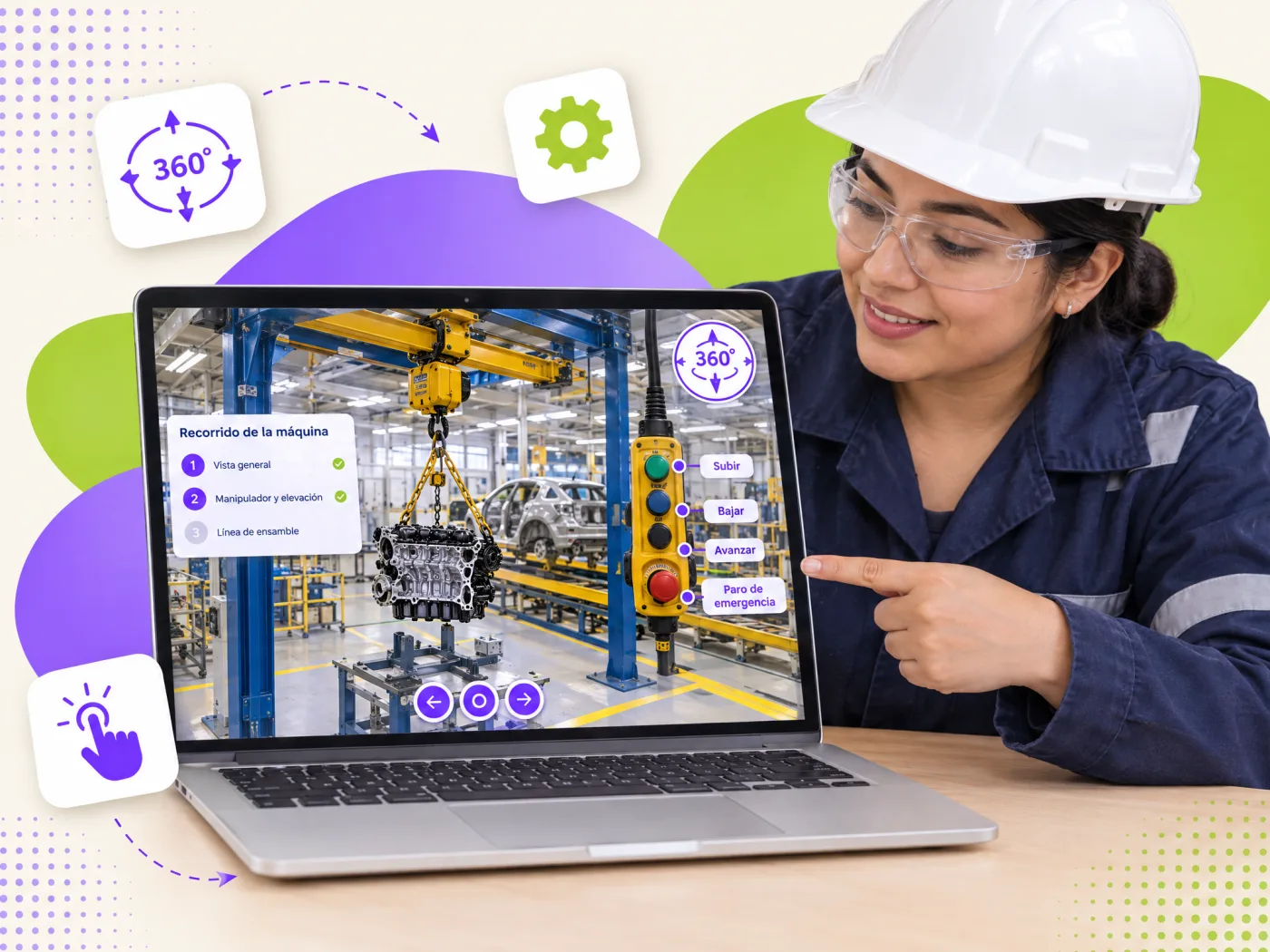
A working scenario, built with WebGL, that runs in the browser without installing anything. Look around the cell, learn the pendant and complete the lifting cycle.
Before any 3D we define the target behavior, the decisions that matter and what happens when the participant gets it wrong. That is what makes a simulator teach instead of entertain.
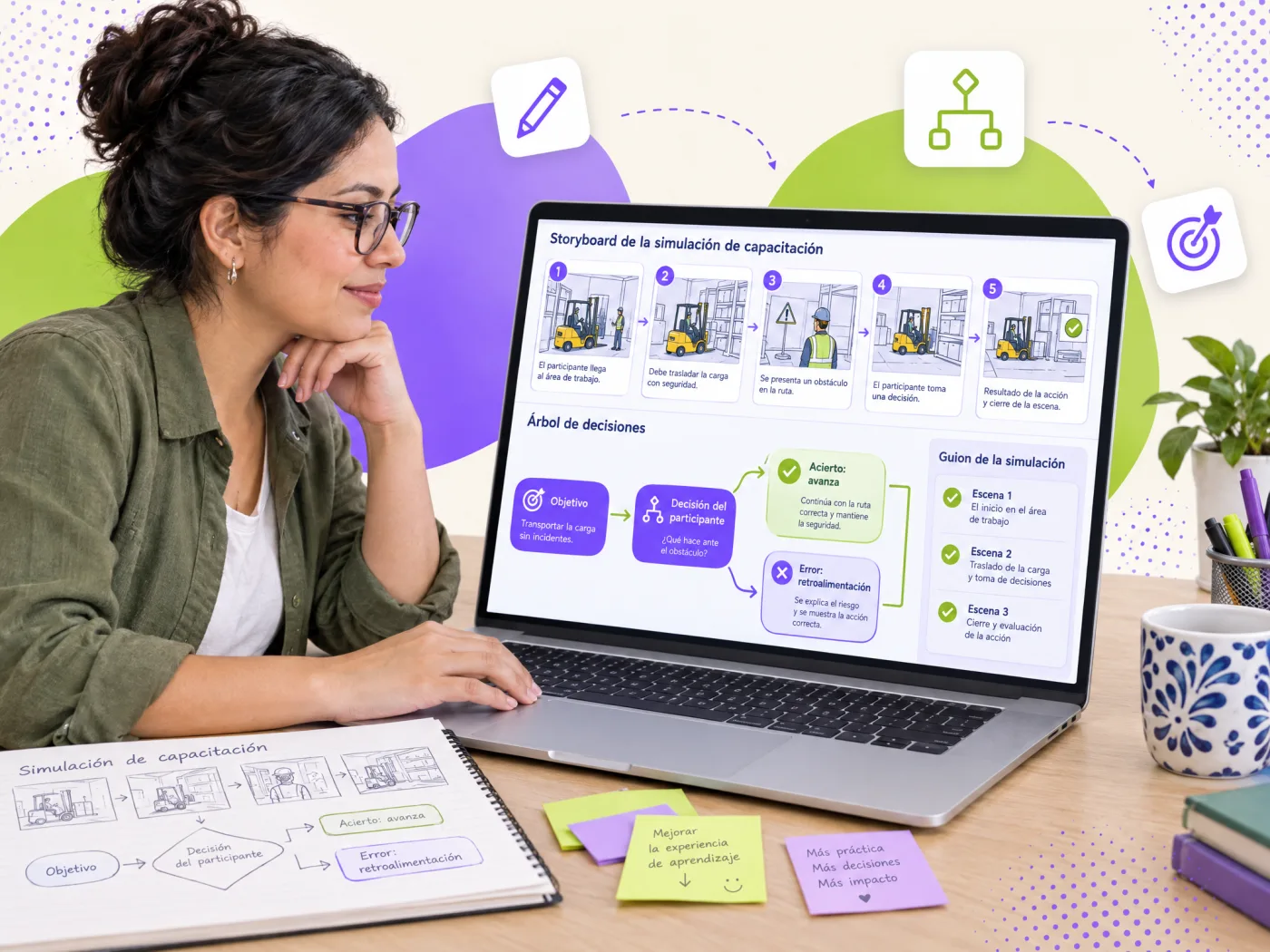
A simulator teaches when it is designed backwards from the behavior you need. These are scenarios we script, storyboard and produce.
A difficult customer, three possible answers and a satisfaction meter that reacts to every decision.
The real cell in 360°: every button explained, the machine cycle simulated and the operator practicing before touching the equipment.
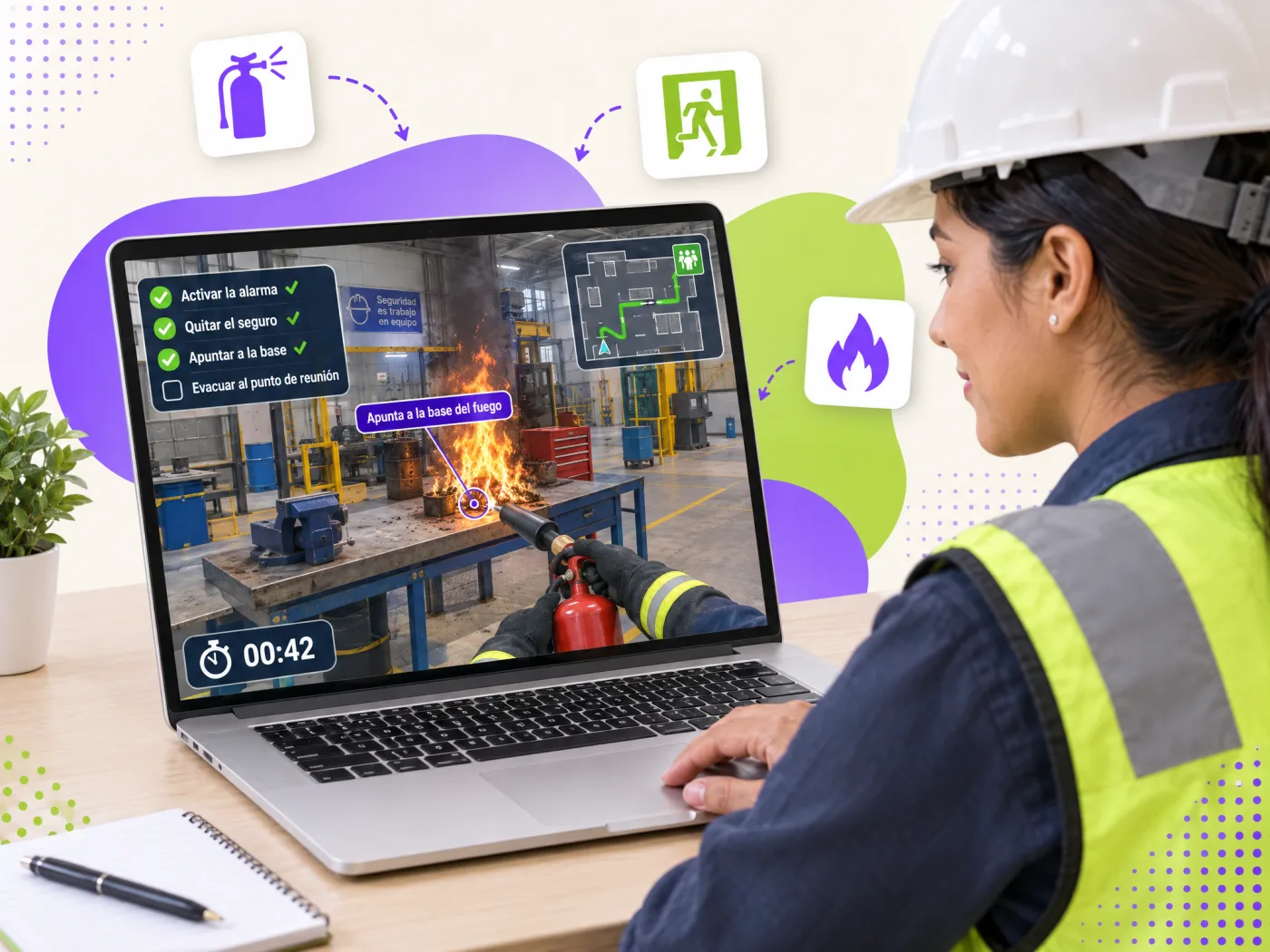
Aim at the base of the fire, follow the route on the map and reach the assembly point against the clock.
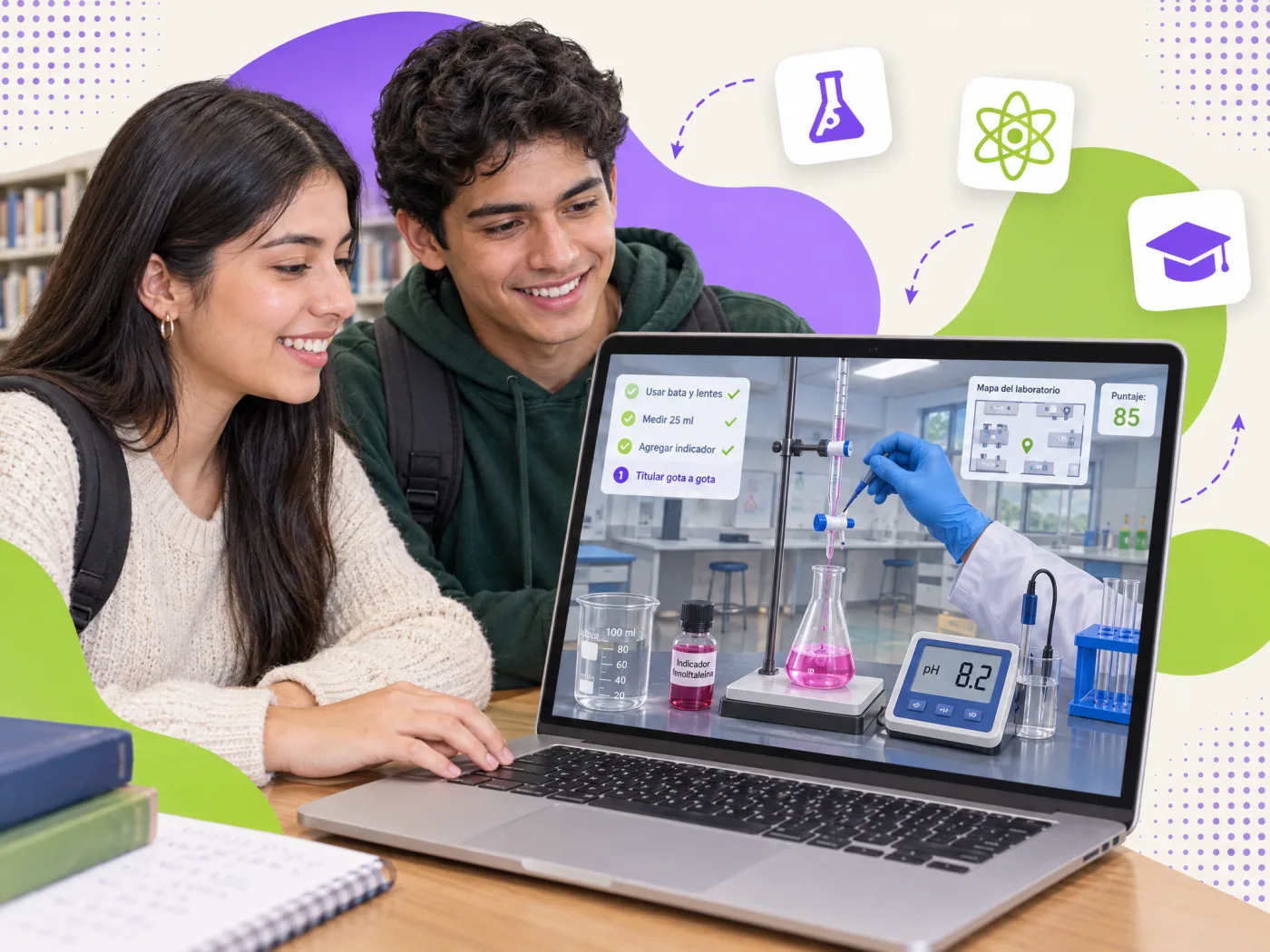
Titrations, circuits or dissections without reagents or risk, as many attempts as the student needs.
Five stages; your experts validate at each one.
Interviews with experts and learners, material review, and a profile of who is learning.
Deliverable: assessmentObjectives, curriculum map, teaching strategy, and assessment strategy.
Deliverable: program designInstructional writing and a screen-by-screen storyboard, with interactions and feedback.
Deliverable: script and storyboardA working lesson tested with real users; we adjust before scaling.
Deliverable: validated prototypeWe support production — with your team or ours — and measure results against the objectives.
Deliverable: results reportWe are not married to one model: we choose based on the content, the deadline, and who is learning.
| How it works | When it fits | |
|---|---|---|
| ADDIE | Analysis, design, development, implementation, and evaluation, in sequence with formal deliverables. | Large or regulated programs, or many departments that must sign off. |
| SAM (iterative) | Short cycles of prototype, test, and adjust. | Fast-changing content or teams already working in agile. |
| Microlearning | 5-to-10-minute lessons with a single objective. | Shift workers, mobile learning, and spaced reinforcement. |
| Scenarios and storytelling | Cases with characters and decisions with consequences. | Judgment skills: service, leadership, safety, ethics. |
Send us a manual, a procedure or a sliofck: in the free assessment we show you how it would become a course, with three fixed-price scopes.
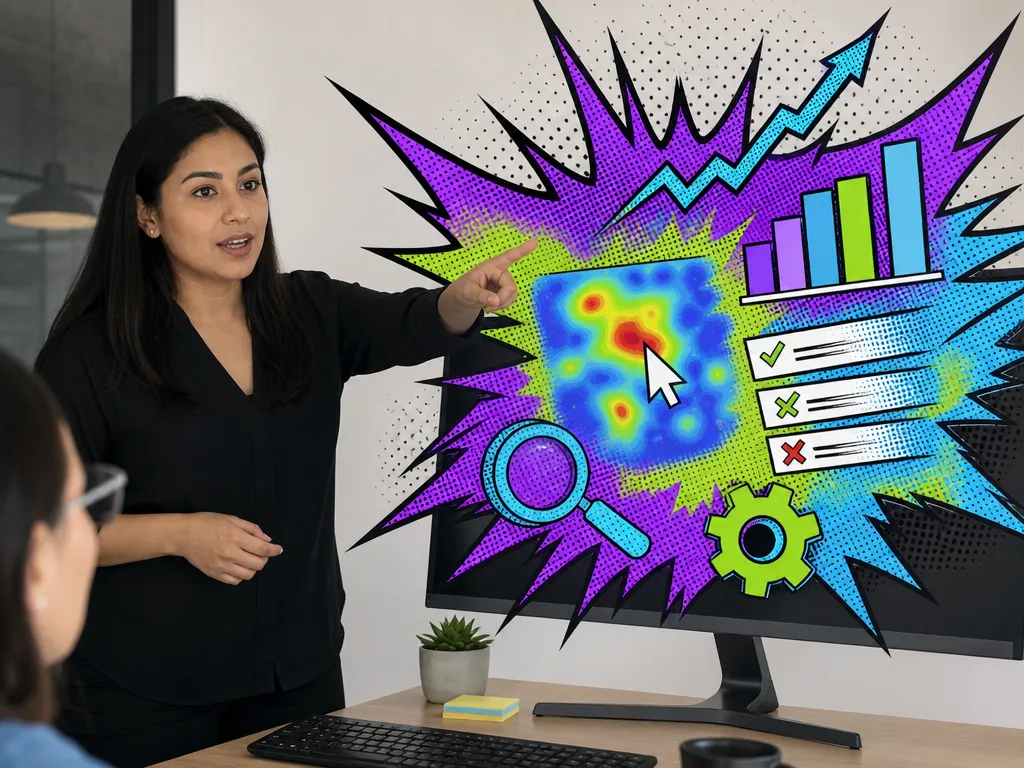
Good instructional design shows afterwards: in what people do differently. That is why every objective is born with its assessment, and once the course is live we compare results against what it set out to achieve.
The context changes, not the rigor: clear objectives and aligned assessment, for an operator or for a graduate student.
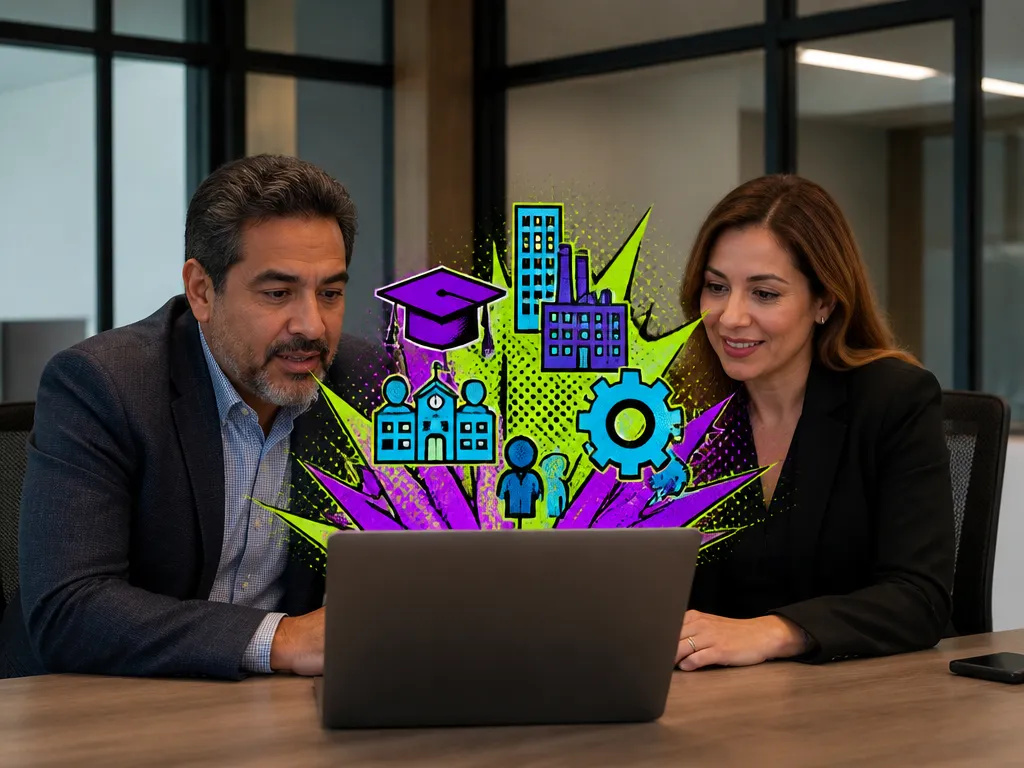
Programs by role and department, with performance criteria the business recognizes.
Online subjects and programs designed alongside faculty and aligned to the educational model.
The same team, with the approach each local industry needs.
Tell us what you need your people to be able to do. In the free assessment we'll tell you what a course can solve and how we would design it.