AI Conversation Simulator: What to Evaluate Before You Buy One
An AI conversation simulator promises that your team will practice sales calls, complaints or audits with a virtual character before facing them for real. The problem is that, in a demonstration, they all look alike. The differences show up later: when the character speaks a Spanish that is not your customers' Spanish, when the report says nothing useful or when the price turns out to be per seat with an annual contract. This nine-point checklist helps you compare options before you sign.
In this article
- What is an AI conversation simulator?
- What should you evaluate before buying an AI conversation simulator?
- Is the conversation by voice or by text?
- Does it speak Mexican Spanish?
- Can it be customized with your company's documents?
- How does it score: rubric, report and exam mode?
- What happens with data privacy?
- Does it integrate with your LMS?
- Is pricing transparent, and can you try it without a meeting?
- Try it for two minutes, or build it around your case?
What is an AI conversation simulator?
An AI conversation simulator is a training tool in which a person practices a work conversation with a character played by artificial intelligence, which answers in real time and reacts to what it hears. When the conversation ends, the system scores it and delivers feedback for the next attempt.
It is also called AI role play or conversation simulation; the concept is explained in what AI role play is. Here we assume you have already decided your team needs to practice and now you have to choose what with. To avoid naming or dismissing anyone, the guide is written as questions you can ask any vendor, Geedle included.
What should you evaluate before buying an AI conversation simulator?
Before buying an AI conversation simulator, evaluate nine things: whether it is voice-based, whether it speaks Mexican Spanish, whether it can be customized with your documents, how it scores, whether it has an exam mode, how it protects data, whether it integrates with your LMS, whether pricing is transparent and whether you can try it without booking a meeting.
| Criterion | Question for the vendor | Warning sign |
|---|---|---|
| Voice or text | Is the conversation by voice, in real time and with interruptions? | Text chat only, or voice with long pauses between turns |
| Mexican Spanish | Does the character speak and understand my customers' Spanish? | Translated voice, idioms from another country or a demo only in English |
| Customization | Can I upload my documents and create my own scenarios? | A closed catalog, or changes only through a vendor project |
| Rubric and report | Which criteria does it score and what does it deliver at the end? | A single overall score, with no evidence from the conversation |
| Exam mode | Is there a mode with no help and a minimum score? | Practice and assessment are mixed; the score can be altered |
| Privacy | Where are conversations stored and who sees them? | Vague answers, no privacy notice and no per-company controls |
| Integration | Does it connect to my LMS and send grades back? | It only exports screenshots or manual reports |
| Price | How much does it cost and how is usage measured? | No public pricing; "it depends, let's schedule a call" |
| Trial | Can I try it today, without a meeting? | A demo only when guided by a salesperson |
Is the conversation by voice or by text?
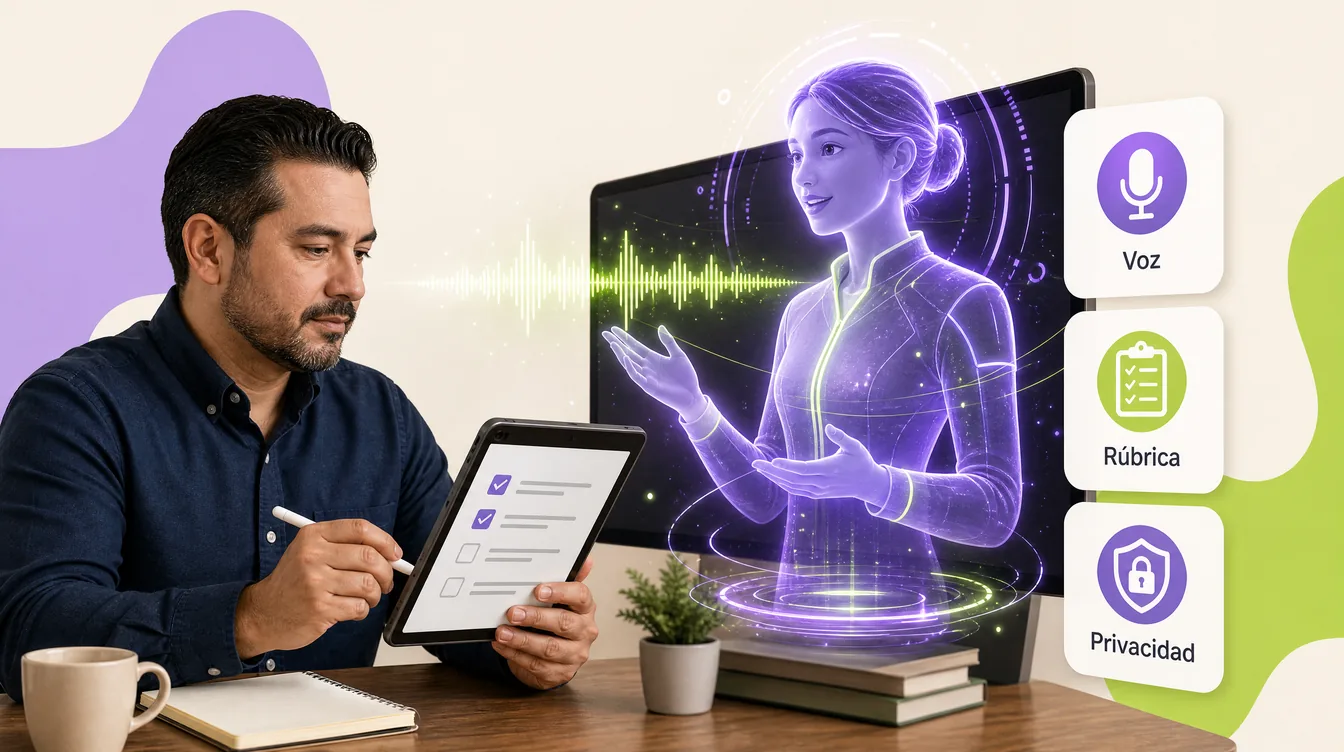
To train spoken conversations, the simulator has to work by voice and in real time: you can interrupt, the character can interrupt you and the reply arrives without awkward pauses. Text is fine for written channels, such as chat or messaging, but it does not train tone, pace or reactions under pressure.
Ask to test three things. First, talk over the character and notice whether it stops. Second, stay silent and see whether it picks the conversation back up naturally. Third, ask which formats you can practice in: ideally the same scenario works with an avatar, as a simulated phone call and over messaging, because a contact center team does not converse the way a front-counter team does. If there is an avatar, its lips should move in sync with the voice; an out-of-sync face distracts more than it helps.
Does it speak Mexican Spanish?
The simulator has to speak and understand the Spanish your customers and your people actually use. A character that says "vale", "ordenador" or "vosotros" breaks the simulation in the first sentence, and one that does not understand "ahorita", "mande" or "¿me regala su nombre?" will score unfairly anyone who speaks the way people speak in Mexico.
Run the test with your real vocabulary: product names, neighborhoods, payment methods such as an SPEI bank transfer or paying at a convenience store, and the courtesy phrases of your industry. Also ask whether the character's accent or region can be adjusted and whether there are live subtitles or translation for those who practice in English. In Geedle RolePlay, Mexican Spanish is the default language, not a translation.
Can it be customized with your company's documents?
A good simulator lets the character know your company: you upload your manuals, policies or price lists and the conversation draws on them. Without that, your team practices with a generic customer and learns generic answers, which do not always match what your company can actually offer.
Check four levels of customization:
- Adjusting a template. Duplicating a catalog scenario and changing the character, difficulty level, objections and rubric.
- Uploading documents. It should accept the formats you already use (PDF, Word, Excel, PowerPoint or text), and the character should detect when you say something that contradicts them.
- Generating scenarios. Creating a new case from your documents or from the recording of a real call, with names anonymized and the corresponding consent.
- Custom service. The vendor builds it with you when you do not have the time or the team to do it.
At Geedle that last level exists as a service: if the scenario your team needs is not in the catalog, we create it with you, using your procedures, your product and your real objections. The steps are in custom scenarios and the methodology in how to design a role play scenario.
How does it score: rubric, report and exam mode?
The simulator should score with a visible rubric, meaning a list of criteria with their points, and deliver a report that shows at which moment of the conversation each success or mistake happened. An overall score with no evidence does not help the employee improve or the leader follow up.
What to ask for in the report:
- A score per criterion, strengths and areas for improvement.
- Key moments with their timestamps and the full transcript.
- Comparison with the previous attempt and with the team.
- The source of each recommendation, so it is not just a machine's opinion.
- PDF export or a link to share it with the leader.
Ask about exam mode too: one attempt with no coach, a locked rubric and a minimum score. And ask where the score is calculated. If the transcript and the score are generated on the server and not on the user's device, nobody can alter them. Without exam mode you have a practice tool; with it, you also have a way to confirm that someone is ready.
What happens with data privacy?
Practice sessions contain voice, names and sometimes customer information, so the vendor should explain in writing what it stores, where, for how long and who can see it. In Mexico, ask for its privacy notice and ask how it meets the obligations of the personal data protection law.
Specific questions worth asking:
- Are my company's documents and conversations isolated from those of other companies?
- Is there two-step verification and a record of who did what?
- Does the system detect personal data in what gets uploaded?
- If there is camera analysis, is the video sent to a server or processed in the browser?
- Can I export and delete my team's information?
Geedle RolePlay isolates information by company, offers two-step verification and an action log, detects personal data and analyzes the camera, which is optional, inside the browser: the video is never uploaded. Geedle's general data handling is described in its privacy notice.
Does it integrate with your LMS?
If your training lives in an LMS, the platform where you manage courses and grades, the simulator should connect to it so the practice shows up as one more activity and the grade comes back on its own. Otherwise, someone will end up copying results by hand every week.
Ask about the connection standard (LTI 1.3 is the usual one in Moodle and Canvas), single sign-on, an API or webhooks for your dashboards and export to CSV or PDF. In Geedle RolePlay, LTI 1.3 integration with grade return belongs to the Enterprise plan. If you do not have a platform yet, review the options for LMS platforms and Geedle's e-learning platform.
Is pricing transparent, and can you try it without a meeting?
A serious vendor publishes its prices, explains how usage is measured and lets you try the product without booking a sales call. If you need three meetings to learn the cost, it will be hard to compare options and put a budget together.
Compare the billing model and not just the figure: per seat or per use, monthly or one-time payment, with or without an expiry period, and what happens to what you do not use. Geedle RolePlay has a Free plan with 15 credits and one-time payment plans from $999 MXN, valid for 12 months; prices are subject to confirmation and the full table is at Geedle RolePlay pricing.
And try before you decide. Today you can talk for two minutes with a simulated customer in the sales role play voice demo, without creating an account. Then set up a short pilot with a single team and a single conversation, and compare the first attempt with the last. The difference between formats is in AI role play vs traditional role play and an applied example in AI sales role play for objections.
Try it for two minutes, or build it around your case?
A checklist helps, but the decision is made after talking with the character. Start with the sales role play with a simulated customer: a free two-minute voice demo in your browser, no account needed. To see the full Geedle RolePlay product with scenarios for your area, request a demo and we will walk through it with your case. And if the scenario your team needs is not in the catalog, we build it with you, using your procedures, your product and your real objections: see custom role-play scenarios. Full product details are at Geedle AI role play.