WhatsApp payment reminders for travel agencies: the sequence and messages that do not feel like spam
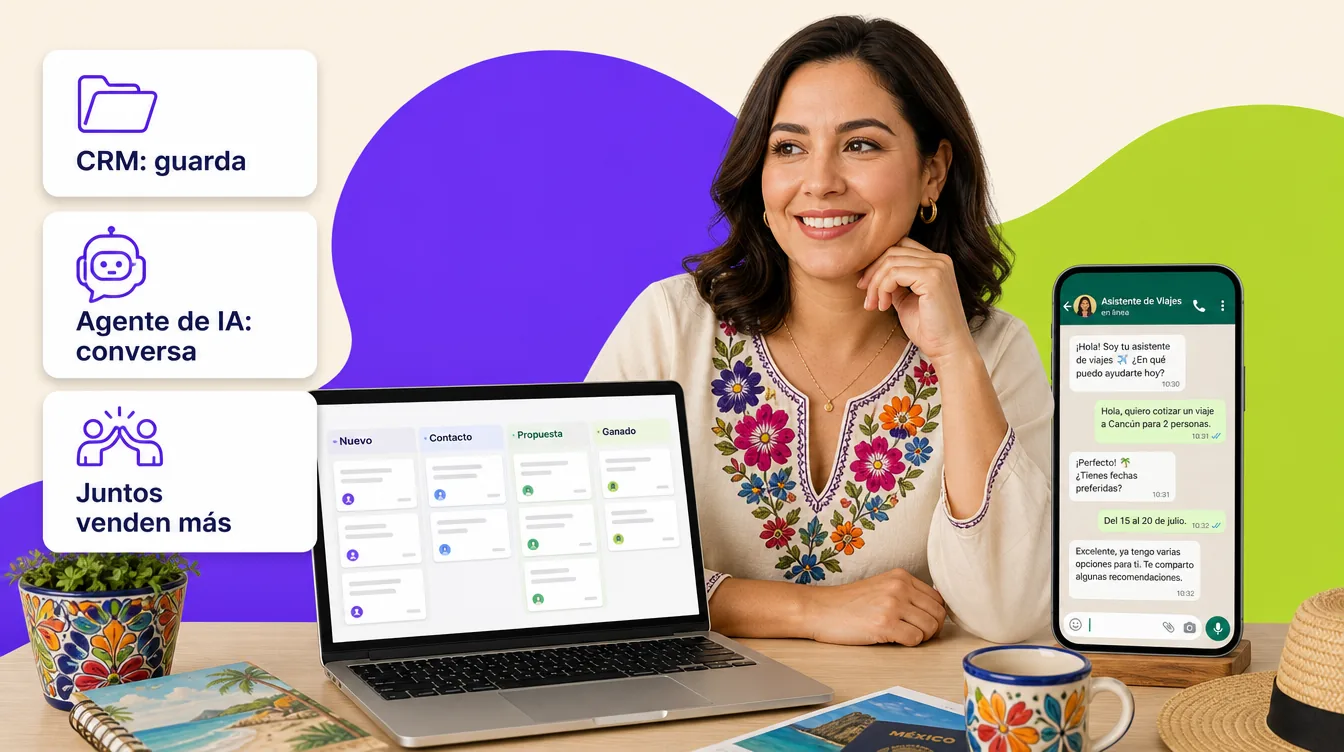
WhatsApp payment reminders for travel agencies work when they reach the right person, at the right moment, with the exact amount and a link to pay right then. They fail when sent by hand, when nobody remembers who already paid or when they sound like debt collection. Here is the full sequence, eight ready-to-adapt messages, the WhatsApp Business rules you must follow and what to do when someone does not pay.
In this article
- Why do agencies lose sales at the payment and not at the quote?
- What is the reminder sequence that works?
- How do you write a payment reminder that does not feel like spam?
- Which WhatsApp Business rules must you follow to send reminders?
- What does the AI agent do that a simple automation does not?
- I want my travel agent: how do we start?
Why do agencies lose sales at the payment and not at the quote?
Because the deposit is paid with excitement and the balance with a calendar. Weeks go by between the two, the traveler gets distracted, the advisor carries thirty groups in their head and the reminder arrives late, at the wrong time or not at all. When it is finally written, the message sounds like a complaint and the customer answers with an excuse. A good reminder does not collect: it keeps the trip alive.
Automation is not about sending more messages, but about sending the right ones without anyone having to remember. How this fits in the full service is in payment reminders for travel agencies.
What is the reminder sequence that works?
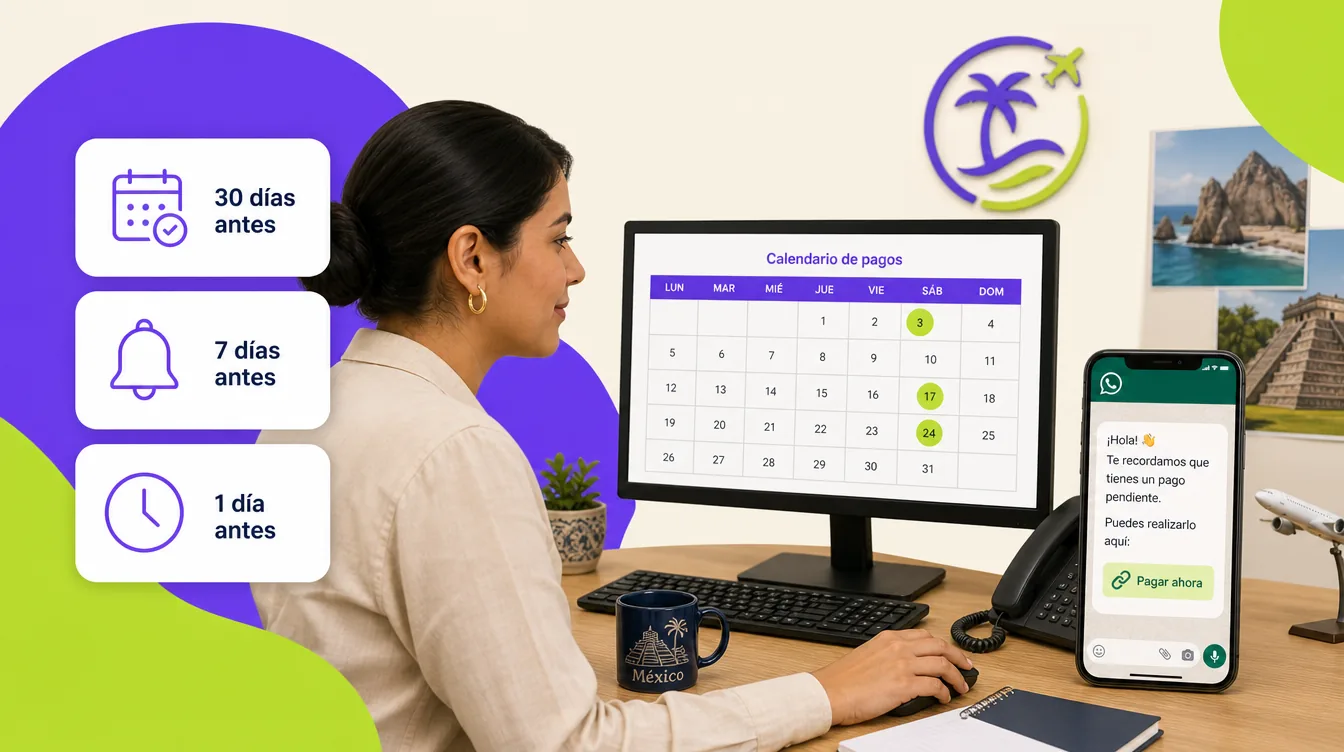
A short, predictable sequence: deposit confirmation with payment dates, a reminder 30 days before the due date, another at 7 days, another the day before, an overdue notice with the option to talk to the advisor and the confirmation with receipt when the payment comes in. Five messages at most before a person steps in; after that, insisting on WhatsApp no longer adds anything.
| Moment | What the message says | If there is no reply |
|---|---|---|
| At deposit | Confirms the trip, the amount paid, the balance and the payment dates | Nothing: it is informational |
| T-30 | Reminds the balance, the due date and the payment link | Waits for T-7 |
| T-7 | Repeats amount and date, offers installments if the agency allows them | Waits for T-1 |
| T-1 | Last friendly reminder with the link and the service hours | Moves to overdue |
| Overdue | States the status and offers to talk to the advisor today | Alerts the advisor: they decide extension or cancellation |
| Payment received | Confirms, sends the receipt and says what comes next (documents, itinerary) | Closes the sequence |
How do you write a payment reminder that does not feel like spam?
With four ingredients: the traveler's and the trip's names, the exact amount and date, a single action (the payment link) and a human way out (“if you need another date, type ‘advisor’”). No capitals, no fake urgency and no repeating what the person already solved. These eight messages are a starting point; adjust them to your brand's tone.
- Deposit: “Paola, your trip to Cancún from March 14 to 19 is reserved with $4,000. The balance is $18,500 and is due February 14. Here are the details and dates: [link]”.
- T-30: “Hi Paola, your payment date is 30 days away. Balance: $18,500, due February 14. You can pay here whenever you like: [link]. If you prefer two installments, reply ‘installments’”.
- T-7: “Paola, your $18,500 balance is due in one week (February 14). Payment link: [link]. If you already paid by transfer, send us the proof here and we will confirm it”.
- T-1: “Your Cancún trip balance ($18,500) is due tomorrow. Pay here: [link]. If you need another date, type ‘advisor’ and we will help you today”.
- Overdue: “Paola, your trip balance was due yesterday. To keep the rates, type ‘advisor’ and we will review options today. If you already paid, share your proof and we will apply it”.
- Proof received: “We received your proof of payment. As soon as we validate it we will send your receipt. Thank you, Paola”.
- Payment confirmed: “Done, Paola: your trip is paid. Here is your receipt [link]. In the next few days we will send the document list and, a week before, your day-by-day itinerary”.
- Installments: “Perfect. Two payments of $9,250 remain: January 31 and February 14. We will remind you of each with its link”.
Which WhatsApp Business rules must you follow to send reminders?
Reminders are initiated by the agency, not the customer, so they can only be sent from the official WhatsApp Business platform with Meta-approved templates and the traveler's prior consent. Each template is registered with its category (payment reminders are usually utility), carries a per-conversation cost and can be rejected if it looks like disguised promotion. The official documentation is at WhatsApp Business Platform.
- Opt-in: the traveler agreed to receive messages from the agency at deposit or on the form; store it with a date.
- Templates: fixed text with variables (name, amount, date, link); wording changes require new approval.
- Frequency: the full sequence fits in five messages; more tires people and can hurt your number's quality rating.
- Opt-out: if the traveler asks not to be messaged, it is respected and follow-up moves to email or a call.
What does the AI agent do that a simple automation does not?
An automation sends the message on the date; an agent also understands the reply. If the traveler answers “I already paid by transfer”, it asks for the proof and routes it; if they say “can I pay half?”, it answers with the rules you defined; if they ask “what if I cancel?”, it explains the policy and offers the advisor. And when someone does not pay, it does not insist blindly: it alerts the advisor with the history so they decide on an extension or cancellation. The agent also handles the quote, the itinerary and the per-tour survey, so payment is one piece, not a separate system.
To see what changes the cost of all this, read what an AI agent for travel agencies does and costs.
I want my travel agent: how do we start?
Start by writing your own five messages in your agency's tone: that is half the work. Tell us how many travelers you move each month and what they ask most in the “I want my travel agent” form: we propose the scope of the first agent (quotes, payments, day-by-day itinerary or per-tour survey) with the calendar and the payment gateway your agency already uses. If you would rather feel it before talking to anyone, upload an itinerary or your package list to the trial bot and ask it what a traveler would ask you. The full service is at AI agent for travel agencies.