How many quotes does your travel agency lose by replying late? The 9:07 p.m. traveler
The quotes your travel agency loses by replying late show up in no report, because the traveler never tells you they left: they simply buy from the agency that answered first. This article follows a real traveler on an ordinary night, calculates with your own numbers what every unanswered hour costs and explains what an AI agent can answer while your team sleeps.
In this article
- What happens to the traveler who writes at 9:07 at night?
- Why does speed matter more in travel than in other businesses?
- How do you calculate what every unanswered night costs you?
- What can an AI agent answer at 9:07 p.m. without getting you in trouble?
- What if the problem is not the quote but everything that comes after?
- I want my travel agent: how do we start?
What happens to the traveler who writes at 9:07 at night?
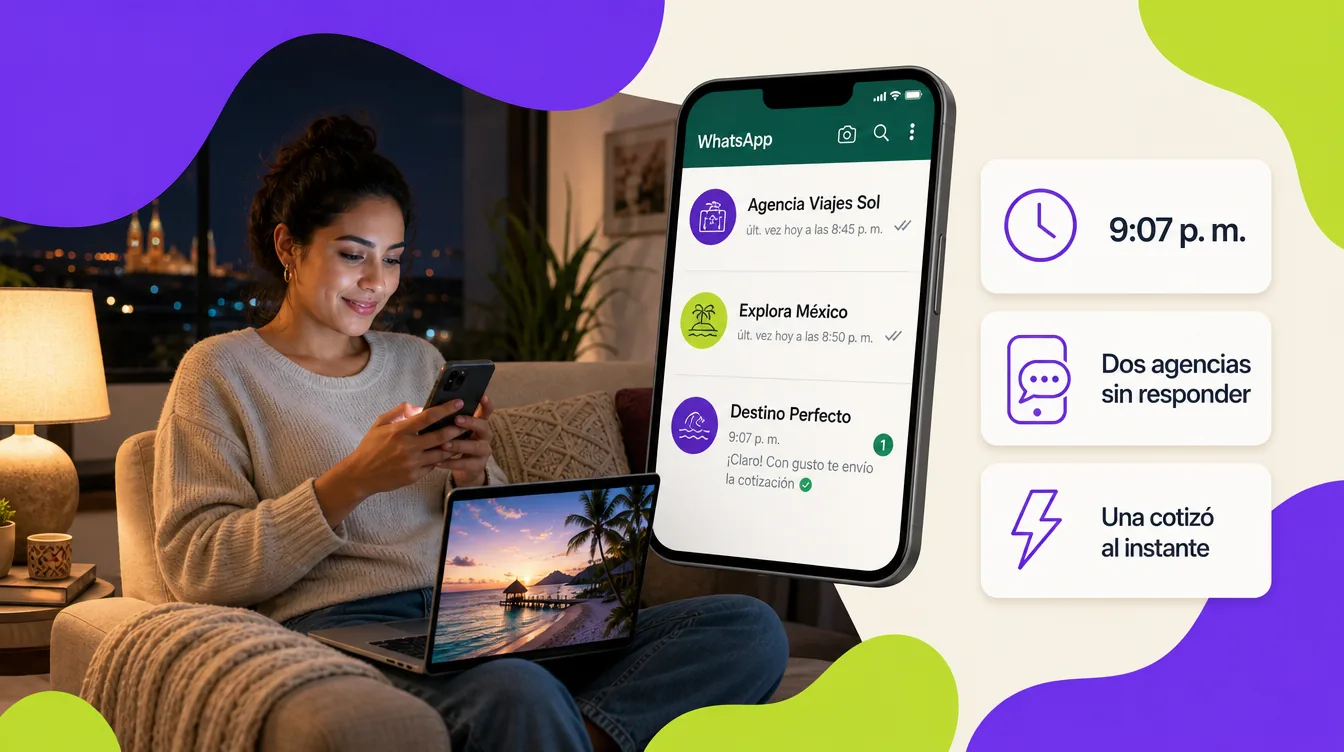
At 9:07 p.m., after putting the kids to bed, Paola opens WhatsApp and sends the same message to three agencies: “Hi, how much is Cancún from March 14 to 19 for two adults and two kids, all inclusive?”. Two agencies closed at seven. The third has an AI agent that replies in seconds with a range, two hotels and one question: “hotel zone or Playa Mujeres?”. By 9:20 Paola has a proposal and an advisor assigned for the morning. The other two agencies will write at ten the next day, once she has decided.
She did not choose the best agency or the cheapest: she chose the one that was there when she had time to think about vacations. The full logic, for any business, is in how many customers you lose by replying late on WhatsApp; here we bring it to travel, where the decision is emotional and the comparison is instant.
Why does speed matter more in travel than in other businesses?
Because travelers ask for quotes at night and on weekends, compare several agencies at once, decide with the family in the moment and, on top of that, availability changes: the price you saw today may not exist tomorrow. WhatsApp Business providers report that most people expect a reply in under ten minutes (source); in a vacation quote, ten minutes later there is already another tab open.
- Inverted schedule: people plan trips when they rest, exactly when your agency is closed.
- Simultaneous comparison: the same message reaches three or four agencies; the first useful reply wins.
- Emotional decision: whoever replies fast talks to the excitement; whoever replies late talks to the doubt.
- Perishable price: a rate left unconfirmed for hours becomes an apology the next day.
How do you calculate what every unanswered night costs you?
With three numbers you already have: how many quote requests arrive outside business hours each week (check your WhatsApp on a Monday), what share of quotes you close when you do answer on time, and your average ticket per trip. Multiply after-hours messages by your close rate and by the ticket, and you have what you leave on the table every week. It does not need to be exact: being yours is enough to decide.
| Figure | Where it comes from | Example (fictional, replace with yours) |
|---|---|---|
| After-hours quote requests per week | Messages received after closing and on weekends | 12 |
| Close rate when you answer on time | Quotes won out of quotes handled | 1 in 5 |
| Average ticket per trip | Monthly sales divided by trips sold | Yours |
| Left on the table | Requests × close rate × ticket | Two or three trips a week you never quoted |
The table is an exercise, not a promise: enter your real numbers and you will see whether the problem is big or small. In most agencies that serve families, the surprise is not the size but that nobody was measuring it.
What can an AI agent answer at 9:07 p.m. without getting you in trouble?
What is already written and approved by you: price ranges per package and season, what is and is not included, change policies, required documents, general availability and the questions you get every day. It collects the data the advisor needs (dates, people, budget) and leaves the conversation ready to close in the morning. It does not confirm rates that depend on a supplier or promise what it does not know.
- Yes: price range, two options, what is included, next step and the time an advisor picks it up.
- Yes: book the call, send the deposit link if the traveler already decided, log everything in your CRM.
- No: invent availability, promise a supplier price, give visa advice or accept a booking change.
- Escalates: groups, weddings, multi-destination or anything that sounds like an exception goes to the advisor with full context.
How that first conversation works, step by step, is in 24/7 quotes for travel agencies.
What if the problem is not the quote but everything that comes after?
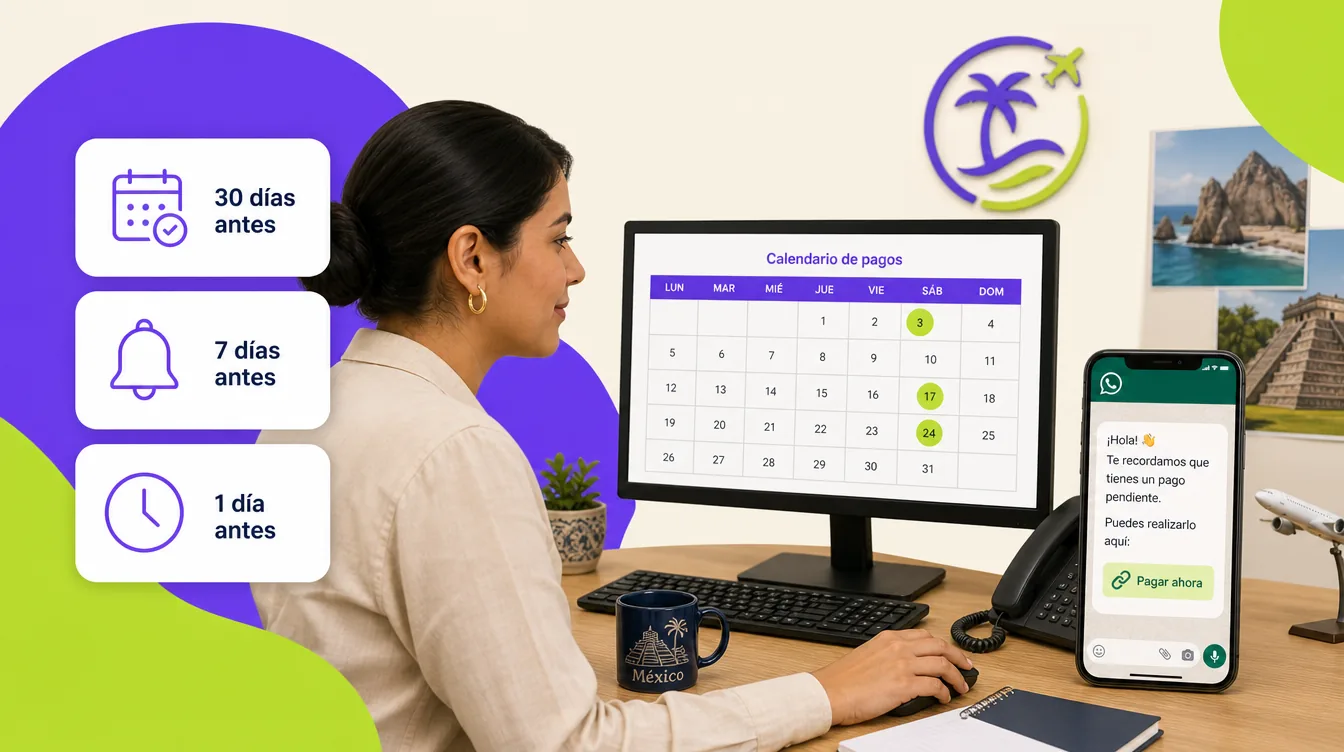
Many agencies do answer the first time fast and lose the customer later: in the payment nobody reminded, in the itinerary that arrived as a PDF nobody opened, or in the tour complaint learned about on return. The same agent that quotes at night reminds payments, accompanies the trip day by day and asks how every tour went. The first fast reply sells the trip; the following ones sell the next one.
I want my travel agent: how do we start?
Before hiring anything, count the messages that arrived last Saturday and Sunday after seven: that is your starting point. Tell us how many travelers you move each month and what they ask most in the “I want my travel agent” form: we propose the scope of the first agent (quotes, payments, day-by-day itinerary or per-tour survey) with the calendar and the payment gateway your agency already uses. If you would rather feel it before talking to anyone, upload an itinerary or your package list to the trial bot and ask it what a traveler would ask you. The full service is at AI agent for travel agencies.