
Retail agencies
Packages with a deposit and a balance before departure, several customers with different dates.
- Deposit
- Balance
- Payment link
- Receipt
In a travel agency money arrives in installments and the coordinator turns into a collector: checks the sheet, writes "hi, just a reminder about your payment", waits, writes again. Geedle's AI agent sends WhatsApp payment reminders at the right moment, with the link to pay and an automatic receipt, confirms when the money comes in and, if the traveler neither pays nor replies, alerts the advisor with the full history. Messages with the traveler's consent and approved templates: on-time collection without looking like spam.

They are scheduled messages the AI agent sends to each traveler before their deposit or balance is due, with the concept, the deadline and the payment link. They go out as WhatsApp Business approved templates, only to those who agreed to receive them, confirm the payment with a receipt and hand unresponsive cases to the advisor.
Because the reminder depends on a person remembering, finding the balance in the sheet and writing the message between quotes and pickups. The customer who wanted to pay gets the notice after the due date, does not have the link at hand or does not know how much they owe, and leaves it for later. Meanwhile the agency advances the money to the operator or the hotel so as not to lose the spot. The problem is not willingness to pay: it is that the notice arrives late, incomplete and from a personal number nobody keeps a record of.
When the booking is confirmed, the traveler agrees to receive notices about their trip and gets the payment calendar with the deposit link. For the balance, the agent sends a reminder thirty days before, another seven days before and one the day before the due date, each with the concept, the balance, the date and the payment link (Mercado Pago, Stripe or transfer details). When the payment comes in, it confirms and sends the receipt; if the customer replies with a question, it answers or hands it to the advisor; if the due date passes without a reply, the agent stops writing and alerts the advisor with the history. Amounts and frequency are set by the agency.
A reminder looks like spam when it reaches someone who already paid, when it repeats the same thing every day, when it does not say how much or by when, or when it comes from a number the customer does not recognize. The agent sends every message through the official WhatsApp Business platform with approved templates and the consent given at booking, always with that traveler's balance and date, stops as soon as the payment arrives and does not insist after the due date: it escalates to the advisor. Examples of the tone: "Hi, Ana. The balance for your Oaxaca trip is due on Friday. You can pay here: [link]. Can I help with anything?" and, on receiving the payment, "Done, we received your payment. Here is your receipt. See you on the 14th".
Three steps; the agency approves the messages, the deadlines and who gets alerted.
Payment policies and message tone
We take your real policy: deposit, balance dates per trip type, payment methods, what happens if someone falls behind. We write the templates (deposit, T-30, T-7, T-1, overdue, confirmation and receipt) in your tone and submit them for approval.

Connection to payments and to your sheet or system
We connect the payment gateway to generate a link per traveler and receive the confirmation, and we read your payment sheet, booking system or CRM to know who owes how much and by when. We define who gets the alert when someone does not pay.

Test with a group and launch
We test the full sequence with a group departing soon: sending, payment from the phone, receipt, question answered and case escalated. We adjust sending times and texts, train the advisor who receives the cases and launch for all new bookings.
The deadlines are the typical ones for a balance; the agency adjusts them per trip type.
| Moment | What the agent sends | If the traveler does not reply |
|---|---|---|
| When the booking is confirmed | Payment calendar, deposit link and consent for notices | Deposit reminder after 48 hours; then, to the advisor |
| 30 days before | Balance, deadline and payment link; offers to pay in parts if the agency allows it | Nothing: the next notice is at 7 days |
| 7 days before | Updated balance, date and link; answers questions about payment methods | Nothing: the next notice is the day before |
| 1 day before | Last reminder with the link and what happens if the balance is not settled | On the due date, alert to the advisor with the history |
| When the payment arrives | Confirmation and receipt; next step of the trip (documents, itinerary) | Not applicable |
| Overdue without payment | A single message offering to talk to the advisor | The advisor calls; the agent does not insist further |
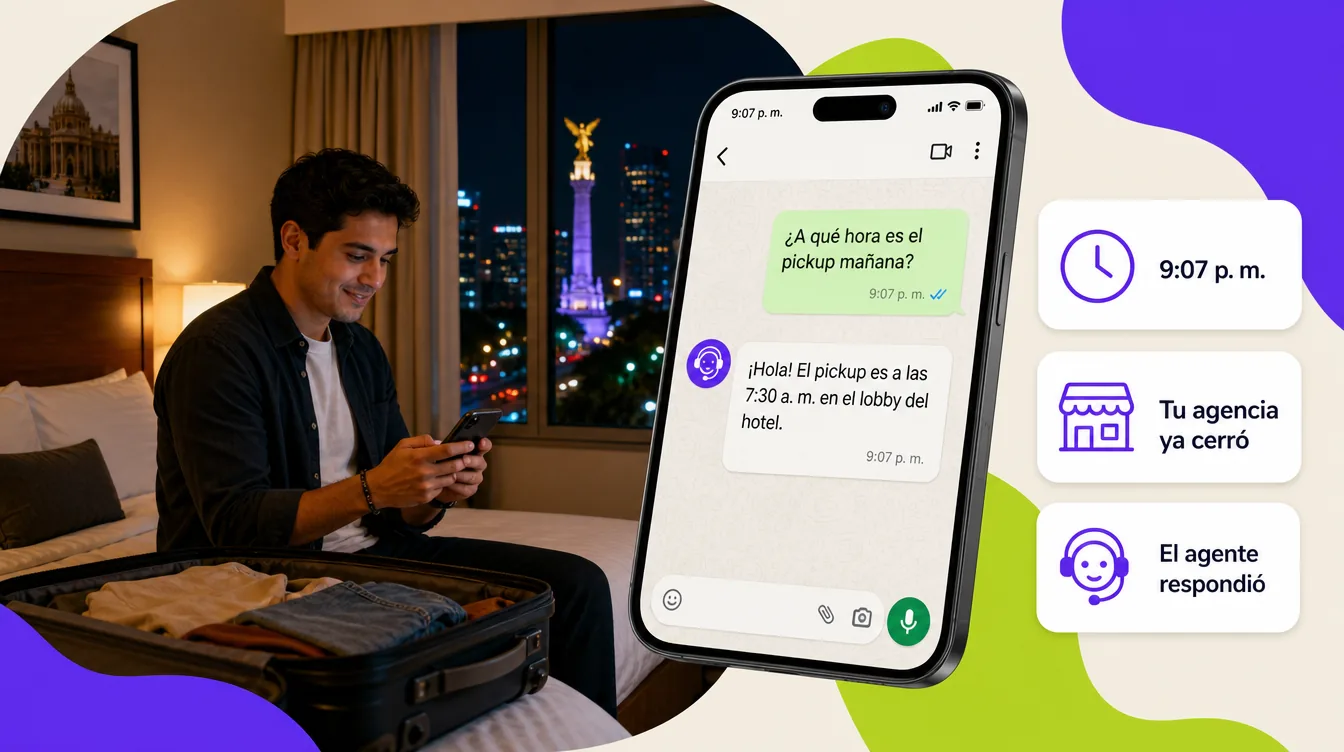
It is 9:07 p.m. on Thursday. Tomorrow the balance of a twelve-person group is due and your coordinator, who is also building the itineraries for Saturday's departure, did not manage to remind three families. Without an agent, on Friday you discover that two did not pay, the agency advances the money to the operator and someone spends the weekend collecting by phone. With the AI agent, each family got its T-7 reminder last week and its T-1 today at 10 a.m., with the payment link and the exact balance; two paid from their phones and the third, who did not reply, is already on the advisor's list to call first thing. Collecting on time is not nagging more: it is notifying earlier with the link at hand.
Six pieces that make collection punctual without wearing down the relationship with the traveler.
Mercado Pago, Stripe or transfer details, with the traveler's exact balance. Paying is one tap, not a call to ask how much and where.
T-30, T-7 and T-1 according to each booking's departure date, not the coordinator's memory. It stops on its own when the payment comes in.
Confirmation to the traveler with their receipt and a record in your sheet or system. The advisor sees who owes, how much and since when, without asking anyone.
After the due date the agent does not chase: it alerts the advisor with the conversation and the account status so they decide whether to call or grant time.
Every notice goes out through the official WhatsApp Business channel, with an approved template and only to those who agreed to receive them. Your number is not at risk.
If the traveler asks whether they can pay in two parts, by card or in cash at the office, the agent replies with your policy or hands it to the advisor.
Tell us how you collect the deposit and the balance. We tell you which sequence and templates the agent would use with your payment policy.
A dashboard to stop checking the sheet cell by cell and call only those who need it.
Eight questions about your quotes, payments, itineraries and complaints. You get a score and a list of what the agent could take over from week one.
For any agency that collects in installments and chases payments by hand today.
Packages with a deposit and a balance before departure, several customers with different dates.
Payments per family with an installment calendar and parents who all ask the coordinator the same thing.
Operators that collect from agencies and direct travelers and advance money to suppliers.
Pilgrimages and company trips with staggered payments and one person in charge per group.
PDF, Word, Excel or PowerPoint. The bot answers only with what is written and tells you the page, section or sheet it came from. Free, no account, deleted after 7 days.
Collection starts when the traveler accepts the quote. See how the agent quotes trips 24/7 on WhatsApp and sends the payment link on acceptance, and the rest of the service in the AI agent for travel agencies.
With the balance complete, the same agent sends the documents, the day's itinerary and the reminder for every tour: itinerary and trip companion.
Read how to write WhatsApp payment reminders that do not look like spam and what an AI agent for travel agencies does and costs.
Real projects told with facts, not promises.
Train crews spread across restaurants in several Mexican states and the United States with the same standard — and give every employee a clear view of how to grow inside the company.
Read the full caseBring an operation that lives on the road under a quality management system that meets the new ISO 9001:2026 and passes the certification audit.
Read the full caseTell us your deposit and balance policy and how you collect today. We reply the same day with the sequence and templates the agent would use.