How many customers you lose by replying late on WhatsApp (and what happened at 9:07 p.m.)
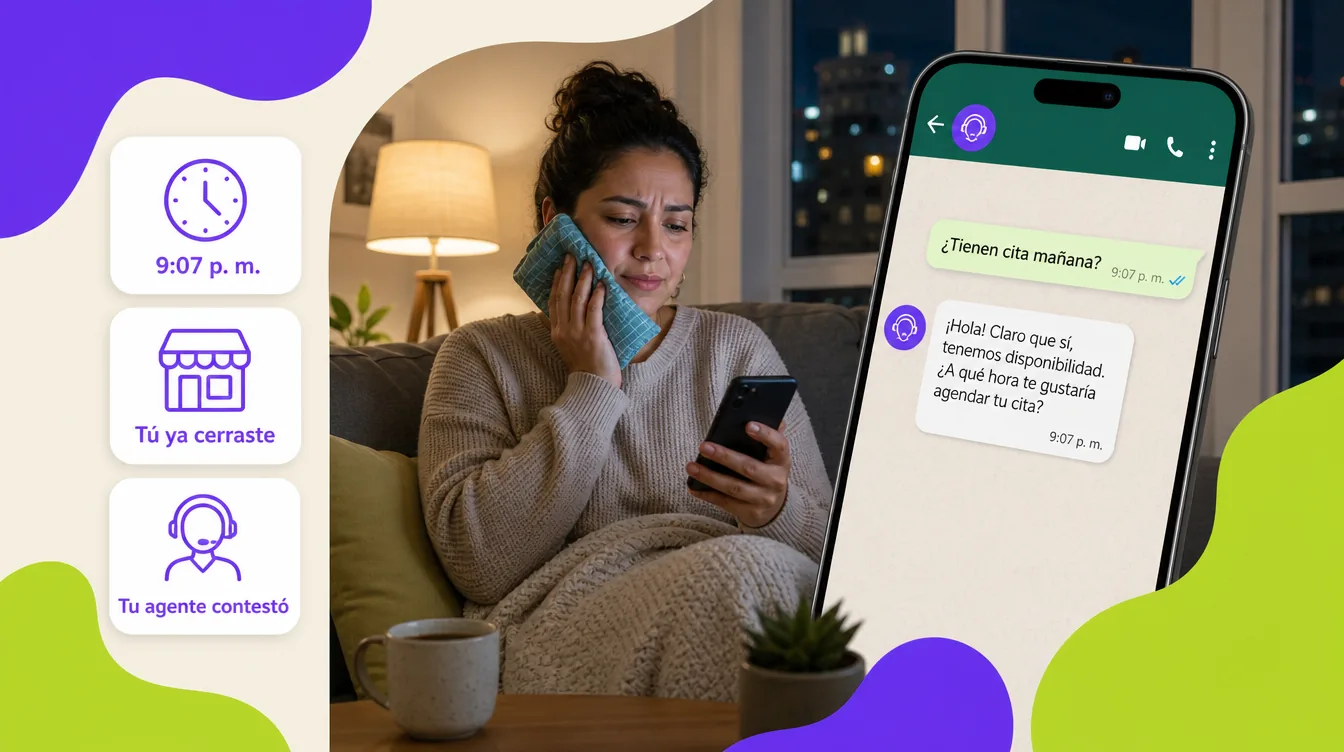
It is 9:07 p.m. A patient writes to your practice's WhatsApp: “Hi, do you have an appointment this week? It's urgent.” You already closed, the phone is on silent and you will see the message tomorrow at 9:30. By then she already has an appointment somewhere else. Replying late on WhatsApp does not feel like losing a customer, because you never see the one who left. This article puts numbers on that loss, explains what people expect from a business today and how to cover the shift nobody covers.
In this article
What does a customer expect today when they message a business on WhatsApp?
The same thing they expect when messaging a friend: a reply within minutes. According to data published by WhatsApp Business providers, most users expect a reply in under ten minutes and consider waiting more than half an hour unacceptable (source). Meanwhile, many businesses take hours. That gap is the window the customer leaves through.
There is an underlying reason: the customer who writes on WhatsApp almost always wrote to two other businesses too. They are not comparing who is better; they are comparing who solved it first. Today people choose the one who answers, not the one with the best review.
Why doesn't the 9:07 p.m. customer wait until tomorrow?
Because their need is now. At 9:07 they have time, they have the phone in hand and they just decided they will deal with that pain, that reservation or that quote. Tomorrow at 9:30 they already solved it with someone else, or the urgency faded and they postponed it another month. Purchase intent has an expiration date, and it is usually minutes.
- The patient who writes at night put up with the pain all day; they want the appointment before falling asleep.
- The family looking for a table on Saturday writes on Thursday at 10 p.m., when they finally agreed.
- The home buyer sends the same message to five listings at once; they visit the two that replied.
- The parent asking about enrollment does it on Sunday, after browsing three schools online.
- The driver with a breakdown writes from the parking lot; tomorrow they are at another shop.
What does replying late cost you?
Do the math with your own numbers, no one else's averages: count the messages you receive outside opening hours in a week, estimate how many were a possible sale and multiply by your average ticket. Then ask yourself how many of those got a reply before the customer solved it with someone else. Almost nobody does the math because the result is uncomfortable.
| When the message arrives | What happens today in many businesses | What happens with an AI agent |
|---|---|---|
| Opening hours, team busy | Answered in one or two hours, between calls | Reply in seconds; the team receives the case already qualified |
| Night (9:07 p.m.) | Seen the next morning | Books the appointment or takes the reservation on the spot |
| Sundays and holidays | Piles up for Monday | Replies, books and sends the reminder on Monday |
| Real emergency | Depends on who has the phone | Detects the urgency and alerts the on-call person with context |
| Repeated question (price, location) | Someone answers it for the tenth time | Answers with the official information and frees the team |
How do you cover the shift nobody covers?
With an AI WhatsApp agent that handles the first contact at any hour: it answers with your information, books in your real calendar, takes the prospect's details and, if it detects an emergency or a complaint, hands the conversation to the on-call person with a summary. It does not replace your team: it covers the hours when your team does not exist.
- Define what it can resolve alone: appointments, hours, prices, requirements, reservations.
- Define what goes to a person: emergencies, complaints, large quotes, anything outside its information.
- Connect the calendar and the CRM so every conversation ends in an action, not in “we'll get back to you tomorrow”.
- Review monthly what people asked that the agent could not answer, and decide whether to add it.
The full story of the 9:07 patient ends like this: the agent offered her three slots for the next day, confirmed the 11:00 one, sent her the location and a reminder at 8:00 a.m. The practice found out when it opened, with the appointment already in the calendar. How it is set up for healthcare is detailed in AI agent for medical and dental practices, and for other industries in real estate and restaurants.
What if my business is small?
Then it is where every lost customer hurts most. A large business absorbs ten unanswered messages; a small one lives off them. The good news is that the agent is quoted on the real volume of conversations, not on company size; what moves the price is explained in what an AI WhatsApp agent is and what it costs. And if you hesitate between a button menu and an agent, read chatbot vs AI agent for small businesses.
I want my agent: how do we start?
The 9:07 customer has already decided to buy; all that is missing is someone to answer. Tell us what your customers ask ten times a day in the “I want my agent” form and we propose the scope of the first agent, with the channels, the calendar and the integrations your business already uses. If you would rather see it before talking to anyone, upload your own documents to the trial bot and ask it what a customer would ask you: that is how an agent that answers only with your information feels. The full service is at AI WhatsApp agent.