



Meta Pixel Saltar al contenido
Hostile meetings · Complaints · Grades · Escalation

Handling difficult parents: conversations that end in agreement, not in crisis

The mother demanding a grade change, the father shouting at the front desk, the family threatening to go to the education authority or to social media: every principal and every teacher faces them without ever having practiced. We train leadership teams and teachers from preschool to university to run hostile meetings with a four-step script, document complaints, back the teacher without neglecting the family and escalate in time when a complaint threatens to become a crisis. Workshops of 90 minutes to 3 hours and a conversation lab with AI voice rehearsal before the real meeting.

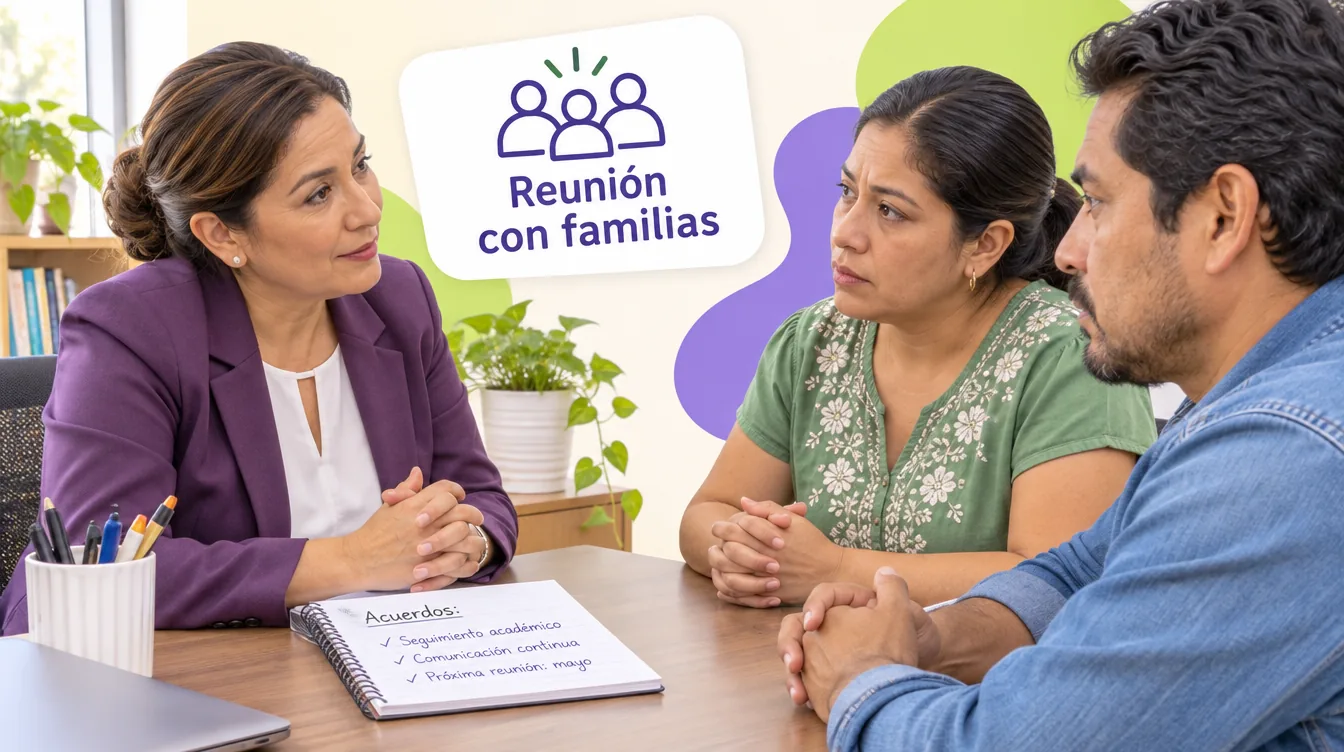
School principal calmly listening to a mother and father in her office, with the agreement log on the desk

What is handling difficult parents?

Handling difficult parents is the set of skills and procedures a school uses to take complaints, demands and hostile meetings to a documented agreement: listen and restate, put facts and evidence on the table, offer options within the rules, close in writing and follow up. At Geedle we teach it to principals, coordinators and teachers with cases from their education level, a script they use in the next meeting and voice practice with an AI character playing an angry parent.

01

Why do difficult conversations with parents wear schools down so much?

Because they arrive unannounced, at peak emotion and to the least prepared person: the teacher at the classroom door at pick-up time, the receptionist facing a shouting father, the coordinator who gets a WhatsApp message at eleven at night. The teacher promises what she cannot deliver to calm things down, the principal gives in on a grade to avoid a complaint to the authority, nobody writes down what was agreed and the family comes back two weeks later with a different version. The cost is not just a bad moment: it is the teacher's authority in front of the class, a family that withdraws and speaks badly of the school and, sometimes, a file before the education authority or the consumer protection agency that could have been avoided with a well-run, well-documented meeting.

02

What does Geedle's parent communication program include?

Seven workshops of 90 minutes to 3 hours, hired separately or as a path: how to handle a difficult parent, when the parent demands and the principal must decide, from complaint to solution, how to back the teacher without neglecting families, when a complaint threatens to become a crisis, difficult conversations with teenagers and documenting to prevent conflict. Plus the difficult-conversation lab (60 minutes, 2 or 4 hours) with the four-step script, a phrase bank for opening, containing and closing, an intervention traffic light (who handles which level of complaint), an agreement log form, a pre-meeting checklist and a referral route. Before the real meeting, each participant rehearses by voice with Geedle RolePlay against an AI character playing an outraged mother or a demanding father, and gets rubric-based feedback. It is part of school leadership training and pairs with the parent school to work on the relationship with families from both sides.

03

What changes at the school after the workshop?

Three visible things. First, hostile meetings stop being improvised: there is a script, a responsible person according to the traffic light and a form filled in during the meeting itself, so the family leaves with a written agreement and a follow-up date. Second, the teacher is no longer alone: she knows when to handle it herself, when to ask the coordinator to join and what she can promise; the principal backs her in front of the family without denying the facts when the teacher got it wrong. Third, the school learns from its complaints: the complaint log shows which groups, which teachers and which topics (grades, discipline, homework, fees, bullying) repeat, and leadership decides with data what to fix before the next re-enrollment season. What the workshop does not do is replace legal advice, psychological care or child-protection protocols: when a case requires them, the traffic light flags it and the referral route says who to turn to.

The four-step script for a difficult conversation with a parent

Learned in the workshop, rehearsed by voice and taken to the meeting in print.

Listen and restate

Before explaining or defending, the family has to feel heard. Let them speak without interrupting, take visible notes, restate the complaint in the parent's words ("I understand what worries you most is that the grade does not reflect your daughter's effort") and confirm that is what they want to solve. It lowers the emotion and avoids arguing over a version nobody has understood yet.

Principal listening to a mother and father with an open notebook on the desk

Facts and evidence

Separate facts from interpretations and put the evidence on the table: the homework log, the rubric used for grading, the incident report, the rules signed at enrollment. If the evidence does not exist, acknowledge it and set a date to gather it. If the teacher made a mistake, accept it right there: backing the teacher is not denying the facts, it is taking care of how the correction is made.

Teacher and coordinator reviewing the evidence record and the agreement log

Options within the rules

Offer two or three possible ways out, all within the rules and within what the school can actually deliver: an exam review by another teacher, a recovery plan with dates, a meeting with the student present. What cannot be done (changing a grade under pressure, sanctioning a teacher without investigating) is said clearly, with the grounds at hand.

Principal reviewing the options under the school rules with a coordinator on a tablet

Written agreement and follow-up

The meeting ends with the agreement log form: what was agreed, who does what, by when and how the family will be informed. Both parties sign and the follow-up is scheduled. If the case exceeds the level of whoever is handling it (threat of a complaint, possible abuse, a conflict between families), the traffic light marks the escalation and the referral route says who is responsible.

Leadership team reviewing the complaint log and follow-up agreements with families

Parent communication and difficult-conversation workshops

Delivered standalone, as a full path or within the principal academy.

WorkshopSituation it solvesDuration
How to handle a difficult parentComplaints, demands and hostile meetings at the front desk, in the classroom or in the office2 hours
When the parent demands and the principal must decidePressure over grades, sanctions and exceptions to the rules90 minutes
From complaint to solutionDocumenting, following up and closing complaints2 hours
How to back the teacher without neglecting familiesConflicts between teachers, students and families90 minutes
When a complaint threatens to become a crisisEscalation, coordination between areas and institutional communication3 hours
Difficult conversations with teenagersDisciplinary and academic situations in secondary and high school2 hours
Documenting to prevent conflictRecords, evidence and logs that protect the school and the student2 hours
Difficult-conversation labAI voice rehearsal of the campus's real cases, with script and rubric60 min, 2 h or 4 h

How many meetings with families this month ended without a written agreement?

Tell us which kind of complaint repeats at your school and we will propose the workshop or lab to start with.

Why Geedle?

Six pieces so difficult families do not set the climate of your school

Tools used in the next meeting, not communication theory.

Four-step script

Listen and restate, facts and evidence, options, written agreement: printed, on the phone and rehearsed by voice before the real meeting.

Intervention traffic light

What the teacher handles, what the coordinator joins and what goes up to the principal; with the cases referred to specialists from the first minute.

AI voice rehearsal

An AI character plays an outraged mother, a threatening father or a defensive teenager; the participant practices and gets rubric-based feedback.

Agreement and complaint log

A one-page form filled in during the meeting and a log that shows which complaints repeat by group, teacher and topic.

Phrase bank and checklist

How to open, contain, say no and close; what to review before sitting down with the family (file, rules, who else should be there).

Referral route

When a case stops being a conversation and moves to legal advice, psychological care or a child-protection protocol, and who to turn to.

Difficult conversations by education level and beyond the school

The same four steps, with different cases for each one.

School auditorium with mothers and fathers listening to a speaker at an evening session

Preschool and primary

Very present parents: overprotection, homework, biting and hitting between children, complaints about the teacher; the conversation is with the family, almost never with the student.

  • Overprotection
  • Homework
  • Conflicts between children
  • Group change

Secondary and high school

Grades, discipline, phones, bullying and absences; the teenager is usually in the meeting and you have to talk to them without humiliating them or letting them take over.

  • Failing grades
  • Sanctions
  • Bullying
  • Teenagers

Universities

Parents of first-year students calling about grades or withdrawals, formal complaints about procedures and student services; backing the professional lecturer.

  • First year
  • Formal complaints
  • Student services
  • Adjunct lecturers
Method

How we implement parent communication at your school

A standalone workshop takes one day; the full path with the lab runs three to six weeks.

  1. Campus cases

    With the principal and coordinators we gather the real complaints of recent years: topics, moments, who handled them and how they ended. We adapt the workshop cases to that.

    Complaint map
  2. Workshops

    In-person sessions at your campus or live online, on planning days or technical council days; each one ends with a ready-to-use tool.

    Script and forms
  3. Voice lab

    Each participant rehearses with the AI character the cases that cost them most; the rubric shows which step of the script they skip and which phrase escalates the conflict.

    Individual feedback
  4. Traffic light and route

    With leadership we define who handles each level of complaint, how it escalates and when it is referred to specialists; it is put in writing and communicated to staff.

    Campus protocol
  5. Follow-up

    At six weeks we review the complaint log: what changed, what repeats and what comes next; Geedle Bot answers questions between sessions with the exact minute of the recording.

    Complaint indicators

Parent communication staff actually apply on Monday

For principals, coordinators, teachers and front desk, with little time and many meetings.

  • Four-step script in print and rehearsed by voice with AI
  • Intervention traffic light: who handles which complaint and when it escalates
  • Agreement log form filled in during the meeting
  • Cases from preschool, primary, secondary, high school and university
  • Referral route to legal advice, psychological care and child protection
Teacher and coordinator logging agreements with a family in the campus logbook

Parent school: the other half of the relationship with families

Complaints drop when families understand how the school educates and what to expect from it. That is why parent communication pairs with the parent school: cycles of talks and workshops on limits, homework, phones, bullying and career choice that the school offers its families with a home application guide. A parent who has already heard the school talk about limits arrives differently to a meeting about a sanction.

Mother helping her teenage son with homework at the kitchen table, with the phone put away
01

Within school leadership training

Parent communication is one of the program's five services: see the principal academy (with the "Hard decisions in school leadership" workshop), tutoring with early alerts to act before the family calls about a failing grade, and the institutional assessment that measures how families perceive the school.

04

Fewer complaints at the door

An AI WhatsApp agent for schools answers inquiries, schedules and notices at any hour, so questions do not turn into complaints and staff handle the conversations that do need a person.

Case studies

Projects we have already delivered

Real projects told with facts, not promises.

Corporate university

A gamified corporate university for a sushi restaurant chain in Mexico and the US

Train crews spread across restaurants in several Mexican states and the United States with the same standard — and give every employee a clear view of how to grow inside the company.

Read the full case
  • One team from start to finish. Pedagogy, design, development and consulting — nothing critical subcontracted.
  • Fixed price, no surprises. A proposal with three scopes and a closed price for each. You choose the size of the step.
  • We listen before we quote. A free, no-strings assessment: you keep a useful report even if we don’t work together.
FAQ

Frequently asked questions about handling difficult parents

Start with the complaint that repeats most

Tell us whether it is grades, discipline, bullying or meetings that get out of hand. We reply the same day with the workshop or lab to start with, free and with no commitment.

Enter the VIP Zone

Geedle clients only. No passwords: we send a code to your email.

or

Not a client yet? Request your free diagnosis · Privacy notice

Choose your assessment

Answer 8 questions in 3 minutes and get your result with recommendations from a consultant.