Interview Techniques for Internal Auditors: Open and Closed Questions, the Funnel and Listening
Audit interview techniques decide whether an internal audit finds what matters or just confirms what everyone already knew. The standard can be learned in a course; asking well, listening and requesting evidence without making the auditee shut down are learned by interviewing. This guide gathers what an internal auditor uses in the field: open and closed questions, the funnel interview, sampling, dealing with difficult auditees and writing the finding, plus a way to practice all of it before your next audit.

In this article
- What interview techniques does an internal auditor use?
- When should you use open questions and when closed ones?
- How does the funnel interview work?
- What is active listening in an audit?
- How do you take the sample and ask for evidence without intimidating?
- How do you handle a difficult auditee?
- How do you avoid over-auditing?
- How do you write the finding from the interview?
- How do you practice these techniques before a real audit?
- Try it for two minutes, or build it around your case?
What interview techniques does an internal auditor use?
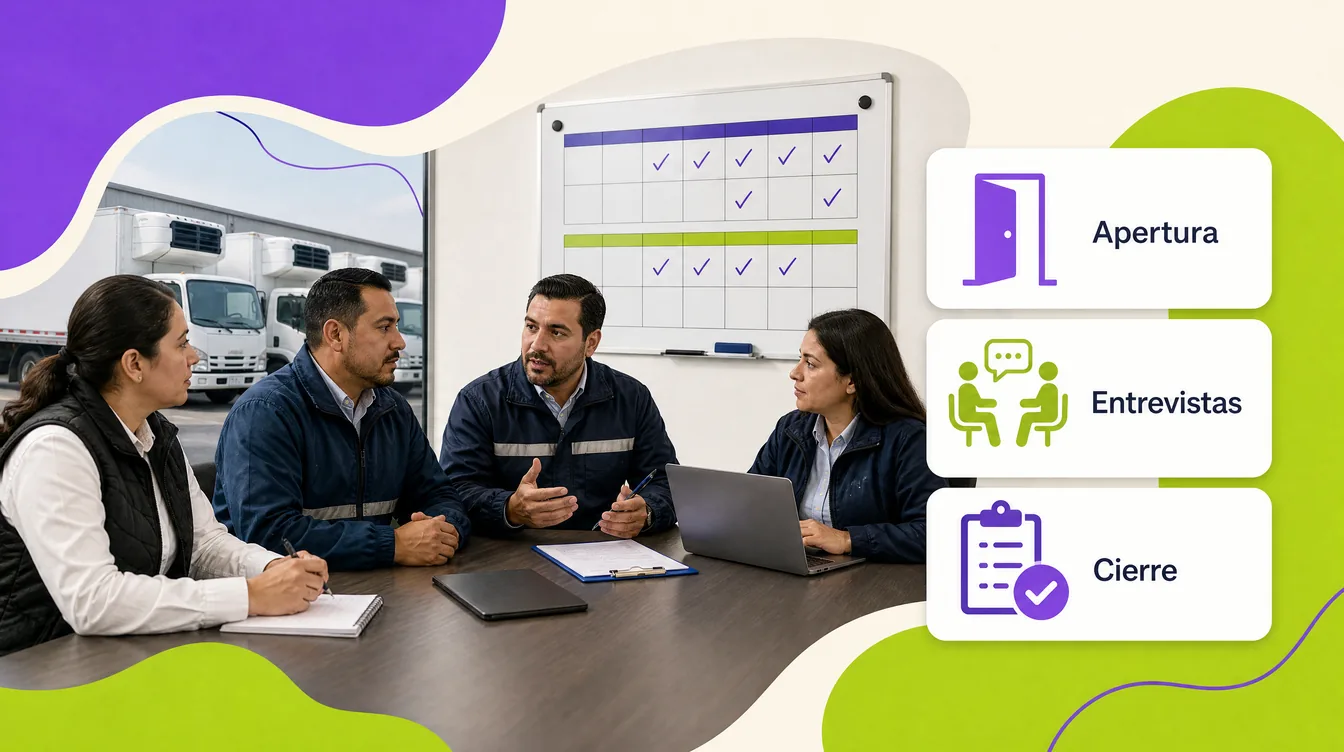
An internal auditor combines six interview techniques: open questions to understand the process, closed questions to confirm facts, the funnel sequence that moves from the general to the specific, active listening, sampling of records, and silence. None of them works alone; the craft lies in knowing which one each moment calls for.
The reference is ISO 19011, the guidelines standard for auditing management systems. It covers the principles of auditing, managing an audit program, conducting the audit and the competence of auditors, and it treats the interview as one of the methods for gathering information, alongside observation and document review. The principles it describes include fair presentation, confidentiality, independence and an evidence-based approach. What a standard cannot give you is practice, and that is what the rest of this guide is about.
When should you use open questions and when closed ones?
Use open questions when you want the auditee to describe their process in their own words, and closed questions when you need to confirm a specific fact. Open questions start with how, what, who, when or where; closed ones are answered with yes, no or a figure. Overusing closed questions turns the interview into an interrogation.
| Question type | What it is for | Example | Risk |
|---|---|---|---|
| Open | Understanding how the work is really done | "How do you decide a unit is cleared to leave?" | Long answers that drift out of scope |
| Closed | Confirming a fact or closing a topic | "Is this checklist filled in for every departure?" | The auditee says "yes" to everything and you learn nothing |
| Probing | Digging into a vague answer | "You said it is sometimes skipped. When was the last time?" | Sounding like an accusation if the tone is curt |
| Hypothetical | Checking the control when something fails | "What do you do if the temperature recorder reads out of range?" | Getting the ideal answer rather than what actually happens |
| "Show me" | Moving from words to evidence | "Can you show me the record from the last time that happened?" | None: it is the most productive question there is |
| Leading | Nothing: avoid it | "You do calibrate the equipment, right?" | It suggests the answer and voids the evidence |
How does the funnel interview work?
The funnel interview starts with a broad question about the process, narrows down with probing questions toward the point you want to verify, and ends with a closed question and a record in hand. The auditee relaxes by talking about what they know best, and you reach the evidence without abrupt jumps.
An example in the maintenance area of a refrigerated freight carrier:
- Open wide. "Walk me through how a unit comes in for preventive maintenance."
- Narrow down. "Who decides the date, and based on what information?"
- Probe the control. "What happens if the unit is on the road the day its service is due?"
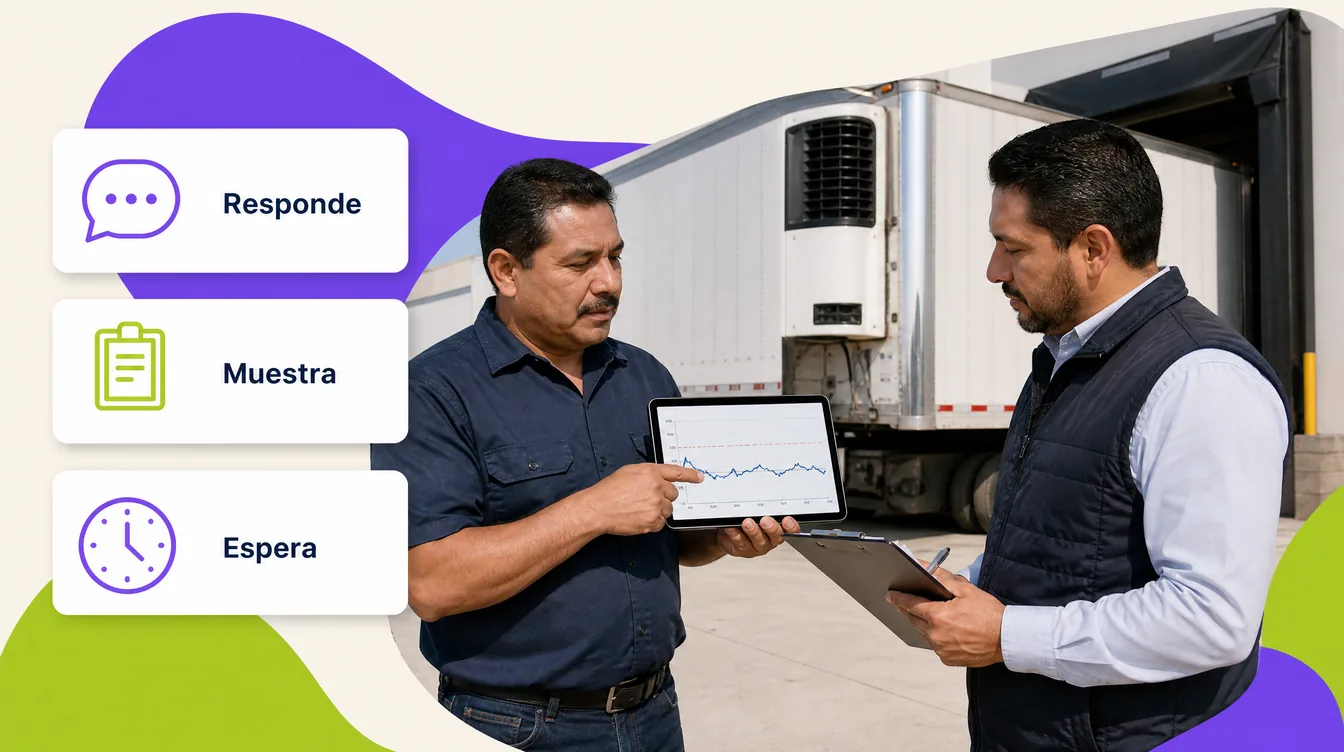
- Ask for the evidence. "Show me this month's schedule and two work orders for units that were rescheduled."
- Confirm and close. "So in these two, the service was done eleven days after the scheduled date and there is no recorded authorization. Is that correct?"
The last step is the one most often skipped. Summarizing what you understood and asking for confirmation prevents arguments at the closing meeting: the auditee has already heard the fact and accepted it with the record in front of them.
What is active listening in an audit?
Active listening in an audit means giving your full attention to what the auditee says, without preparing your next question while they talk, and checking that you understood before moving on. It shows in three behaviors: not interrupting, paraphrasing what you heard and tolerating silence while the person thinks or looks for a document.
- Take notes in plain sight. Explain what you are writing down and why; an auditor who writes in secret makes anyone nervous.
- Paraphrase. "If I understood correctly, the shift supervisor signs the release." You are either corrected in time or confirmed.
- Listen for what is not said. A "normally" or an "almost always" is an invitation to ask about the exception.
- Leave the silence. Three seconds of saying nothing often brings more information than a new question.
It is a skill that can be trained on its own; if your audit team struggles with it, the active listening course works on it through exercises.
How do you take the sample and ask for evidence without intimidating?
The sample is chosen by the auditor, not the auditee, and is noted with identifiers that let anyone find it again: record number, date, unit number, batch or document name with its version. To ask for it without intimidating, explain what you are going to review and why, and talk about the process, never the person.
Three habits help. First, request the sample by criterion rather than leaving it to the auditee: "the work orders from the 12th and the 27th", not "show me one". Second, watch your wording: "Can you help me see how it was recorded?" gets the same result as "prove it" without putting anyone on the defensive. Third, say thank you and say what you saw: "All five are complete, thanks." An auditee who also gets good news cooperates more on the next question.
How do you handle a difficult auditee?
You handle a difficult auditee by adjusting the technique, not by raising your voice. The quiet one needs open questions and time; the talker needs closed questions and a summary; the evasive one needs a direct request for the record; the hostile one needs calm, facts and a reminder that the system is being audited, not them.
| Profile | How it shows | What to do |
|---|---|---|
| The quiet one | Answers in monosyllables and looks at the boss before speaking | Ask an open question about their routine, at their workstation and, if possible, without the boss hovering |
| The talker | Tells the whole history of the area while time runs out | Summarize, say thanks and come back with a closed question: "To confirm, is this the record?" |
| The evasive one | "Someone else has that", "I'll get it for you in a minute", changes the subject | Ask for the specific record, note who has it and come back for it before the closing meeting |
| The staller | Arrives late, stretches the tour, looks for documents in no hurry | Recall the times in the audit plan and continue with another sample while the document turns up |
| The hostile one | Questions your competence or disputes every finding | Slow down, cite the requirement and the evidence, and leave the classification for the report |
How do you avoid over-auditing?
Over-auditing is continuing to request samples, opening topics outside the scope or pressing a point when you already have enough evidence to conclude. You avoid it with one rule: stop when the sample lets you state whether the requirement is met or not, and go back to the audit plan.
The signs that you went too far are clear: you have spent twice the allotted time on one process, you are reviewing something that is not in the audit criteria, or you are no longer seeking information but trying to confirm a suspicion. Over-auditing does not make the audit more rigorous; it makes it unfair to that process and leaves the following ones unreviewed.
How do you write the finding from the interview?
A well-written finding has four parts: the place or process where it was detected, the criterion that is not met, the condition found and the evidence that supports it, with its identifiers. If any of them is missing, the process owner cannot analyze the cause and the corrective action will come out weak.
| Part | What it answers | Example |
|---|---|---|
| Place | Where, and in which process? | Maintenance process, workshop at the main depot |
| Criterion | Which requirement applies? | The preventive maintenance procedure states that any rescheduling requires recorded authorization |
| Condition | What was found? | Two preventive services were carried out after the scheduled date without authorization |
| Evidence | What proves it? | Work orders for two units from the month's schedule, identified by number and date |
Compare it with the version nobody can act on: "Lack of control in maintenance." It does not say where, against which requirement or with what evidence. After writing comes classifying: major or minor nonconformity, observation or opportunity for improvement, according to the criteria defined by your organization or your certification body.
How do you practice these techniques before a real audit?
These techniques are practiced by interviewing, and today that can be done with a simulated auditee. In AI role play, a character answers by voice the way a real process owner would: they ramble, contradict the record or get annoyed, and you have to lead the interview.
Geedle RolePlay's role play for internal ISO auditors includes scenarios designed for each difficulty: the process where "everything is perfect" but a record is missing, the evasive auditee and the staller, the hostile auditee at the closing meeting, the remote opening meeting, a micro-case on not over-auditing and the follow-up of a corrective action. There are also scenarios for ISO 14001 and ISO 45001. The evidence appears on screen and, at the end, you get a rubric-based report: a score per criterion, strengths, areas for improvement and key moments with their timestamps.
A note on editions: Geedle RolePlay scenarios follow the clauses of the 2015 edition, the one that applies during the transition, and are adjusted to ISO 9001:2026, published on September 16, 2026. A three-year transition is expected, to be formalized by the IAF; what is known so far is in the ISO 9001:2026 transition guide.
The simulator is the practical complement to theory, not a substitute for it. The methodology, the audit plan and the audit report are learned in the ISO 9001 internal auditor course (more options in ISO courses for internal auditors); fluency in interviewing comes from repetition. To see the other side of the table, read how to answer an ISO 9001 auditor and the ISO 9001 mock audit plan; the repertoire of questions by clause is in ISO 9001 auditor questions. The full scenario catalog is at AI role play.
Notice. "ISO" is a trademark of the International Organization for Standardization; Geedle is not affiliated with it and is not a certification body. The simulator is for rehearsal: it does not replace the audit or guarantee its outcome.
Try it for two minutes, or build it around your case?
An internal auditor improves by interviewing, and the first interviews are better done where mistakes cost nothing. Start with the virtual ISO auditor: a free two-minute voice demo in your browser, no account needed. To see the full Geedle RolePlay product with scenarios for your area, request a demo and we will walk through it with your case. And if the scenario your team needs is not in the catalog, we build it with you, using your procedures, your product and your real objections: see custom role-play scenarios. Full product details are at Geedle AI role play.