Questions an ISO 9001 auditor asks and how to rehearse them with a virtual auditor
The hardest part of an ISO 9001 audit is not the documents: it is the interview. The auditor asks about context, risks, indicators and evidence, and whoever answers has to connect them out loud. This guide gathers the questions a quality auditor asks most, clause by clause, explains what they expect to hear and proposes a way to rehearse the interview with a virtual auditor before the internal or certification audit.
In this article
- What does an ISO 9001 auditor look for in an interview?
- ISO 9001 audit questions by clause
- Questions about the context of the organization (ISO 9001 clause 4)
- Questions about leadership and the quality policy (clause 5)
- Questions about planning, risks and quality objectives (clause 6)
- Questions about support: competence, documents and equipment (clause 7)
- Questions about operation and quality control (clause 8)
- Questions about performance evaluation and improvement (ISO 9001 clauses 9 and 10)
- How to answer an ISO 9001 auditor's questions without getting nervous
- How to rehearse the ISO 9001 audit questions with a virtual auditor
- Which findings come up most often in an ISO 9001 internal audit?
- Try it, or have us build yours
What does an ISO 9001 auditor look for in an interview?
An auditor of a quality management system (QMS) looks for evidence that the system works and that the person interviewed understands their part; they are not looking for you to recite the standard.
That is why almost all their questions have the same shape: "how do you do it?", "where is it written?", "show me an example" and "what happens when it goes wrong?". A complete answer connects the requirement to the process, the process to the evidence and the evidence to a result. If the audit is for certification or for the transition to the 2026 version of the standard, also review the ISO 9001:2026 transition and the ISO 9001 certification service.
ISO 9001 audit questions by clause
Clauses 4 to 10 of ISO 9001 are the auditable requirements; under each group of questions is the evidence the auditor expects to see.
Questions about the context of the organization (ISO 9001 clause 4)
- What external and internal issues affect your quality management system and how do you review them?
- Who are the interested parties and what requirements do they have?
- What is the scope of the QMS and which processes does it include? Where is it documented?
Expected evidence: a context analysis with a review date, an interested-parties register and the documented scope of the QMS.
Questions about leadership and the quality policy (clause 5)
- How does top management demonstrate its commitment to the management system?
- What is the quality policy, how was it communicated and how does staff know what it means in their job?
- Who owns each process and how were responsibilities assigned?
Expected evidence: a published quality policy, management review minutes and a responsibility matrix per process.
Questions about planning, risks and quality objectives (clause 6)
- Which risks and opportunities did you identify for this process and what actions did you take?
- What are the quality objectives, how are they measured and what progress do they show?
- How do you plan changes to the system?
Expected evidence: a risk and opportunity matrix with actions, quality objectives with an indicator and progress, and a record of planned changes.
Questions about support: competence, documents and equipment (clause 7)
- How do you determine the competence required for this role and where is the evidence of training?
- How do you control documented information: versions, approval, access?
- Which measuring equipment do you use and how do you ensure its calibration?
Expected evidence: job profiles with competences, training records with effectiveness evaluation, a master list of documents and calibration certificates.
Questions about operation and quality control (clause 8)
- How do you review customer requirements before committing to deliver?
- How do you evaluate and re-evaluate external providers?
- What do you do with a nonconforming output? Show me the latest case.
Expected evidence: requirement reviews before accepting orders, supplier evaluations and nonconforming-output records with their disposition.
Questions about performance evaluation and improvement (ISO 9001 clauses 9 and 10)
- Which indicators does this process track and what decisions were made with them?
- When was the last internal audit, what findings did it have and which corrective actions were closed?
- How do you measure customer satisfaction and what did you do with the results?
- What inputs and outputs did the last management review have?
Expected evidence: indicators with decisions taken, the internal audit program and report, corrective actions closed with verification, customer-satisfaction measurement and the management review record.
How to answer an ISO 9001 auditor's questions without getting nervous
| Rule | What it means | Example |
|---|---|---|
| Answer what was asked | No more, no less; the auditor asks for more if needed | "Purchasing risks are in the matrix; the main one is…" |
| Show, don't describe | Open the record, the indicator or the procedure | "Here is the March supplier evaluation" |
| Say "I don't know" with a path | Admit it and point to who or where | "The coordinator handles that; I'll check now" |
| Connect to the result | Close with what changed thanks to the process | "Returns dropped after that action" |
| Don't defend the indefensible | A well-accepted finding is worth more than an argument | "You're right, the signed version is missing" |
How to rehearse the ISO 9001 audit questions with a virtual auditor
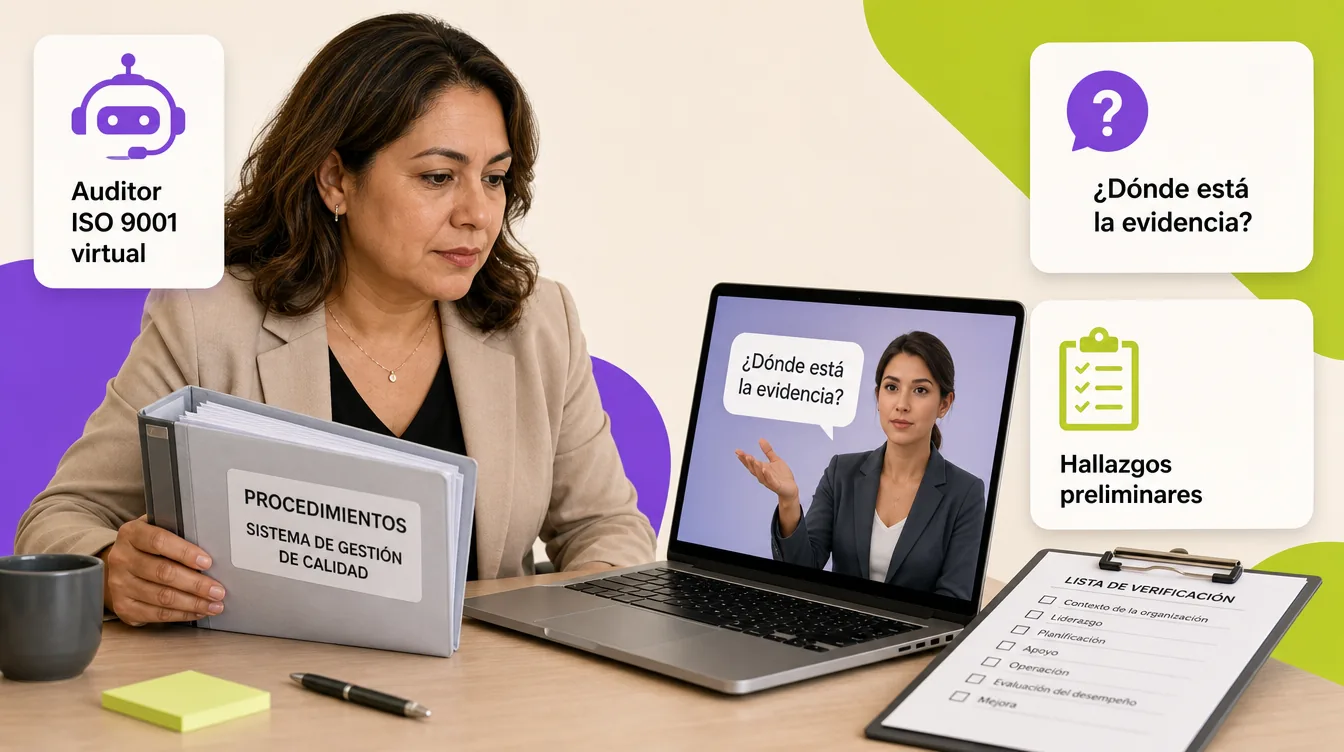
Classic preparation for an ISO 9001 internal audit is a checklist of questions by clause and a drill with the quality manager playing the auditor. It works, but it depends on one person's schedule and is usually rehearsed once. A virtual auditor with AI lets you repeat the interview as many times as needed: the virtual ISO auditor with avatar asks for the standard (9001, 14001 or 45001) and your industry, asks what an external auditor would ask, tactfully points out gaps and closes with two or three preliminary findings. Two minutes are free; with your details you continue up to ten.
To make the rehearsal pay off: pick one clause per session, keep the real evidence at hand (open the indicator or the record while you talk) and ask the virtual auditor to press where you hesitated. Process owners who have been through the fewest interviews improve the most with three or four sessions. If your company is preparing ISO 45001, the same agent adapts the questions to occupational health and safety, in line with our ISO 45001 consulting.
Which findings come up most often in an ISO 9001 internal audit?
This list is qualitative, drawn from the internal audits we support; it is not a statistic. The findings that repeat most:
- Quality objectives without an indicator or progress.
- Risks identified but without action or follow-up.
- Documented information in different versions depending on the folder.
- Staff competence without evidence of effectiveness evaluation.
- External providers without re-evaluation.
- Corrective actions closed without verifying they worked.
Almost all are detected in the interview with two follow-up questions, and almost all are fixed with record discipline rather than new documents. The full support is in our ISO consulting.
Try it, or have us build yours
Before the internal audit, rehearse the interview with an auditor who never tires of asking "where is the evidence?". Try the virtual ISO auditor with avatar first: two free minutes in the browser, no account. If you want one with your content, your voice and your avatar, message us on WhatsApp or fill out the contact form: we reply the same day with a scope and a closed price. The full catalog is at AI agents with avatar.