Chatbot vs AI agent: which one suits a small business on WhatsApp?
The chatbot vs AI agent question comes up as soon as a small business decides to automate its WhatsApp: the button chatbot is cheap and predictable; the AI agent understands what the customer writes and resolves more, but requires you to organize your information. Here we compare both without jargon: what each one understands, what happens when the customer goes off script, what each option costs to run and when the chatbot is enough.
In this article
What is a chatbot and what is an AI agent?
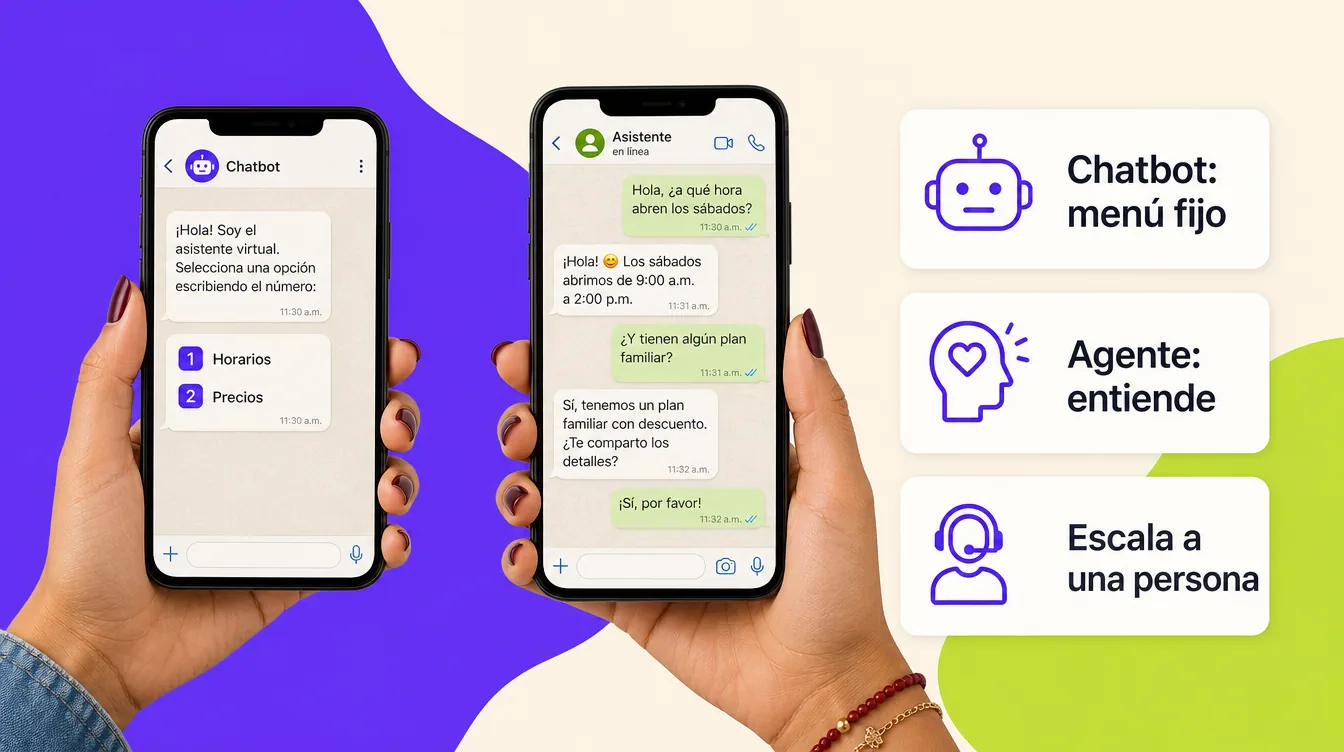
A chatbot is a flow of predefined messages: the customer picks numbered options or presses buttons and the system replies with fixed texts. An AI agent interprets the customer's natural language, looks up the answer in the business's information, performs actions such as booking or logging a detail and hands the case to a person when needed. They share the channel; they do not share the intelligence.
Both live on WhatsApp Business and sometimes in the same business: the chatbot greets with three buttons and the agent takes over when the customer writes something that was not anticipated. How the second one works is explained in AI WhatsApp agent: what it is and what it costs.
How do they differ once the customer types?
The difference shows in the customer's second sentence. With “hi” both work; with “can you see me today after 6 even without an appointment?” the chatbot replies “I didn't understand, pick an option” and the agent replies with the openings after six or explains how walk-ins work.
| Criterion | Button chatbot | AI agent |
|---|---|---|
| How it understands | Keywords and numbered options | Natural language, with typos and slang |
| Source of answers | Fixed texts written one by one | Your information (prices, policies, calendar) consulted on every message |
| Unexpected question | “I didn't understand” or back to the menu | Interprets it, answers or escalates to a person |
| Actions | Links and forms | Books, logs in the CRM, checks orders |
| Maintenance | Editing every branch of the tree | Updating the source information; the agent adapts |
| Risk | Frustrating the customer so they leave | Over-answering if it lacks clear limits |
| Running cost | Low and fixed | Variable with conversations and integrations |
When is a chatbot enough?
When questions are few, identical and the answer does not change: hours, location, a short catalog and a link to order. A well-built chatbot handles the greeting, routes the conversation between areas and shares the emergency number. If your business gets twenty messages a day and all of them fit in five buttons, do not pay for more.
- Businesses with a single service and a fixed price.
- Teams that do reply within minutes throughout opening hours.
- Cases where the right answer is always “talk to someone”.
When is an AI agent the better choice?
When questions arrive in free text, when the answer depends on data that changes (availability, stock, prices by area) and when the business loses sales for not replying at night or on weekends. There the agent stops being an expense and becomes the shift nobody was covering.
- Live calendar. Medical practices, dental clinics, salons, workshops: the question is always “when do you have an opening?”.
- Prospects that must be filtered. Real estate agencies and schools receive hundreds of messages in season and only some are ready to move forward.
- Volume outside opening hours. Restaurants and online stores sell when the team has gone home.
- Information that changes. Prices per service, promotions, stock, requirements for a procedure at a firm.
The agent's risk is the opposite of the chatbot's: it can over-answer. That is why it gets written limits (what it does not promise, when it hands off to a person) and its conversations are reviewed monthly. What a business loses when the reply comes late is measured in how many customers you lose by replying late on WhatsApp.
Can they be combined?
Yes, and it is often the best option for a small business: buttons for what is the same for everyone (greeting, hours, location) and the AI agent for everything else. The customer never sees the seam; they only notice they were answered well and fast. If you also want the agent to answer with your documents (menu, price list, rulebook), try it first with the chat with your documents tool: upload a PDF and ask it what a customer would ask you.
For companies with internal manuals, per-user permissions and systems such as an ERP, the comparison changes scale: there we talk about AI agents for business with RAG and data governance. And if you want to hear how an agent converses, the avatar agents can be tried free for two minutes.
I want my agent: how do we start?
The question is not “chatbot or agent” but how many conversations slip away today because nobody understands them in time. Tell us what your customers ask ten times a day in the “I want my agent” form and we propose the scope of the first agent, with the channels, the calendar and the integrations your business already uses. If you would rather see it before talking to anyone, upload your own documents to the trial bot and ask it what a customer would ask you: that is how an agent that answers only with your information feels. The full service is at AI WhatsApp agent.