US visa interview questions and how to answer them consistently
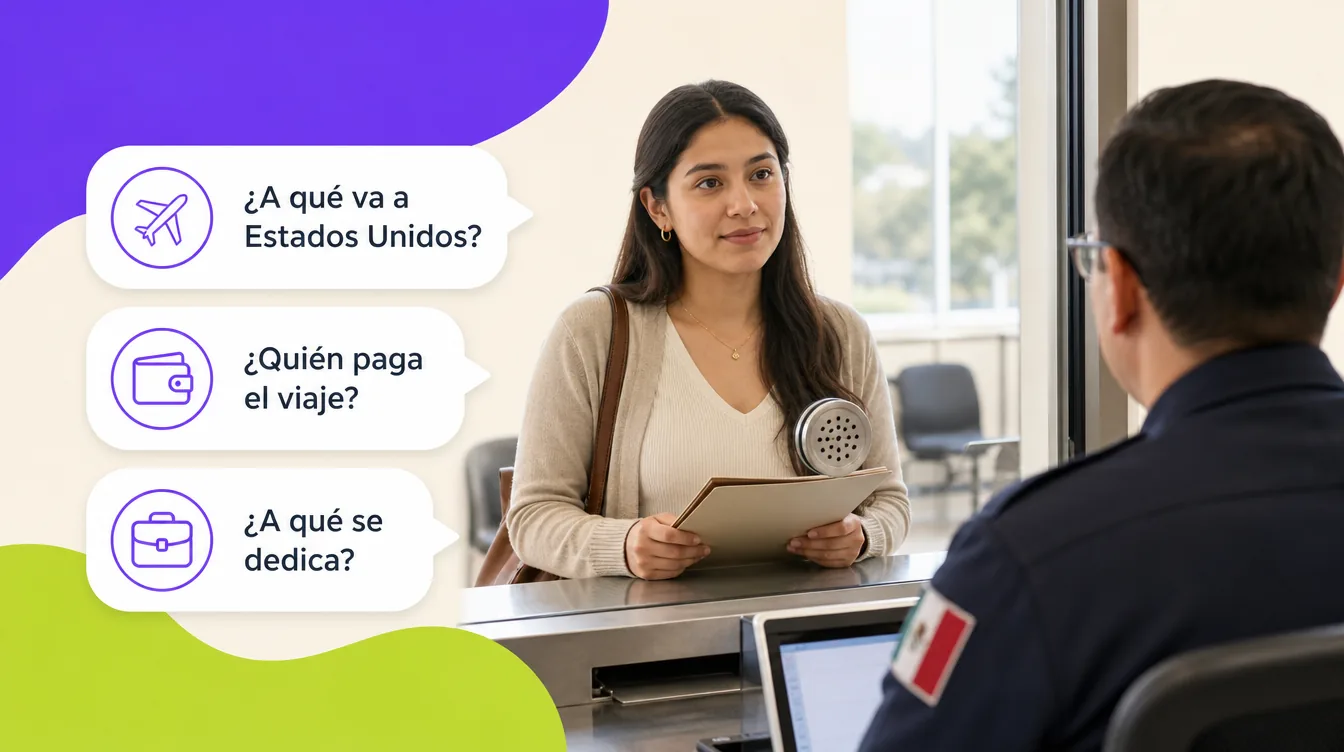
US visa interview questions almost always revolve around five topics: why you are going, for how long, who pays, what you do for a living and what brings you back to Mexico. The consular officer does not follow a fixed script; they use your DS-160 form and your answers to decide in a few minutes. Here are the most frequent questions, what each one is really asking and how to answer in short sentences that never contradict what you already declared.
In this article
- What does the consular officer evaluate in the US visa interview?
- What are the most frequent US visa interview questions?
- How do you answer "Why are you going to the United States?"
- How do you answer about your job and income?
- How do you answer "Who is paying for the trip?"
- How do you answer questions about family in the United States?
- What separates a vague answer from a concrete one?
- How do you prepare without memorizing a script?
- Want to hear these questions before the window?
What does the consular officer evaluate in the US visa interview?
Whether your trip is credible and whether you will return. For a B1/B2 visa (business and tourism) the consular officer reviews your purpose, your ability to pay for the trip and your ties to Mexico: job, family, studies or property. They compare what you say with your DS-160 and decide during the same interview.
That is why the interview is short and the questions look simple. The officer is not checking for a "correct" answer; they are checking for consistency. The law applied when they are not convinced is section 214(b), which we cover in why US visas are denied.
What are the most frequent US visa interview questions?
US visa interview questions fall into trip purpose, length of stay, funding, employment, family and travel history. The consular officer picks a few based on your case and your DS-160. If an answer raises a doubt, they dig into that topic; if it is clear, they move on.
- Purpose: "Why are you going to the United States?", "Which city?", "With whom?"
- Length: "How long will you stay?", "When do you plan to travel?"
- Money: "Who is paying for the trip?", "How much do you earn per month?"
- Work or studies: "What do you do?", "Since when?", "What are you studying?"
- Family and ties: "Are you married?", "Do you have children?", "Do you have family in the United States?"
- History: "Have you traveled before?", "Have you been refused a visa?", "Have you ever overstayed?"
How do you answer "Why are you going to the United States?"
With the specific reason, the place and the dates, in a single sentence. "Vacation in Orlando with my wife, July 10 to 20." That answer covers purpose, company and length without the consular officer having to ask twice, and it must match the dates and destination on your DS-160.
Avoid open answers like "tourism" or "to visit". They are not lies, but they force the officer to pull the thread and suggest you have no plan. If you travel for business (B1), name the company you are visiting and why: "a three-day training at our supplier's plant in Houston".
How do you answer about your job and income?
With your position, employer, seniority and an approximate monthly income you can back up. "I have been a quality supervisor at an auto parts company in Querétaro for six years; I earn around 28,000 pesos a month." The consular officer wants to know you have a job to return to and that the trip fits your finances.
Do not inflate the figure: if they ask for an employment letter or a bank statement and it does not match, the problem is bigger than a modest salary. If you are self-employed, explain your activity and since when; if you are a student, your school, program and semester.
How do you answer "Who is paying for the trip?"
Truthfully and with a reason that makes sense. "I am, with my savings" or "my parents, who are traveling with me" are complete answers. If a relative living in the United States is paying, say so and explain the relationship; hiding it and having it surface later is worse than the awkward answer.
How do you answer questions about family in the United States?
Head-on: who they are, where they live and their status if you know it. Having family there does not disqualify you; lying about it can, because the information is cross-checked against other databases. What the consular officer weighs is whether your ties to Mexico outweigh any reason to stay.
If your DS-160 says you have a brother in Chicago and at the window you say "nobody", you have just created a contradiction. In US visa interview mistakes you will find more examples of answers that sink a case that was going well.
What separates a vague answer from a concrete one?
The concrete answer has verifiable details (place, date, figure, name) and fits in one sentence; the vague one forces a follow-up question and leaves the impression that you are improvising. The table compares both versions of the most common US visa interview questions.
| Consul's question | Vague answer | Concrete answer |
|---|---|---|
| Why are you going to the United States? | Tourism, just to visit. | Vacation in San Antonio with my two kids, one week in August. |
| How long will you stay? | I don't know, a few weeks. | Ten days; I'm back on the 21st because I work on the 22nd. |
| What do you do? | I work at a company. | I've been an accountant at a firm in León since 2019. |
| Who is paying? | Well… me, or my family. | I am, from savings; the flight and hotel are already booked. |
| Do you have family there? | No… well, a cousin. | Yes, a cousin in Dallas; I'm not staying with him, I'm at a hotel. |
| Have you been refused a visa? | Long ago, I don't remember. | Yes, in 2019; I had no steady job then. I've been at my company five years now. |
How do you prepare without memorizing a script?
By practicing out loud with someone who asks like the consular officer and cuts you off when you ramble. Memorized answers sound recited and it shows; practicing the conversation gives you rhythm and confidence. Ideally rehearse with your DS-160 in front of you so every detail matches.
- Print your DS-160 and underline dates, employment, income and declared relatives.
- Write a one-sentence answer for each question on the list.
- Rehearse out loud with someone playing the consul, in the language you will use at the interview.
- Ask them to cut you off after two sentences and to follow up whenever something sounds doubtful.
- Repeat until you answer just as clearly when the order of the questions changes.
The full step-by-step is in how to practice your US visa interview. If you would rather do it with a character that never tires of following up, AI role play works as we explain in what is AI role play.
Want to hear these questions before the window?
Reading the list helps; answering it out loud under pressure is what resembles the interview. Practice for two minutes free with the AI consul: it asks the questions you will hear at the window, reacts to what you say and how you say it, and at the end points out which answer sounded vague or contradictory. For a full path, with your own DS-160 details and several attempts with a report, see the US visa interview role play from Geedle RolePlay.
Geedle is not an immigration firm or a law office, does not represent the United States government and does not guarantee the approval of any visa: the AI consul is a rehearsal so you arrive at your interview with practice. The decision always belongs to the consular officer; official information is at travel.state.gov and the US Embassy in Mexico.