US visa interview mistakes: what not to say to the consul
US visa interview mistakes are rarely dramatic: they are almost always well-meant phrases that open a doubt the consular officer did not have. "I'll see what comes up", "my sister will support me", "I don't remember if I was refused". Here we gather what not to say, why it matters and what to say instead, so an interview that was going well does not collapse on the last question.
In this article
- What is the most serious mistake in the US visa interview?
- Which phrases raise doubts even when they are true?
- Which contradictions with the DS-160 cost the most?
- Which attitudes work against you during the interview?
- What should you say instead of the problem phrases?
- How do you catch your own mistakes before the appointment?
- Which of these phrases would you say without noticing?
What is the most serious mistake in the US visa interview?
Lying. A refusal under section 214(b) lets you apply again; a detected lie about a previous refusal, a relative in the United States or a past stay can bring far more serious and lasting consequences. The consular officer has access to your history and your DS-160, so the "small" omission is almost never small.
What you can do with an uncomfortable truth is present it with context: "I was refused in 2019, when I had no steady job; I have been at my company for five years now." That is how you explain the ties we detail in why US visas are denied.
Which phrases raise doubts even when they are true?
The ones that suggest an intent to stay, to work or to have no plan: "to see what comes up", "to look for opportunities", "I'd stay a while with my aunt", "to help at my cousin's business". For a B1/B2 visa, any mention of working over there, even a family favor, sets off an alert.
- "I'm going to see if I like it enough to stay." States immigrant intent on a visitor visa.
- "I'm going to help my cousin at her store." That is work, and B1/B2 does not allow it.
- "I'll stay as long as they let me." Suggests you have no reason to come back.
- "My brother will support me over there." Financial dependence in the United States, not in Mexico.
- "I don't know where I'm going yet." A trip without a plan, a purpose that is hard to believe.
Which contradictions with the DS-160 cost the most?
Those about travel dates, employment, income, relatives in the United States and previous trips or refusals. The consular officer has your form on screen while you talk; a gap between what is written and what is said is not read as a slip but as a lack of credibility. Review your DS-160 the night before and answer with those same details.
| What your DS-160 says | What you say at the window | What the consul perceives |
|---|---|---|
| Trip from July 10 to 20 | "About three weeks" | You don't know when you are coming back |
| Employed since 2021 | "I just started" | The job is not a real tie |
| Monthly income of 18,000 pesos | "Around 40,000" | You inflate figures or someone else is paying |
| Brother in Chicago | "I have no family there" | You are hiding information |
| Visa refused in 2019 | "I've never applied" | A lie that can be checked in the system |
| Traveling alone | "With my wife and kids" | The form does not reflect the real trip |
Which attitudes work against you during the interview?
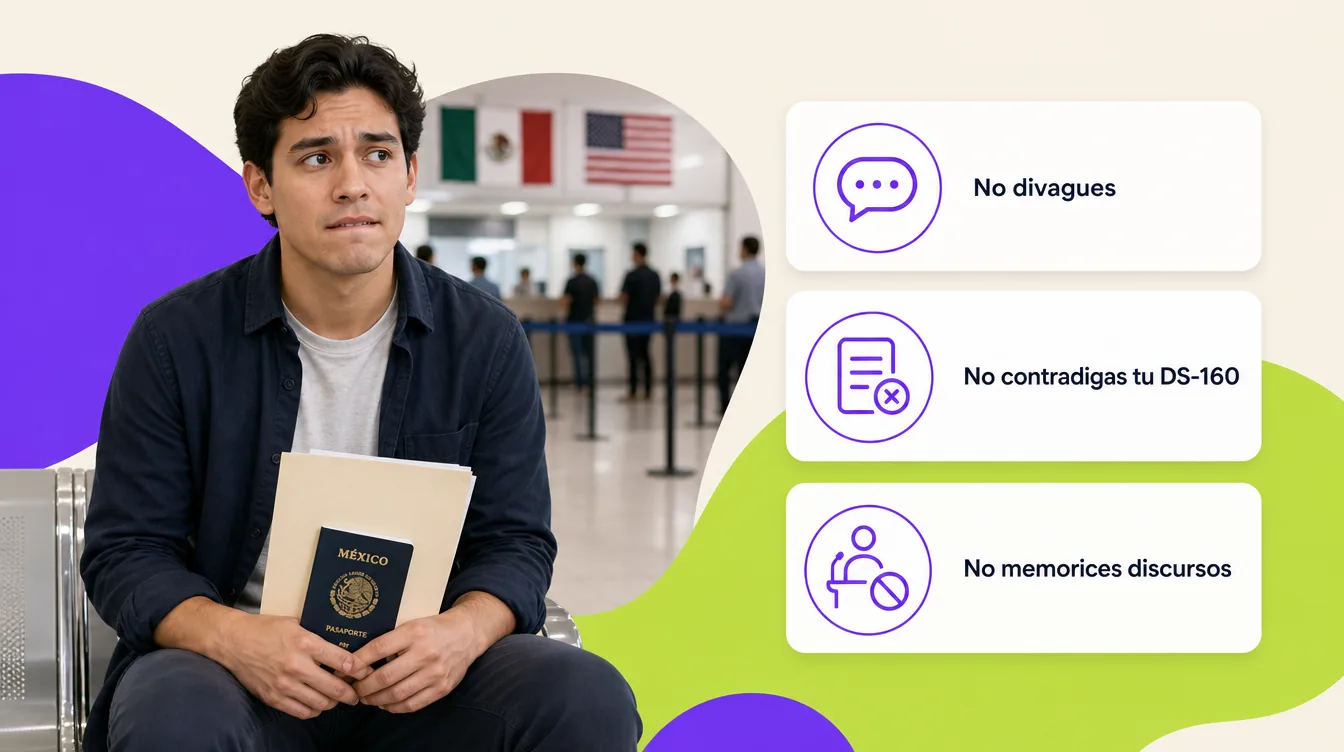
Talking too much, arguing, reading papers without being asked and adding information after the "thank you". The consular officer decides with a few questions; every extra sentence is a chance to contradict yourself or mention something that does not help. Calm, brief and looking at the consul is the attitude that best accompanies clear answers.
- Do not interrupt or answer before the question ends.
- Do not argue with a follow-up: answer it with a fact.
- Do not pull out documents unless asked.
- Do not tell the whole story: one or two sentences, then silence.
- Do not add anything once the consul closes the interview.
What should you say instead of the problem phrases?
A concrete, truthful version of the same idea, with date, place and a tie to Mexico built in. "I'm going to Los Angeles for ten days to visit my brother; I'm back on the 21st because I work on the 22nd" says the same as "I'm going to stay a while with my brother", but with a plan, a length and a reason to return.
- Instead of "to see what comes up": "on vacation, to Orlando, one week in August".
- Instead of "to help at my cousin's store": "to visit my cousin; I'm going as a tourist, not to work".
- Instead of "as long as they let me": "twelve days; my vacation is approved until the 15th".
- Instead of "I don't remember if I was refused": "yes, in 2019; my work situation was different".
- Instead of "my sister supports me": "I'm paying for the trip; my sister is hosting me".
The concrete versions of the most common questions are in US visa interview questions.
How do you catch your own mistakes before the appointment?
By running a mock interview with someone who follows up and writes down every long, vague or off-DS-160 sentence. You cannot hear yourself; that is why practicing out loud in front of another person, or an AI consul, finds mistakes you would never catch by reading. The full method is in how to practice your US visa interview.
Geedle's AI consul is built to follow up exactly when an answer opens a doubt ("and what does your cousin do?", "who pays for the hotel?") and to point out at the end the phrases that sounded like an intent to stay or to work. It is a rehearsal with someone who does not know you and does not help you, which is exactly what you will find at the window.
Which of these phrases would you say without noticing?
The only way to know is to hear yourself answer under pressure before the appointment. Practice for two minutes free with the AI consul: it asks the questions you will hear at the window, reacts to what you say and how you say it, and at the end points out which answer sounded vague or contradictory. For a full path, with your own DS-160 details and several attempts with a report, see the US visa interview role play from Geedle RolePlay.
Geedle is not an immigration firm or a law office, does not represent the United States government and does not guarantee the approval of any visa: the AI consul is a rehearsal so you arrive at your interview with practice. The decision always belongs to the consular officer; official information is at travel.state.gov and the US Embassy in Mexico.