How to practice your US visa interview: a mock interview step by step
To practice your US visa interview it is not enough to read lists of questions: you have to answer them out loud, under pressure, in front of someone who follows up the way a consular officer would. A well-run mock interview takes less than an hour and is repeated several times before the appointment. Here is the step-by-step, what you need on hand and how to do it with an artificial intelligence consul when you have nobody to rehearse with.
In this article
- Why run a mock US visa interview?
- What do you need before practicing?
- How do you run a mock consular interview step by step?
- What should the person playing the consul check?
- How do you practice the US visa interview with artificial intelligence?
- How many times and when should you practice before the appointment?
- Ready for your first mock interview?
Why run a mock US visa interview?
Because the interview lasts minutes, is decided on the spot and punishes improvisation. In a mock interview you discover which answers run long, which contradict your DS-160 and which question makes you nervous, while you can still fix it. On the day of the appointment there is no second chance.
Most 214(b) refusals do not come from lies but from weak explanations of real ties; we explain it in why US visas are denied. Practicing does not change your ties, but it does change how clearly you communicate them.
What do you need before practicing?
Your printed DS-160, your appointment confirmation, a list of questions by topic and someone to play the consul. With that you can rehearse at home in one afternoon. If you have nobody, an AI character that asks and follows up replaces the partner and adds the advantage of never getting tired or going easy on you.
- DS-160: every date, job and income you declared; your answers must match.
- Question list: the one in US visa interview questions, grouped by topic.
- Your three ties to Mexico written as one sentence each.
- A timer: answers of 10 to 20 seconds.
- Someone who asks for real: no helping, no laughing, following up.
How do you run a mock consular interview step by step?
You recreate the window: standing, documents in hand, no phone, and a "consul" who picks questions from the list without telling you the order. Each round lasts five minutes; then three minutes of concrete feedback, and you repeat changing the order and the consul's tone.
- Set the scene: you standing, your partner seated across from you, documents in a folder.
- Greeting and first question: almost always "Why are you going to the United States?". Answer in one sentence.
- Four to eight more questions on different topics, with a follow-up whenever something sounds vague.
- One uncomfortable question per round: family over there, a previous refusal, a recent job.
- Close: the consul says "thank you" and it ends; practice stopping without adding information.
- Feedback: which answer ran long, which contradicted the DS-160, where your voice dropped.
- Repeat three times on different days, changing the order of the questions.
What should the person playing the consul check?
Four observable things: consistency with the DS-160, brevity, concrete details and attitude. The point is not to judge whether "you would get it", which nobody can know, but to spot answers a consular officer would have to ask again. The table works as the rubric for the mock interview.
| Criterion | Good | Warning sign |
|---|---|---|
| Consistency | Every detail matches the DS-160 | Dates, jobs or relatives that differ from what was declared |
| Brevity | One or two sentences per answer | One-minute explanations or full stories |
| Detail | Place, date, figure, name | "I don't know", "a few weeks", "with some friends" |
| Ties | Job, family or studies come up on their own | It takes three questions to find a tie |
| Attitude | Calm, looks at the consul, does not argue | Justifies, gets upset or adds details nobody asked for |
| Close | Stops when the consul stops | Keeps talking after the "thank you" |
How do you practice the US visa interview with artificial intelligence?
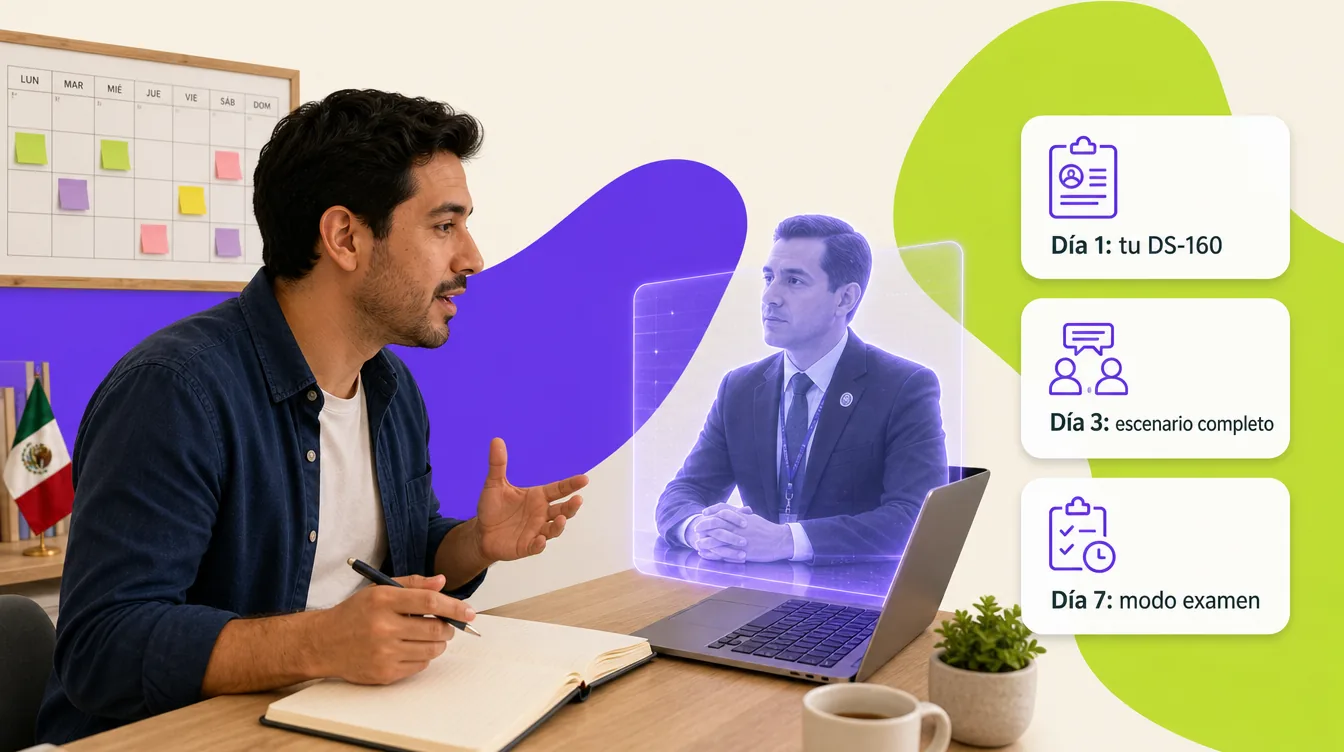
With an AI character that plays the consular officer: it asks you by voice, reacts to your answers, follows up when something is vague and at the end steps out of character to tell you what sounded contradictory. You do it from the browser, at any time and as many times as needed, without depending on a friend's schedule.
Geedle's AI consul gives you two free minutes of that conversation. The full US visa interview role play adds several scenarios (tourism, business, renewal, family travel), practice with your own DS-160 details and a report per attempt showing what improved compared with the previous one. It is the same technology behind the AI role play used by sales and audit teams: a character with personality, information it only reveals if you ask well, and the same rubric for every attempt.
What the AI does not do: book your appointment, fill in your DS-160 or predict the decision. Geedle is not an immigration firm or a law office, does not represent the United States government and does not guarantee the approval of any visa: the AI consul is a rehearsal so you arrive at your interview with practice.
How many times and when should you practice before the appointment?
At least three mock interviews on different days, the last one or two days before the interview, and none on the morning itself. The first round detects problems; the second corrects them; the third confirms you answer just as clearly with a different order of questions. Over-practicing on the same day produces recited answers.
- One week before: first full mock interview, note the weak answers.
- Three or four days before: second mock interview focused on the uncomfortable questions.
- One or two days before: a short third one, to confirm pace and calm.
- Appointment day: review your DS-160 and rest; do not rehearse in line.
Before the last mock interview read what not to say in the US visa interview to remove the phrases that do the most damage.
Ready for your first mock interview?
Start today with a short round and find out which question makes your answer run long. Practice for two minutes free with the AI consul: it asks the questions you will hear at the window, reacts to what you say and how you say it, and at the end points out which answer sounded vague or contradictory. For a full path, with your own DS-160 details and several attempts with a report, see the US visa interview role play from Geedle RolePlay.
Geedle is not an immigration firm or a law office, does not represent the United States government and does not guarantee the approval of any visa: the AI consul is a rehearsal so you arrive at your interview with practice. The decision always belongs to the consular officer; official information is at travel.state.gov and the US Embassy in Mexico.