Training to handle difficult customers: from the manual to the simulator
Training to handle difficult customers works when the employee practices the conversation, not just when they study it. The manual says what to do; the simulator checks whether they can do it with a customer who interrupts, makes demands and raises their voice. Here you will see how to build the program for contact centers and front desks in Mexico: customer types, difficulty levels from upset to aggressive, a four-criterion rubric and the evidence the supervisor receives.
In this article
- What is difficult customer training?
- What types of difficult customers are there?
- Why do the manual and the traditional course fall short?
- How do you move from the manual to the simulator?
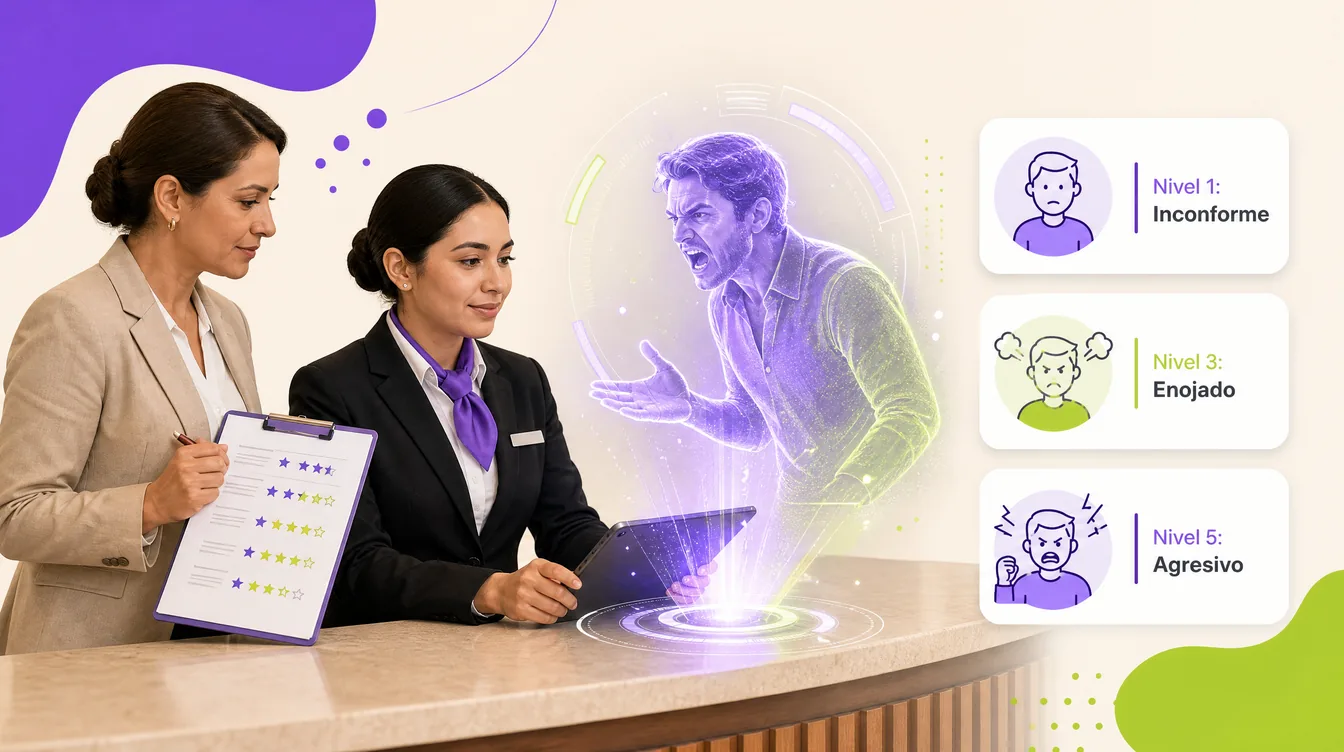
- Which difficulty levels should you train?
- What rubric do you use to evaluate service to a difficult customer?
- What changes between a contact center and a front desk?
- What does the supervisor or HR receive?
- Want to take your team from the manual to the simulator?
What is difficult customer training?
It is a program that prepares service staff to handle tense conversations: complaints, claims, demands outside policy and upset customers. It combines techniques (active listening, empathy, managing emotion, problem solving) with repeated practice, until the employee can apply them calmly in front of a real customer.
A word about the term. “Difficult customer” doesn't describe a person but a situation: someone with an unresolved problem, an unmet expectation or little patience that day. The training is not about “beating” the customer; it is about resolving the situation without losing them and without the employee ending up worn down.
What types of difficult customers are there?
The most frequent are six: the upset, the demanding, the distrustful, the indecisive, the rushed and the aggressive. Each one calls for different handling. Treating them all with the same script is the usual mistake: what reassures an angry customer exasperates a rushed one, and what guides an indecisive one irritates a demanding one.
- Upset or angry: complains about a failure. Needs to be heard before any solution.
- Demanding: knows their rights and wants precision. Needs exact data and deadlines that are kept.
- Distrustful: has been let down before. Needs small, verifiable commitments.
- Indecisive: asks a lot and doesn't decide. Needs you to narrow the options.
- Rushed: has no time. Needs short answers and a clear next step.
- Aggressive: insults or threatens. Needs a respectful limit and, if it continues, escalation of the case.
Why do the manual and the traditional course fall short?
Because they teach you to recognize the right answer, not to give it under pressure. An employee can pass the manual's test and still freeze, argue or sound scripted when a customer shouts at them. The gap between knowing and doing only closes by practicing with someone who reacts, and that almost never fits into a one-day course.
The result is familiar: real practice happens with real customers. A new agent's first difficult complaints are also their training, with the cost that has for the customer experience and for the morale of the person taking the call.
Role-play between colleagues helps, but it has limits: the person playing the customer struggles to get angry convincingly, the feedback depends on who is watching and coordinating shifts pulls two or three people out of operations. That is why it usually happens once, during onboarding, and is never repeated.
How do you move from the manual to the simulator?
In stages, and without throwing away the manual. First you learn the procedure; then the service techniques; after that you practice with guided decisions, rehearse the conversation by voice and, finally, the employee is shadowed on the floor. Each stage leaves a different kind of evidence, and only the last ones prove the skill exists.
| Stage | What is learned | How it is practiced | Evidence |
|---|---|---|---|
| 1. Manual | Policies, procedures and how far each role can go to resolve | Reading and a knowledge test | Test score |
| 2. Course | Techniques: active listening, empathy, complaint handling | Examples and group exercises | Attendance and exercises |
| 3. Guided decisions | Choosing the best response at each moment | Simulation with answer options | Path chosen and outcome |
| 4. Voice simulator | Saying it in your own words and controlling your tone | Conversation with a character that reacts | Report with a rubric per attempt |
| 5. Floor | Applying it with real customers | Supervisor shadowing | Monitoring and service indicators |
For stage two there is the customer service course and the conflict resolution course. For stage three, the branching customer service role-play, where you choose between answer options in front of an upset customer at the counter. Stage four is the territory of Geedle RolePlay.
Which difficulty levels should you train?
Five, from lower to higher tension: dissatisfied, upset, angry and interrupting, very angry with demands, and aggressive. Moving up a level only when the previous one goes well avoids two problems: frustrating new hires with an impossible case and boring experienced staff with one that is too easy.
| Level | How the customer behaves | What the employee must achieve |
|---|---|---|
| 1. Dissatisfied | Complains politely and accepts explanations | Listen, acknowledge and resolve without detours |
| 2. Upset | Curt tone, repeats the complaint | Acknowledge the emotion before proposing |
| 3. Angry | Interrupts and rejects the first solution | Keep control and offer alternatives |
| 4. Very angry | Demands a supervisor or threatens to cancel | Take ownership, negotiate within policy and know when to escalate |
| 5. Aggressive | Raises their voice, insults or threatens | Set a respectful limit and apply the escalation protocol |
In the simulator, each scenario has a difficulty from one to five and a personality (hostile, skeptical, rushed, indecisive, kind but firm). The difficulty also adapts: if the employee improves, the character demands more. An emotional thermometer shows during the conversation whether the customer is calming down or getting more worked up, and each company defines its forbidden phrases, such as “that's not my department” or “it's company policy.”
What rubric do you use to evaluate service to a difficult customer?
Four criteria: empathy, control, solution and close. Together they cover the whole call, from the first complaint to the goodbye. Describe each one with observable behaviors so that two different supervisors score the same conversation the same way and the employee knows exactly what to repeat.
- Empathy: listened without interrupting and acknowledged the emotion in their own words, not with a scripted line.
- Control: kept a calm tone of voice, steered the conversation and did not argue or make excuses.
- Solution: asked the necessary questions and proposed something concrete, within policy and with a deadline.
- Close: confirmed the agreement, summarized the next steps and said goodbye cordially.
Use the same rubric in the simulator, in call monitoring and in the supervisor's feedback; when all three speak the same language, the employee stops getting contradictory messages. The phrases that support each criterion are in how to calm an angry customer on the phone.
What changes between a contact center and a front desk?
The channel. In a contact center you only have your voice, a system to look things up in and a call time to watch. At a front desk there is eye contact, body language and a line of customers watching. The techniques are the same; the practice should resemble the place where the employee actually works.
- Contact center: rehearse in phone mode, with no visual support, with announced holds and transfers with context. Details in role-play for contact centers.
- Counter, reception or branch: rehearse standing, with the customer in front of you, minding posture and volume because others are listening.
- Messaging: on WhatsApp or chat, practice short messages without cold templates.
Geedle RolePlay already includes templates for both settings: “Customer upset about a late delivery,” “Technical service: recurring fault,” “Upset customer at reception” and the express practice “First response to a complaint.” The overview is in customer service role-play.
What does the supervisor or HR receive?
Evidence per person and per team. Each practice generates a report with the score for each criterion, strengths, areas to improve with “how to say it better” suggestions, key moments with their minute, a transcript and a comparison with the previous attempt. You no longer need to listen to every call to know who needs support.
The supervisor assigns scenarios with a deadline, attempts and a minimum score; exam mode, without a coach, is used to clear a new agent before they take live customers. The heat map shows which competency the team is failing on, and the reports can be exported. To close the loop, cross that information with your customer service KPIs and with the protocol for handling complaints step by step.
Want to take your team from the manual to the simulator?
The public demo is a sales one, but it is enough to feel how a character reacts to your tone; the upset and aggressive customer scenarios are what we review in the demo with your team. In the meantime, try the free 2-minute voice demo: you face a buyer with objections and feel how an AI character reacts to what you say and how you say it. To see it with your team, request a demo of Geedle RolePlay. And if the scenario your team needs is not in the catalog, we build it with you: with your procedures, your product and your real objections.