


More scenarios for service and sales
Combine the role-play with the virtual onboarding tour for new branch hires and with gamified sales scenarios.

Platforms
Course production
Online course production
From content to SCORM, in your city
Instructional design for courses
Objectives, script and storyboard
Course content design
Writing, scripts and graphic design
Gamified courses
End-to-end SCORM production
Interactive videos
Decisions and assessment in video
Learning objects
Interactive micro-content
Moodle Plugins
Artificial intelligence
ISO 9001 — Quality
ISO 14001 — Environmental
ISO 45001 — Safety
ISO services
Formats
Learn
A 360° customer service role-play that runs in the browser: you are at the counter, a customer arrives for the third time with the same complaint and you have five moments to greet, listen, own the mistake, solve within your authorization and close. Every answer moves the satisfaction meter and gets explained. This is how service, sales and branch teams train without risking a real customer.
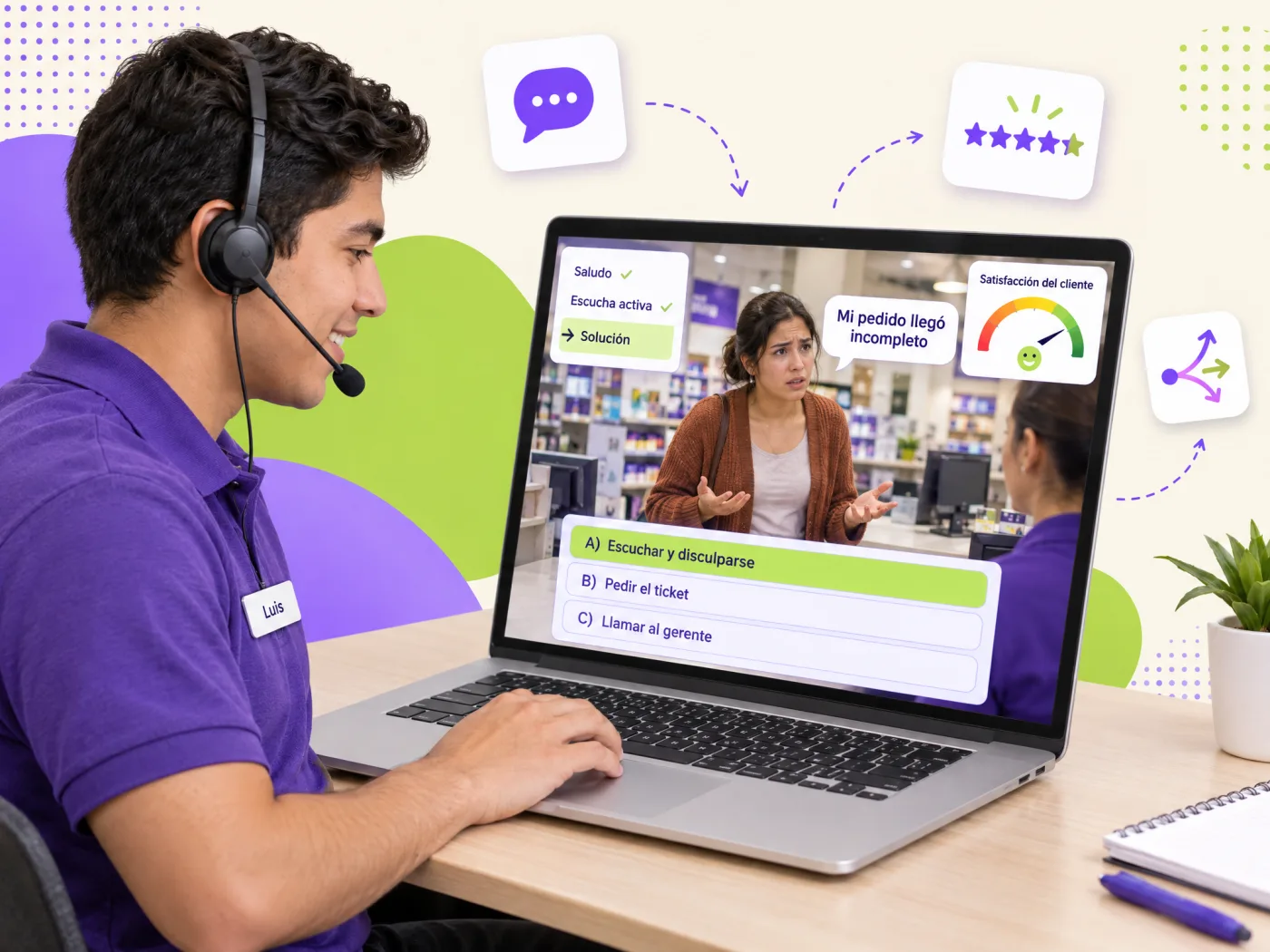
One 360° counter scene, five decisions with an avatar customer, a real-time satisfaction meter and feedback on every answer.
It is a branching conversation in which a person practices handling a difficult customer: each moment offers three possible answers, each answer raises or lowers a satisfaction meter and gets an immediate explanation, and the conversation continues even if the answer was not the best, because that is how it happens in real life. In our 360° version the scene is a photographed branch counter with its system, queue display and complaints box, and the customer has a face of his own through an avatar. The simulator teaches what a service manual cannot: what it feels like to say the wrong sentence and watch satisfaction drop, and which sentence wins it back.
The structure of a well-handled complaint, from arrival to closing.
Greeting by name, a specific apology for what they went through and a concrete commitment to take ownership. No minimizing or redirecting in the first sentence.
Let them talk without interrupting, take notes and paraphrase to confirm. The customer stops repeating the story when they feel understood.
Check the history and admit the company's mistake as "we", without blaming coworkers or doubting the customer.
Propose a solution within authorization and policy, with a real timeline, evidence (ticket) and proactive follow-up.
Thank them, restate the commitment and open the door to another need. The last impression is the one the customer remembers.
Service system, queue display and complaints box: what to check before the customer arrives.
Because service is learned by practicing conversations, and practicing on real customers costs customers. In-person role-play between coworkers works, but it depends on a facilitator, a group and a schedule; the simulator lets each person practice alone, as often as they want, with a customer who reacts the same way every time and feedback written by your best supervisor. It also measures: which answers each employee picks, at which moment they lose the customer (greeting, listening, solving or closing) and how their average satisfaction evolves with practice. It is the way to standardize service across many branches or a large contact center.
Complaints about charges, returns and warranties, delivery delays, customers asking for the manager, sales objections, collections, phone and chat support, patients and families in healthcare, and risky situations such as an aggressive customer. Each conversation is written with your supervisors from the most frequent real cases and graded against your own service standard.
We photograph your branch, counter, sales floor or contact center in 360°; write the conversations from your real cases and service script; create the characters (customers and, if you want, a coach with your identity); and deliver each conversation as a SCORM or xAPI package for your LMS, with the satisfaction meter as the grade. We can add voice to the customer and longer branches depending on budget.
Data for the supervisor, the service program and your LMS.
The meter at the end of the conversation, with the history of ups and downs.
Which option they chose when greeting, listening, owning, solving and closing.
Where in the conversation they lose the most satisfaction: that is where training goes.
Promises outside authorization or unnecessary redirects, counted and explained.
How many times they repeated the conversation and how their final satisfaction changed.
Every decision as an "actor-verb-object" statement for your LMS's LRS.
Quote the conversations your team needs to practice: three scope options with a closed price.
Role-play between coworkers is still valuable; the simulator makes it scalable and measurable.
| In-person role-play | Geedle simulator | |
|---|---|---|
| Who practices | A group with a facilitator, on a date | Each person, alone, whenever they want |
| The customer | A coworker improvising | A character who reacts the same way every time |
| Feedback | From the facilitator, from memory | Written by your best supervisor, on every answer |
| Measurement | Subjective observation | Satisfaction, answer per moment and attempts (SCORM/xAPI) |
| Branches | Depends on each region's facilitator | The same standard everywhere |
Five phases with a deliverable you approve in each one.
360° photos and video of the area, the current procedure and an interview with the expert.
Deliverable: technical scriptTarget behavior, critical decisions, frequent mistakes and the feedback for each one.
Deliverable: storyboard and decision treePanoramas with hotspots, or the machine modeled when its movement must be simulated.
Deliverable: navigable scenarioSteps, interlocks, checklist, score and the xAPI events that will reach your LMS.
Deliverable: working simulatorSCORM or xAPI tested on your platform and a pilot with real staff before launch.
Deliverable: published package and reportCombine the role-play with the virtual onboarding tour for new branch hires and with gamified sales scenarios.
Publish the simulator inside your gamified corporate university and see our corporate training in customer service.
See the full catalog at training simulators and 360° virtual tours.
Every scenario runs in the browser and is delivered as SCORM or xAPI.
Tell us how many people serve customers, which cases repeat and which LMS you use. We reply the same day.