How to give feedback to an underperforming employee (and rehearse it first)
To know how to give feedback to an underperforming employee, hold on to this: in private, soon, with concrete facts, listening to their point of view and closing with clear next steps. The hard part is not understanding it, but saying it well when the person makes excuses, goes quiet or gets upset. That is why here you will find the steps, the SBI model, phrases to open the conversation and a way to rehearse it before having it for real.
In this article
- How do you give feedback to an underperforming employee?
- What should you prepare before the conversation?
- What is the SBI model and how do you use it?
- How do you open the conversation without it sounding like a reprimand?
- What do you do if the employee gets defensive?
- How do you close the conversation and follow up?
- What common mistakes should you avoid?
- Why should you rehearse feedback before giving it?
- Want your leaders to rehearse their difficult conversations?
How do you give feedback to an underperforming employee?
Describe what you observed, explain its impact, listen to their side and agree on what will change and by when. Do it in private and close to the event, not months later. Feedback is information for improving, not a judgment of the person; if the employee leaves without knowing what to do differently, the conversation didn't serve its purpose.
- Prepare concrete examples: two or three recent facts, with dates.
- Choose the right moment: a private space, no hurry and no audience.
- State the purpose at the start: what you want to talk about and why.
- Describe the behavior and its impact, with no adjectives and no assumptions about their intentions.
- Ask and listen: there may be causes you don't know about.
- Agree on next steps with dates and a follow-up review.
What should you prepare before the conversation?
Prepare four things: the facts, the expectation, the impact and the support you can offer. With those written down you avoid the two most common stumbles of a difficult conversation: softening the message so much that it isn't understood, or hardening it so much that the person stops listening and only defends themselves.
- Facts: what happened, when and how you know. “Three reports delivered late in October,” not “you are always late with everything.”
- Expectation: what the role requires. If it was never stated clearly, admit it.
- Impact: who it affects and how: the team, the customer, the operation.
- Support: what you can do: training, clearer priorities, coaching.
- Your goal: one sentence that says what must be agreed by the end.
What is the SBI model and how do you use it?
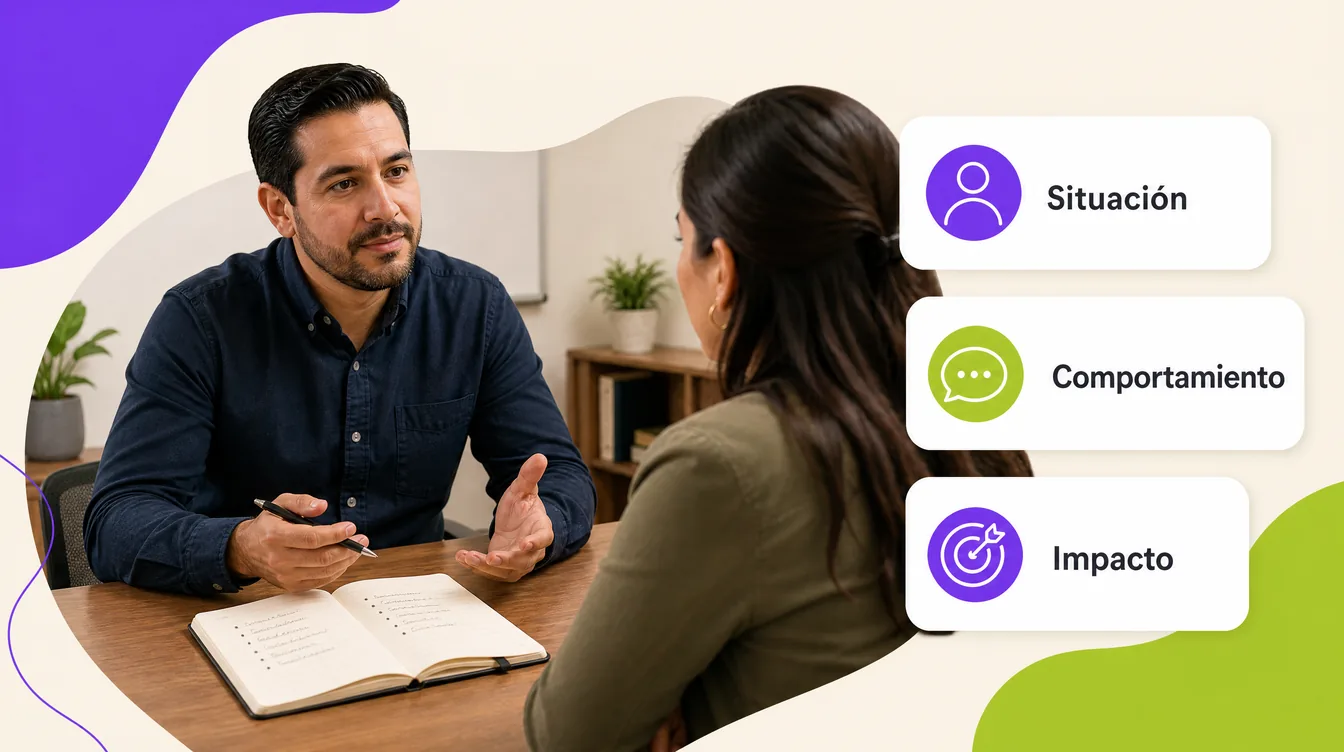
SBI stands for situation, behavior and impact, a widely used framework for giving feedback without slipping into judgments. First you place when and where it happened, then you describe what the person did and finally you explain the consequence. It forces you to talk about observable facts, which is exactly what lowers defensiveness.
| Element | What it describes | Example |
|---|---|---|
| Situation | When and where it happened | “In Monday's meeting with the client…” |
| Behavior | What the person did or said, without interpreting it | “…you presented the report without the September figures…” |
| Impact | The consequence for the team, the customer or the result | “…and we had to push the decision to next week.” |
| Question | Opens up the employee's point of view | “What happened from your side?” |
Compare two versions of the same message. Without the model: “You are very careless with your reports.” With the model: “In Monday's meeting you presented the report without the September figures and we had to push the decision. What happened?” The first labels the person; the second describes a fact that can be corrected.
How do you open the conversation without it sounding like a reprimand?
Get to the point respectfully in the first sentence. Say what you want to talk about, why it matters and that you also want to listen. Long detours and filler compliments before the “but” create anxiety and blur the message; a direct, composed opening conveys that the topic is serious and the intention is to help.
- “I want to talk with you about this month's deliveries. I'd like to understand what is going on and see how we fix it.”
- “I asked for this time because I noticed something in your work that I want to raise with you directly, and I also want to hear your side.”
- “There is an issue that is affecting us and I'd rather discuss it with you now, before it grows.”
Mind your tone of voice: measured, no sarcasm, no hurry. The same words said with irritation turn into a scolding. And avoid opening with trap questions like “how do you think you're doing?” when you already have a conclusion: the person senses it and enters the conversation on the defensive.
What do you do if the employee gets defensive?
Slow down, listen and return to the facts. Defensiveness is a normal reaction to an uncomfortable message, not a sign of disrespect. If you respond by raising your tone, the conversation becomes a fight; if you acknowledge what the person feels and go back to the concrete example, you get back on track.
- They make excuses: “I understand there was extra workload. Even so, the report didn't arrive; what do you need so it doesn't happen again?”
- They blame others: “I'll look into it with that department. Right now I want to focus on your part.”
- They go quiet: ask an open question and hold the silence. “How do you see what I'm describing?”
- They get upset or cry: offer a pause. “Let's take a few minutes; the topic is still important and we'll come back to it.”
- They agree with everything: ask them to summarize. “Just to be sure, what are you taking away from this conversation?”
In every case, active listening helps: paraphrase what you heard before responding. And if the conversation spins out of control, it is fine to stop it and pick it up the next day; what you should not do is end it without agreements.
How do you close the conversation and follow up?
Close with agreements both parties can repeat: what will change, how it will show, what support you will give and when it will be reviewed. Without a follow-up date, the feedback remains an awkward chat. Write down the agreements, share them in writing and keep your part before demanding theirs.
- Clear expectations: “Reports are delivered on Fridays before noon, complete.”
- Committed support: “I will confirm priorities with you every Monday.”
- Review: “We'll meet in two weeks to see how it's going.”
- Recognition: when there is progress, say so soon and with the same level of detail.
If the underperformance has to do with the team's skills in general, a 360-degree feedback helps you see patterns, and the leadership course works on these conversations with middle managers.
What common mistakes should you avoid?
The most damaging are waiting for the annual review, generalizing with “always” and “never,” labeling the person instead of their behavior, doing all the talking, comparing them with colleagues and doing it in public or by message. They all have the same effect: the employee is left with the anger or the embarrassment, not with the information to improve.
Add a less obvious one: improvising. Many leaders arrive at this conversation without ever having said it out loud, and the first version is rarely the best. With delicate messages, effective communication shows in the preparation.
Why should you rehearse feedback before giving it?
Because it is a one-shot conversation with consequences for the working relationship. Rehearsing lets you hear how your message sounds, adjust the opening and test what you do when the person reacts badly. You arrive calmer, and that calm is part of the message your employee receives.
You can rehearse with a trusted colleague or with a simulator. Geedle RolePlay has the scenario “Feedback on low performance”: you talk by voice with a character playing the employee, who shuts down if you interrupt and opens up when you listen. When you finish you receive a report with a rubric, key moments with their minute and “how to say it better” suggestions. There is also an express practice, “Listen before you answer,” to warm up. The details are in role-play for leadership and HR; it is the same practice logic we apply to training to handle difficult customers.
A note for HR: Mexico's NOM-035 standard includes leadership and workplace relationships among the psychosocial risk factors a workplace must identify and prevent. Training leaders to hold clear, respectful conversations goes in that direction, although no simulator replaces the standard's obligations. We develop this in active listening and NOM-035.
Want your leaders to rehearse their difficult conversations?
The public demo is a sales one, but it lets you feel how a character reacts to your tone; the feedback scenario is what we review in the demo with your HR team. In the meantime, try the free 2-minute voice demo: you face a buyer with objections and feel how an AI character reacts to what you say and how you say it. To see it with your team, request a demo of Geedle RolePlay. And if the scenario your team needs is not in the catalog, we build it with you: with your procedures, your product and your real objections.