Role play for public speaking: how to present results to management without a shaky voice
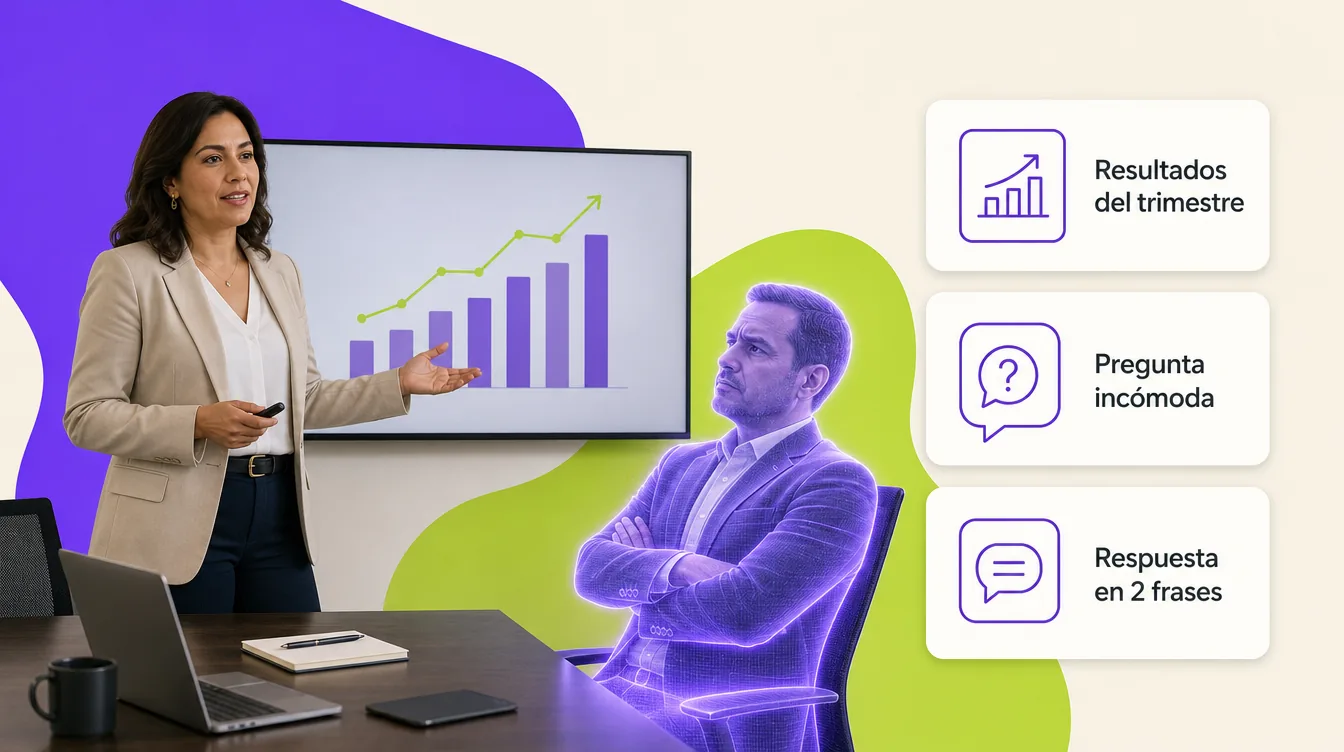
An AI role play for public speaking puts you in front of a virtual committee that listens to your presentation, interrupts you with uncomfortable questions and scores your clarity, structure and answers under pressure. It is the way to rehearse the management meeting before it is the real meeting. Here is the structure that works in ten minutes, the objections directors raise most and a practice routine.
In this article
- Why is presenting to management different from public speaking?
- How do you structure a results presentation in ten minutes?
- Which uncomfortable questions does a director ask?
- How do you practice with an AI committee?
- What do you do about nerves when speaking in public?
- Who is this role play for?
- Do you have a management meeting coming up?
Why is presenting to management different from public speaking?
Because the audience interrupts. At a conference you speak and get applause; in front of a director or a committee you get cut off on slide three with "and how much does that cost?". Presenting to management is a conversation with asymmetric power: you have little time, they assess the decision you propose, not your oratory, and one poorly answered question weighs more than ten well-made slides.
That is why the training is not memorizing the script but practicing the interruption. An AI character playing the director gives you that as many times as needed; how it compares with rehearsing in front of a mirror or a colleague is explained in AI role play versus traditional role play.
How do you structure a results presentation in ten minutes?
Start with the conclusion and the decision you are asking for, follow with the three pieces of evidence that support it, anticipate the main objection and close with next steps and dates. That structure, which some call the "inverted pyramid", respects how directors listen: first what, then why, finally how. If they interrupt you in minute two, you already said what matters.
- Minute 1: conclusion and concrete request ("I need approval for X to achieve Y").
- Minutes 2-6: three pieces of evidence, one slide each, with the figure and what it means.
- Minute 7: the objection you know is coming, answered before they raise it.
- Minutes 8-9: risks and how you control them.
- Minute 10: next steps, owners and dates. You ask for the decision.
Which uncomfortable questions does a director ask?
A director's questions almost always aim at four things: money, risk, alternatives and accountability. If you prepare a thirty-second answer for each, the rest of the meeting is easier. What a committee punishes is not not knowing, but improvising a long answer to hide it.
| Director's question | What they are after | Answer that works |
|---|---|---|
| "And how much does that cost us?" | Whether you command the total figure, not only the initial investment. | Total figure, over what period and what it returns. One sentence. |
| "What happens if we don't do it?" | Measuring the cost of not acting. | The concrete risk and when it materializes. |
| "Why not the cheaper option?" | Checking that you compared alternatives. | Two alternatives you assessed and why you ruled them out. |
| "Who is accountable?" | Seeing whether you commit to the result. | Your name, one indicator and a review date. |
| "I have no time, summarize it" | Testing whether you know what is essential. | Conclusion and request in twenty seconds. |
How do you practice with an AI committee?
You pick the scenario, present by voice as you would in the room and the character interrupts with the questions in the table, changes mood if you ramble and pushes if you dodge the question. In practice mode a coach suggests on screen how to rephrase; in exam mode it switches off and the session counts toward the score. At the end you receive a report with a rubric.
- Typical criteria: conclusion first, clarity of the request, handling of the interruption, answer to the cost objection, closing with next steps.
- Key moments: the report marks the exact minute where you lost the thread or answered in circles.
- Repetition: you present again with adjusted difficulty and compare with the previous attempt.
The difficult-conversations-with-management scenario lives in leadership and HR role play; for the foundation of structure and plain language, the effective communication course is the natural complement.
What do you do about nerves when speaking in public?
Nerves go down with repeated exposure, not with advice. Every time you present to the virtual committee and survive the interruption, the body reacts less the next time. There are also three habits that help right away: breathing before answering (two seconds of silence read as confidence), answering the question and stopping, and having the first sentence memorized so you start without hesitating.
- Practice the opening ten times: it is where nerves show the most.
- Rehearse the interruption, not just the full speech.
- Record or review the transcript: filler words are easier to see than to feel.
- Use the simulator's optional camera to measure eye contact and posture without uploading video.
Who is this role play for?
For managers who present monthly results, project leads who ask for budget, quality managers who explain findings to management and anyone who has to defend a proposal in a meeting. Also for those preparing for an AI job interview role play, where the logic of answering under pressure is the same, or for an oral exam or a certification.
Do you have a management meeting coming up?
Rehearse the presentation and, above all, the interruption, with a virtual committee that does not hold back the uncomfortable questions. You can try the free two-minute voice demo: you talk to an AI character that reacts to what you say and how you say it, and scores you at the end. To bring it to your team or your institution, request a demo of Geedle RolePlay. And if the conversation you need to rehearse is not in the catalog, we build it with you: with your questions, your criteria and your real cases.