Role play for oral exams and certifications: how to prepare with an AI assessor
An AI role play for oral exams reproduces the situation that causes the most nerves in a certification: someone asks you questions live and assesses what you answer and how you demonstrate it. It works for the CONOCER competency assessment, for the oral English exam and for any interview where you are graded. Here is what is assessed in each case, how to practice with a rubric and a two-week routine.
In this article
- What do an oral exam and a certification have in common?
- How do you prepare for the CONOCER competency assessment?
- How do you practice the oral English exam?
- Which other "oral exams" are prepared the same way?
- How do you use the rubric to improve?
- How do you organize two weeks of preparation?
- Do you have an oral exam or a certification coming up?
What do an oral exam and a certification have in common?
In both cases an assessor observes your performance live against criteria defined in advance: a rubric. Knowing is not enough; you have to show it with words, in order and with evidence. And in both cases traditional preparation fails the same way: you study in silence and the first time you say it out loud is in front of the assessor. AI role play moves that first time to the day before.
The mechanics are the same as in any role play: an AI character plays the assessor, asks you, requests more when an answer falls short and scores with the rubric at the end.
How do you prepare for the CONOCER competency assessment?
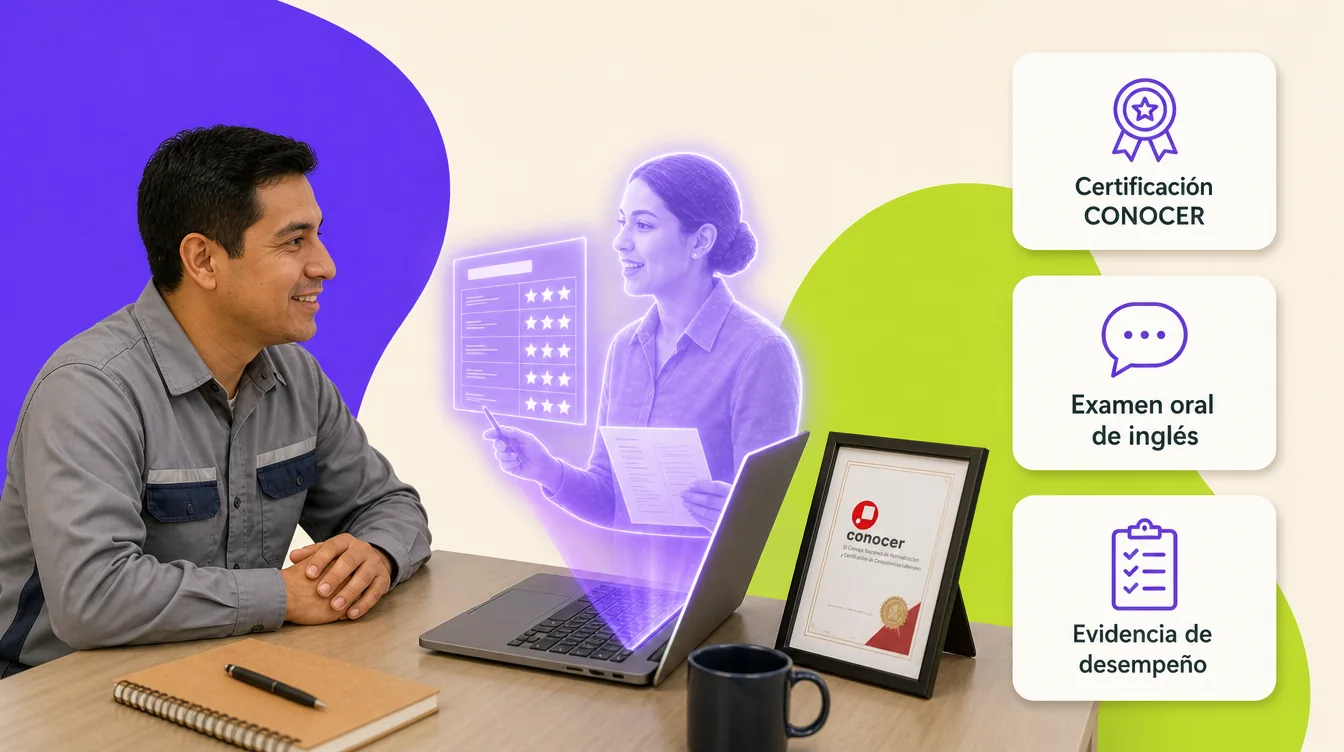
CONOCER certification (Mexico's national competency standards system) assesses that a person performs a job function according to a published competency standard. The assessor gathers evidence of performance (what you do), product (what you deliver), knowledge (what you explain) and attitude. The knowledge part and the explanation of performance are oral questions, and that is where role play helps.
- Read the standard: every criterion says exactly what you must demonstrate or explain; the role play rubric is built from those criteria.
- Practice the explanation: describe out loud how you perform the function, step by step, with the standard's vocabulary.
- Prepare the knowledge questions: regulations, procedures and why it is done that way.
- Rehearse the attitude: order, confidence and straight answers count in the assessment.
How the full process works (standards, assessment centers and the certificate) is explained in CONOCER certification. Geedle supports the preparation; the certificate is issued by the corresponding body.
How do you practice the oral English exam?
Oral English exams aligned to the CEFR assess fluency, vocabulary, grammar in use, pronunciation and interaction: whether you understand and respond to what you are asked. The way to move up a level is to speak more minutes a week with someone who corrects you, and an AI character can be that someone at any hour.
| CEFR level | What the oral exam asks for | What to practice in the role play |
|---|---|---|
| A2 | Introduce yourself, describe your job and your routine. | A one-minute introduction and basic questions about your role. |
| B1 | Narrate an experience and give a simple opinion. | Tell about a problem at work and how you solved it. |
| B2 | Argue, compare options and handle the unexpected. | Defend a proposal and answer an objection. |
| C1 | Speak precisely about complex topics and add nuance. | Present results to a committee and negotiate terms. |
You can try two minutes with Geedle's English teacher, who corrects one mistake per turn and estimates your level; the full program is at corporate English.
Which other "oral exams" are prepared the same way?
Any situation in which a person with authority asks you questions and decides based on your answers. The interview with an ISO auditor, defending a project before a committee, the job interview and the results presentation to management work with the same logic. So does the US visa interview: a few minutes of questions with a consular officer who assesses coherence and clarity. Geedle offers prior training with an AI "consul"; it is not immigration advice and does not guarantee the visa.
How do you use the rubric to improve?
The rubric turns "it went badly" into "I failed criterion three". After each session, the report shows the score per criterion, strengths, areas to improve with the exact moment in the transcript and a model answer. You repeat the question of the lowest criterion until it rises, then do a full attempt in exam mode, with no help from the coach.
- First full attempt: baseline per criterion.
- Three short sessions on the two lowest criteria.
- Listen to the model answer and try again.
- Full attempt in exam mode and comparison with the baseline.
How do you organize two weeks of preparation?
Two weeks of 15-to-20-minute sessions are enough for most oral exams if you practice out loud from day one. The first week covers every criterion; the second focuses on the weakest ones and on full mock exams. The day before, no new content: only a short mock exam and rest.
- Week 1: one criterion or topic per session, in practice mode with the coach.
- Week 2: sessions on the low criteria and two full mock exams in exam mode.
- Day before: a ten-minute mock exam and a look at the report, nothing more.
For schools and assessment centers, the scenario is built from the standard or the exam syllabus through custom scenarios, and the teacher or assessor sees each person's progress on the dashboard.
Do you have an oral exam or a certification coming up?
Practice with an AI assessor who asks like the real one and tells you, criterion by criterion, what to improve next. You can try the free two-minute voice demo: you talk to an AI character that reacts to what you say and how you say it, and scores you at the end. To bring it to your team or your institution, request a demo of Geedle RolePlay. And if the conversation you need to rehearse is not in the catalog, we build it with you: with your questions, your criteria and your real cases.