Open Badges 3.0 and verifiable credentials: how micro-credentials work under the hood
Open Badges 3.0 is the standard behind today's verifiable micro-credentials and digital badges. We explain what it is, what changed from Open Badges 2.0, how it builds on W3C Verifiable Credentials, the role of digital signatures, decentralized identifiers (DIDs), IPFS, and blockchain, and what to demand from a platform before issuing.
In this article
- What is Open Badges 3.0?
- What changed from Open Badges 2.0
- The parts of a verifiable credential
- Digital signature and DID
- Metadata: competency, criteria, and evidence
- IPFS: permanent image and metadata
- Blockchain: the immutable anchor
- How an Open Badges 3.0 micro-credential is verified
- What to demand from a micro-credentials platform
- Want to see a micro-credential issued under your brand?
What is Open Badges 3.0?
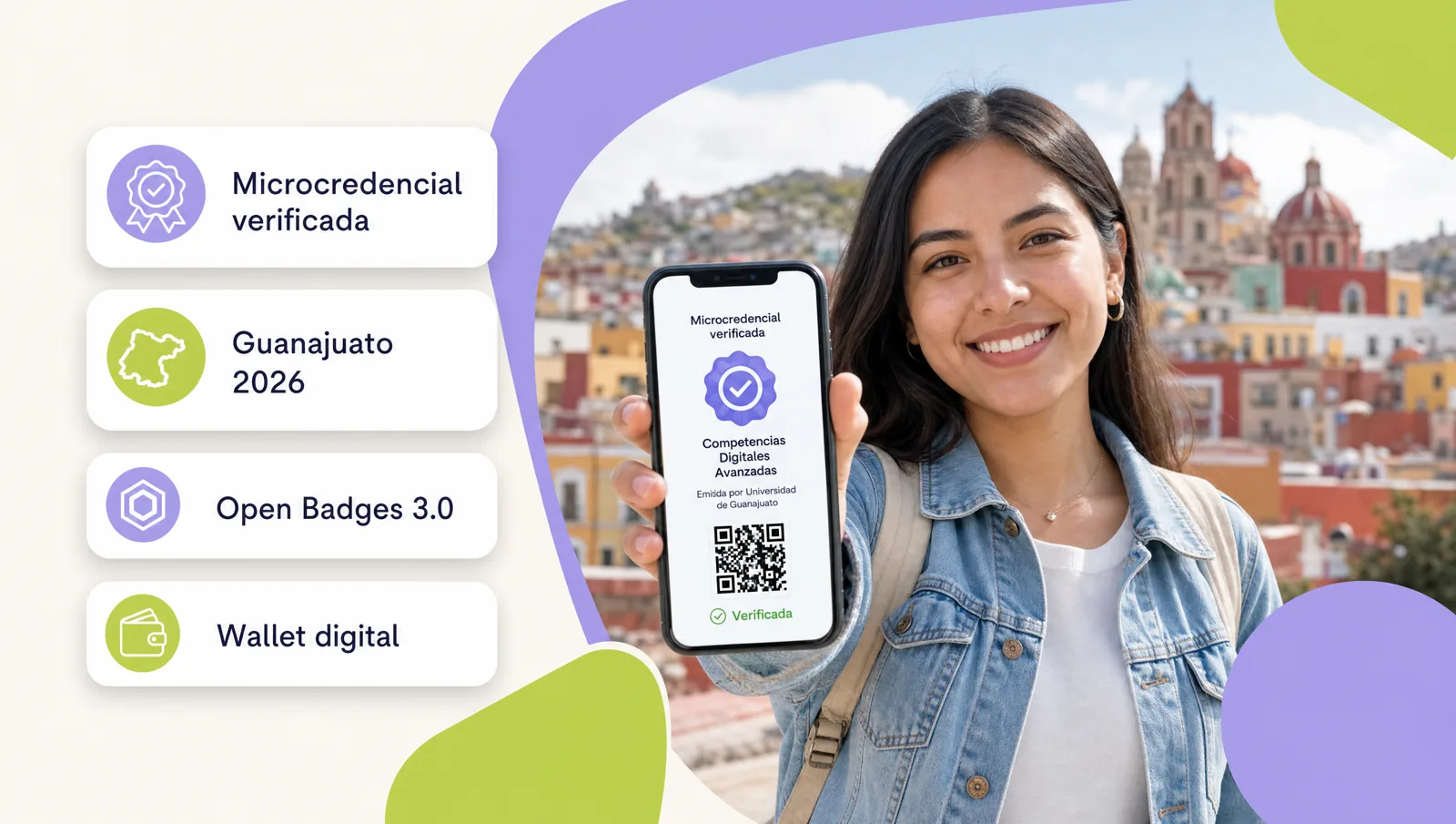
Open Badges is the open standard from 1EdTech (formerly IMS Global) for describing digital badges so that any system can read, display, and verify them without depending on the original issuer. Version 3.0 aligns the standard with the W3C Verifiable Credentials data model: every badge is a verifiable credential cryptographically signed by the issuing organization, and the recipient controls it from a wallet. It is the technical foundation of any modern micro-credentials platform.
What changed from Open Badges 2.0
| Aspect | Open Badges 2.0 | Open Badges 3.0 |
|---|---|---|
| Data model | Its own JSON-LD | W3C Verifiable Credentials 2.0 (JSON-LD) |
| Verification | Query the issuer server (hosted) or JWS signature | Cryptographic signature verifiable without querying the issuer |
| Issuer identity | Profile URL | DID (decentralized identifier) or URL |
| Credential control | Hosted by the issuer | Held by the person in a wallet, shared on their terms |
| Interoperability | Badge platforms | Digital wallets, LinkedIn, HR systems, any W3C verifier |
The practical consequence matters: with 3.0, a micro-credential stays verifiable even if the issuer changes platforms or shuts down, because the proof lives in the signature, not on a server.
The parts of a verifiable credential
Digital signature and DID
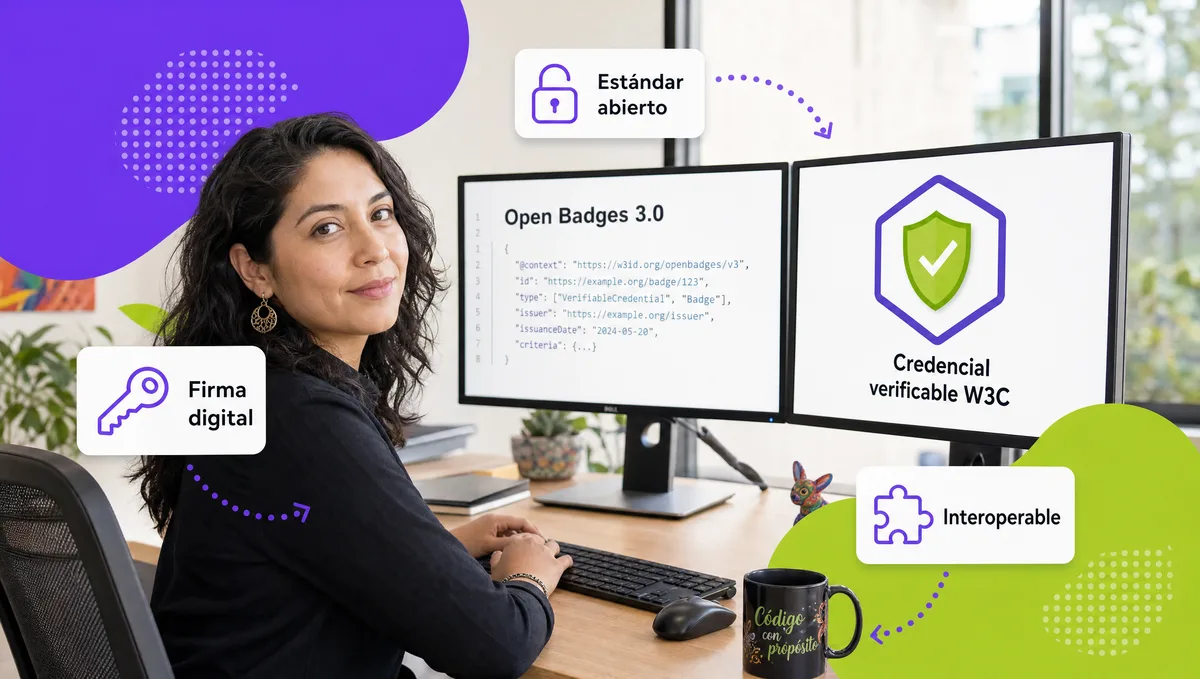
The issuing organization has a DID (Decentralized Identifier) and a private key. Every credential is signed with it (on our platform, with the Ed25519 algorithm). A verifier uses the DID's public key to confirm the credential came from that organization and that not a single byte changed since.
Metadata: competency, criteria, and evidence
The badge's JSON-LD describes which skill it certifies, the criteria used, the supporting evidence, the issue date and, if any, the expiry. That is what turns a pretty image into a credential that means something to an employer or an HR system.
IPFS: permanent image and metadata
If the badge image lives on the issuer's server, it disappears with it. So it is stored on IPFS, a decentralized network, under a content identifier (CID) that changes if a single pixel changes. Our platform pins those files through Pinata.
Blockchain: the immutable anchor
The standard does not require blockchain, but it adds a guarantee the signature alone does not: proof of existence in time. The credential's hash is recorded on Ethereum or Polygon with NFT metadata (ERC-721); anyone can check it on Etherscan or Polygonscan. Ethereum offers wider recognition; Polygon, low fees for bulk issuance. Revocation is recorded without deletion, so the history stays intact.
How an Open Badges 3.0 micro-credential is verified
- The verifier scans the QR or opens the badge's public link.
- The verification page downloads the credential and checks the signature against the issuer DID's public key.
- It compares the hash with the blockchain record and checks the status (valid, expired, revoked).
- It shows the result: issuer, recipient, competency, date, and evidence. No sign-up, no phone call.
What to demand from a micro-credentials platform
- Real compatibility with Open Badges 3.0 and W3C Verifiable Credentials, not only 2.0.
- Per-organization signing with its own DID and public verification without an account.
- Optional anchoring on a public blockchain and IPFS storage.
- Apple and Google wallets with push notifications, and a public recipient profile.
- Bulk CSV issuance and LMS integration (for example, automatic from Moodle with smart rules and alerts).
- Learning paths with prerequisites, reporting, and white label with a custom domain.
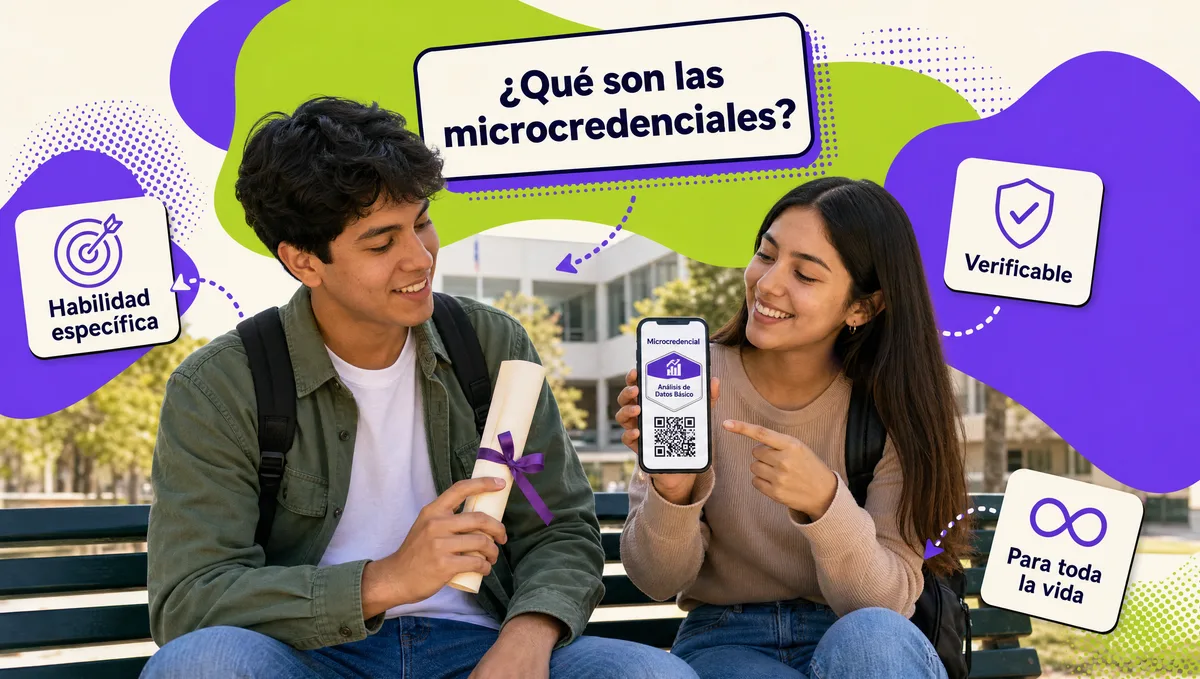
For the context before the technology, start with what micro-credentials are.
Want to see a micro-credential issued under your brand?
The best way to understand Open Badges 3.0 is to watch a real credential being verified in real time. Book a 30-minute demo: message us on WhatsApp, fill out the contact form or open this site's live chat. We show you issuance, QR verification, and the wallet in your colors, no cost and no commitment. The whole platform is described at verifiable micro-credentials platform.