Leadership course for supervisors: what it should include (and what is just theory)
Most plant supervisors got the job for being the best operators, not for knowing how to lead people. A leadership course for supervisors works if it changes what they do on Monday at shift start; if it only changes what they know, it was an expensive lecture. This guide explains what it should include, how many hours it needs and how to tell a hands-on course from a sliofck.
In this article
- What should a leadership course for supervisors include?
- The six topics, one by one
- 1. The supervisor's role: from star operator to line leader
- 2. Clear instructions and shift start
- 3. Situational leadership
- 4. Delegation and follow-up
- 5. Feedback and correcting without humiliating
- 6. Motivation, turnover and the 90-day plan
- How many hours does a leadership course for supervisors need?
- How to tell whether a leadership course is theory only
- Leadership for supervisors, by city
- Which courses come next
- Want a leadership course for your supervisors?
What should a leadership course for supervisors include?
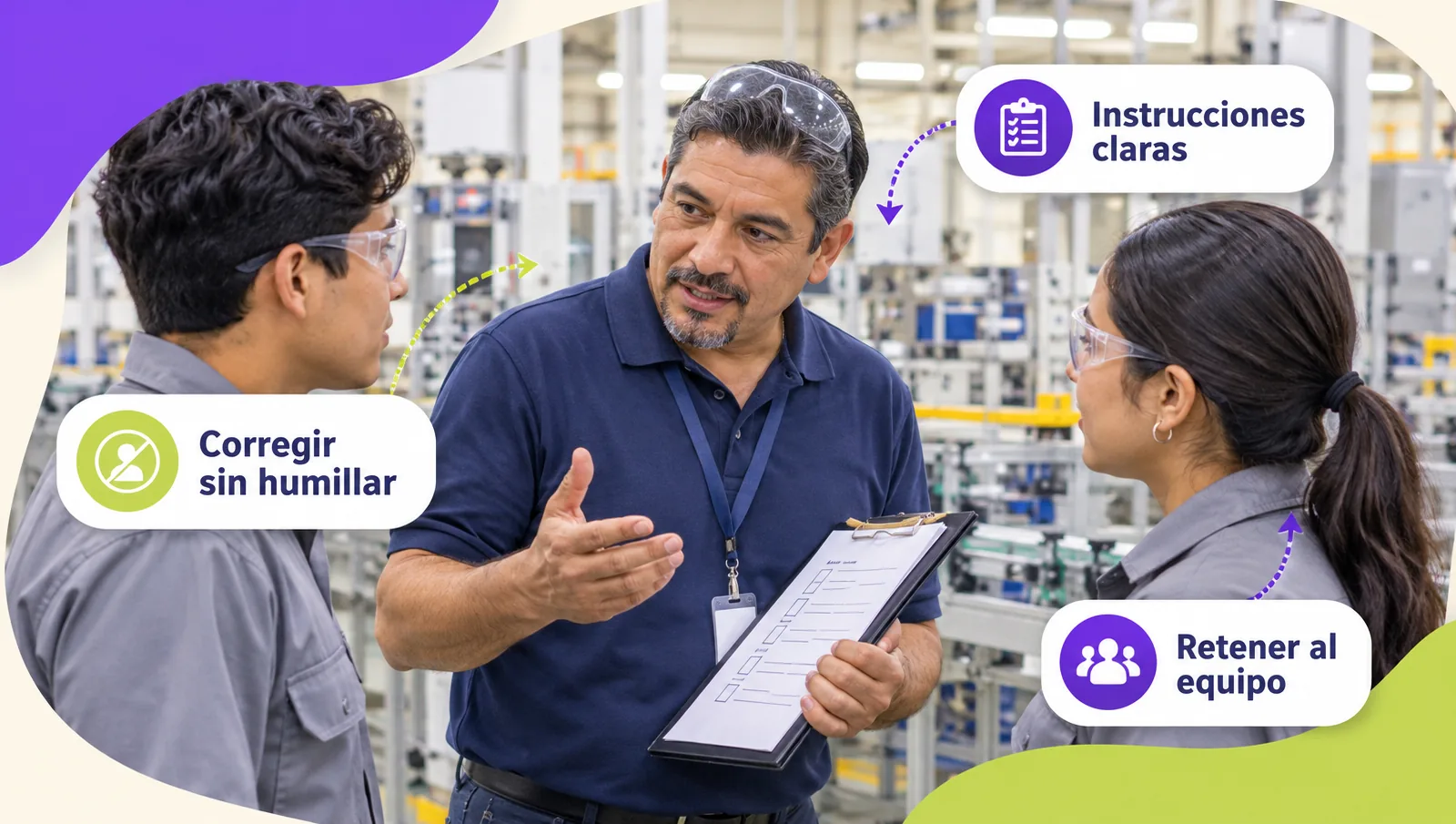
A leadership course for supervisors should include six topics: the supervisor's role (what the company expects and what the team expects), clear instructions and shift start, situational leadership to adjust the style to each operator, delegation with follow-up, feedback and correcting without humiliating, and motivation and retention. It lasts 12 to 16 hours, is practiced with cases from the supervisors' own plant and ends with a 90-day plan and a DC-3 certificate from Mexico's labor authority.
What cannot be missing is practice. A supervisor does not learn to correct an operator by reading the situation-behavior-impact model: they learn by rehearsing it with a real case from their line, getting feedback and repeating it. That is why courses that work combine the classroom, voice role play and an on-the-job application between sessions.
The six topics, one by one
1. The supervisor's role: from star operator to line leader
The first module clarifies something almost nobody told the supervisor when they were promoted: their job is no longer to produce, it is to make sure their people produce. Participants build a role map with three columns (what the company expects, what the team expects, what the supervisor does today) and the same gap almost always appears: 70 percent of the shift fighting fires and 5 percent leading people.
2. Clear instructions and shift start
Most floor errors are not about ability but about instruction: it was half said, said in a hurry or assumed to be understood. The module trains an instruction structure (what, by when, how you will know it is right and what to do if something fails), verification by repetition and a five-minute shift start with a fixed agenda. It is the topic that shows up fastest in the indicators.
3. Situational leadership
You do not lead last week's new operator the way you lead the technician with fifteen years. The situational model gives the supervisor four styles (directing, coaching, supporting, delegating) and a rule for choosing one according to each person's competence and commitment on each task. We explain it with floor and office examples in situational leadership: examples on the plant floor and in the office.
4. Delegation and follow-up
Delegating is not handing out pending tasks. The module works on what to delegate (what develops the person and frees the supervisor), to whom (according to their maturity on that task) and how to follow up with two or three simple shift indicators, without micromanaging or disappearing. Every supervisor leaves with a delegation matrix for their own team.
5. Feedback and correcting without humiliating
It is the module HR asks for most and the one most avoided in practice. Participants train the situation-behavior-impact model, specific recognition and the poor-performance conversation, first in pairs and then out loud with an AI team member that reacts to their tone. The full script is in how to give feedback to an underperforming employee.
6. Motivation, turnover and the 90-day plan
The last module connects leadership with the indicator that hurts most on the floor: turnover. Participants identify each person's real motivators (rarely just the paycheck), the team rituals that sustain commitment and the supervisor's personal 90-day commitment, with dates and evidence.
How many hours does a leadership course for supervisors need?
Between 12 and 16 hours spread over two to four weeks. Under eight hours is enough to raise awareness, not to change behavior; more than 20 consecutive hours at a plant is impossible to schedule without stopping production. The format that works best in manufacturing is 2-to-4-hour sessions per shift, with an on-the-job application between them and mobile microlessons to reinforce.
| Format | Hours | Who it suits | What it leaves |
|---|---|---|---|
| Lecture or talk | 2 to 4 | Raising awareness across the plant | Concepts; no new behavior |
| One-day workshop | 8 | New supervisors, as onboarding | Two or three basic tools |
| Modular course | 12 to 16 | The whole layer of supervisors and shift leads | Six tools, a 90-day plan, a DC-3 and a before-and-after assessment |
| Diploma program | 80 to 120 | Managers with time to study | Conceptual framework and a university diploma |
How to tell whether a leadership course is theory only
Before hiring, ask the provider these questions. If the answer is no to three or more, what you are being sold is a long lecture:
- Are the cases and examples built from situations at our plant, or are they generic?
- Does every supervisor leave with their own tools (delegation matrix, feedback script, 90-day plan) or with a manual?
- Is there observed practice with a rubric, in the room or out loud with AI, or only group discussion?
- Is learning measured before and after, and is the result delivered to HR?
- What happens with questions between sessions? Is there an AI agent or recordings, or does the supervisor wait a week?
- Is the certificate a DC-3 with the data the STPS requires, and does the evidence stay available for an inspection?
- Can it be scheduled by shift without stopping the line?
Leadership for supervisors, by city
The profile changes by region and the course should change with it. In León, footwear and tannery supervisors rose from the floor and never received training; the challenge is giving clear instructions and keeping workers in peak season. In Monterrey, industrial groups ask for measurable results and 360-degree evaluations. In Mexico City, managers lead hybrid teams and feedback happens over video calls. The city pages explain the local approach; the syllabus is the same.
Which courses come next
The leadership course is the first link in the middle-management path. Next usually come the effective communication course, so instructions and feedback land as intended, and the teamwork course, when the problem is no longer the supervisor but coordination between cells or departments. For plants with high turnover, the line supervisor course concentrates safety, quality and leadership in a single program. If the NOM-035 diagnosis flagged leadership and workplace relationships as risk factors, the course goes straight into the action plan.
Want a leadership course for your supervisors?
Tell us how many supervisors, on which shifts and which indicator you want to move. The full program is the leadership course for companies: on-site at your company in Mexico, live virtual or self-paced, with a DC-3 certificate, gamified challenges and Geedle Bot answering questions, delivering summaries and the exact minute of the recording. If you want your people to rehearse the difficult conversation first, try the two-minute voice demo of Geedle RolePlay or request a proposal: we send it with three scope options and a closed price in under 24 business hours.