How to reduce process errors and accidents with training microcapsules at the workstation
Process errors and accidents almost never happen for lack of training; they happen because training is far away: the course was months ago and the instruction is somewhere else. Training microcapsules at the workstation shorten that distance to one scan. This article explains a five-step method to implement them where it hurts most and measure the result with the indicators the plant already has.
In this article
- Why people make mistakes even when trained
- Step 1: find the points where errors concentrate
- Step 2: one microcapsule per critical point, not a course
- Step 3: stick it where the task happens
- Step 4: verify, do not just look up
- Step 5: measure with the indicators you already have
- Mistakes when implementing microcapsules
- How it connects with the rest of training
- Want to bring this to your team?
Why people make mistakes even when trained
An operator gets eight hours of onboarding, passes the assessment and, three weeks later, does the changeover alone for the first time. The procedure has fourteen steps, the supervisor is on another line and the coworker "has always done it this way". The error is not one of knowledge but of access: the correct instruction was forty meters away and the wrong one was one meter away. The same happens with safety: the lockout-tagout rule was explained in a room; the risk is at the machine.
Step 1: find the points where errors concentrate
Do not start by documenting the whole plant. Take the last three months of rejects, rework, stoppages and incidents and group them by workstation. Usually five or six stations account for most of them. Walk those stations with production, quality and safety and ask three things: what goes wrong, at which step and what people consult when in doubt. That list is your QR code map.
Step 2: one microcapsule per critical point, not a course
Each point gets a one-to-three-minute microcapsule: video filmed on the machine itself with the operator who does it best, numbered steps, the most frequent mistake and a check question. It is the one-point lesson format taken to video. If you already have work instructions, they are converted with our AI course creation from manuals and reviewed by your expert; if not, they are written with the operator in an hour.
Step 3: stick it where the task happens
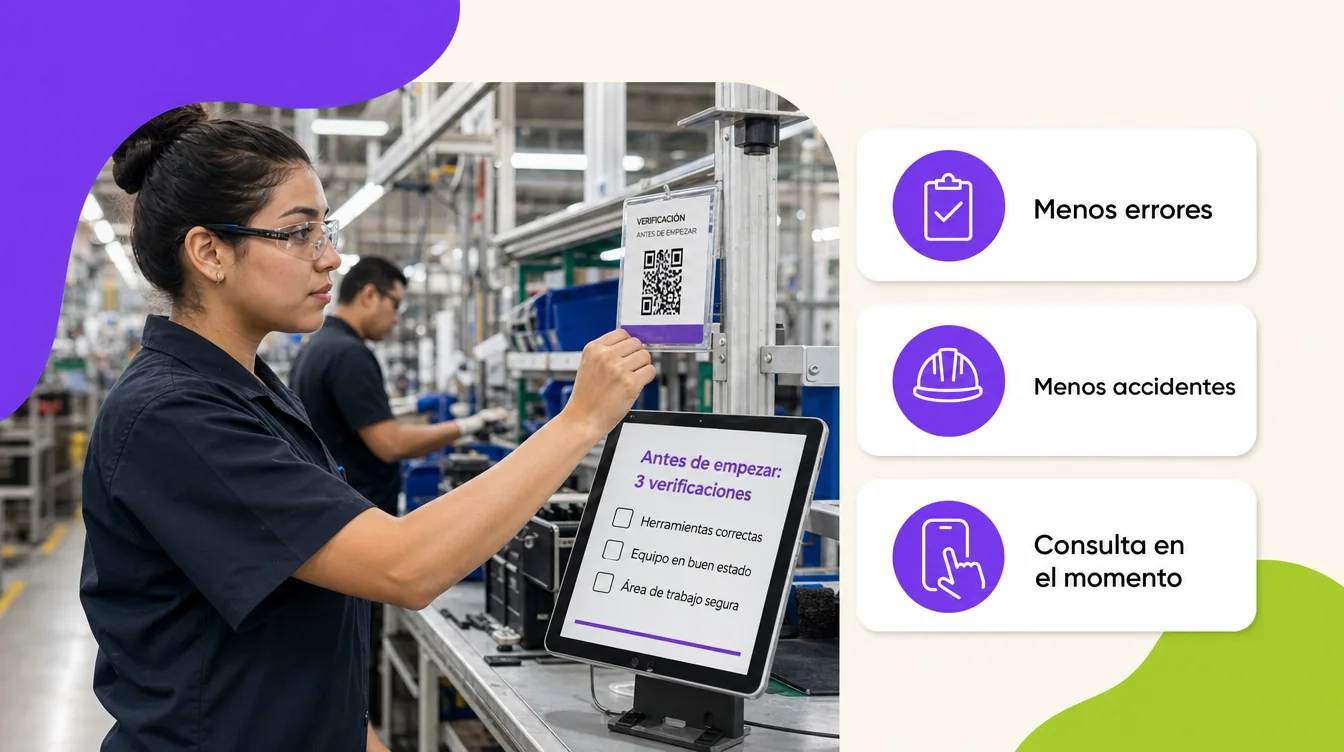
The QR code goes on the machine, the station board or the area sign, with a label that says what it opens. The rule is that the capsule must be less than a meter from the point where the decision is made. For safety, the code goes on the hazard sign: PPE, lockout-tagout, chemical handling and emergency, right where the risk exists.
Step 4: verify, do not just look up
The difference between "watched the video" and "learned" is one question. Each capsule ends with a one-question check; before a shift or a critical task, the code can launch a 60-second micro-drill: "the machine stopped with the guard open, what do you do first?". The answer is recorded per person and station, and the failed questions show where the standard or the practice needs adjusting.
Step 5: measure with the indicators you already have
| Indicator | Source | What to expect when implementing capsules |
|---|---|---|
| Rejects and rework per station | Quality | They drop first at stations with a capsule; compare with stations without one |
| Incidents and near misses | Safety | Fewer incidents at points with a safety capsule and pre-task check |
| New-hire learning curve | Production and HR | Fewer days to expected productivity at the covered stations |
| Lookups per capsule | QR system log | Lookup peaks reveal real doubts: review the standard or add guided practice |
| Failed questions | QR system log | The questions with most failures show where to train in depth |
Mistakes when implementing microcapsules
- Filming in a studio instead of on the machine: people do not recognize their equipment or their language.
- Ten-minute capsules: that is no longer a capsule, it is a course nobody watches standing up.
- Codes without a label or maintenance: three months later they point to an old version.
- Implementing without measuring: if you do not compare rejects and incidents before and after, you cannot defend the project.
- Forgetting contractors and visitors: many incidents involve people who are not plant staff; for them there is the QR induction for contractors and visitors.
How it connects with the rest of training
Microcapsules do not replace full workforce training or emergency brigade training; they make them pay off at the workstation. They combine with the microlearning subscription for skills and annual compliance, and with the training required by NOM-035. And if you would rather not start from scratch, with QR Capsules we run the critical-point assessment, film at your plant and leave tracking running.
Want to bring this to your team?
Start with the five stations where your plant makes the most mistakes. Message us on WhatsApp, fill out the contact form or open this site's live chat: we send a proposal with three scope options and a closed price in under 24 business hours, with the DC-3 certificate and Geedle Bot included. The full program is at QR code training at the workstation and the catalog at training courses for companies.