How to practice cold calls with AI before you dial a prospect
To practice cold calls with AI you need three things: a short script, a character that answers the way your prospects answer and a report that tells you what to fix. You rehearse by voice with a rushed “director” who asks who you are, asks for an email or hangs up, and you repeat until the opening comes out naturally. That way you reach the real call with the first thirty seconds solved and an answer ready for the most common brush-offs.
In this article
- Why should you practice cold calls before dialing?
- How do you practice a cold call with AI, step by step?
- What should a cold call script include?
- Which prospect responses should you rehearse?
- What are the most common mistakes on a cold call?
- How should your voice sound on a cold call?
- How many times should you rehearse before the real call?
- What does the sales manager get after the practice?
- Want your team to rehearse before they dial?
Why should you practice cold calls before dialing?
Because in a cold call, the first call to a prospect who doesn't know you and isn't expecting you, mistakes are expensive: a bad opening burns the prospect and you rarely get a second chance. Rehearsing first lets you get it wrong with a character, not with your list, and arrive with a steady voice and a clear message.
The trouble with traditional rehearsal is that it barely exists. The new salesperson gets a script, listens to a couple of calls from a colleague and starts dialing. They learn, yes, but at the expense of real prospects. Practice with AI changes the order: first you repeat, then you dial. And because it is available on demand, it doesn't depend on a colleague having time to play the customer or on the manager being able to listen to you that day.
How do you practice a cold call with AI, step by step?
You pick a scenario, talk by voice with the character, get a report and repeat. The whole session fits in ten or fifteen minutes, so you can do it right before your prospecting block. What matters is practicing one thing at a time: first the opening, then the brush-offs and finally the close with a date.
- Define who you are calling: role, industry and the problem you solve for them. Without that, any script sounds generic.
- Write your opening in two sentences and read it out loud once. Then put the paper away.
- Open the scenario. Geedle RolePlay has a “Cold call to a director” template, high difficulty; phone mode removes the visuals so you depend on your voice alone.
- Make the whole call without stopping, even if you slip. In practice mode a live coach gives you hints; in exam mode you are on your own.
- Read the report: the rubric, the key moments with their minute and the “how to say it better” suggestion.
- Repeat with one change: a different prospect personality (skeptical, rushed, kind but firm) or one more level of difficulty.
What should a cold call script include?
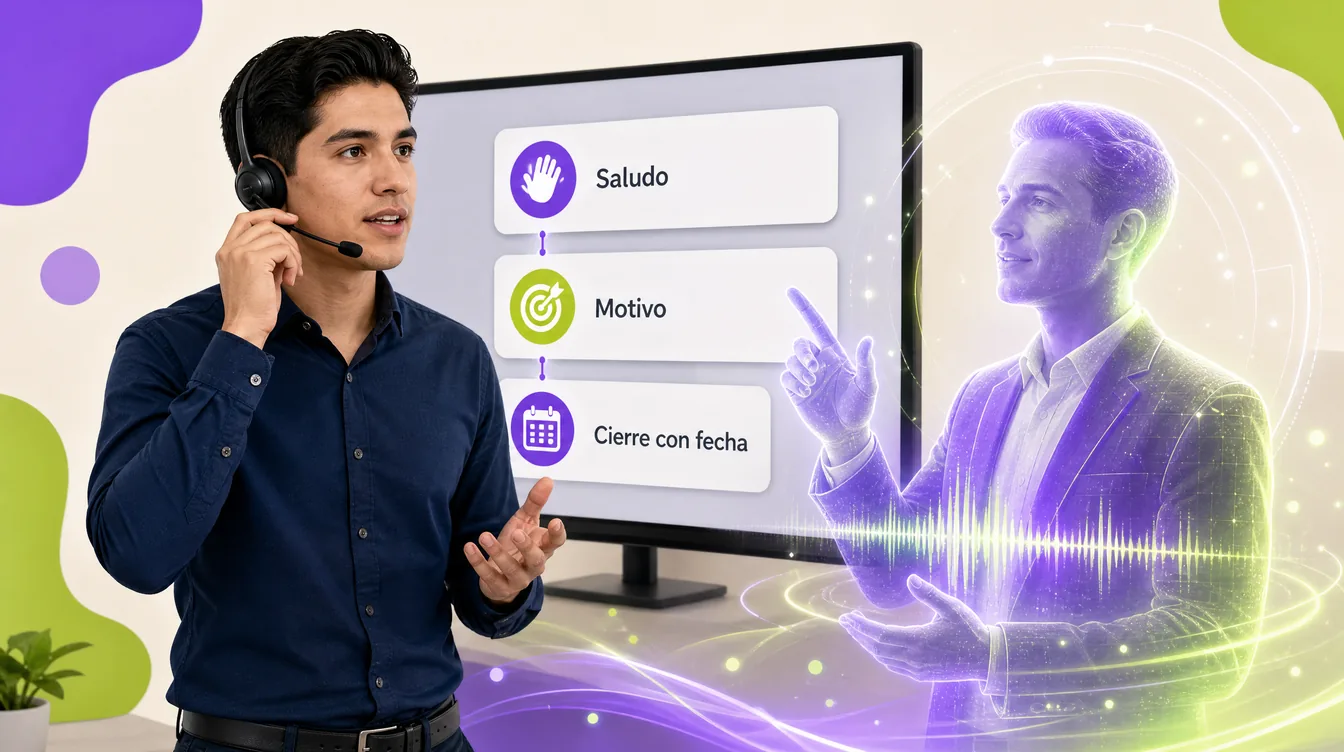
Five moments: a greeting with a name, the reason for the call, a question that opens the conversation, a value bridge and a close with a date. The script is not for reading: it is a map. If you recite it, you sound like a recording; if you own it, you can wander off and find your way back.
| Moment | What you are after | Example out loud |
|---|---|---|
| Greeting | They know who you are and you don't sound scripted | “Good morning, Mr. Ramírez. This is Laura Méndez, from [your company].” |
| Reason | Earning thirty seconds by being honest | “I'm calling without an appointment, so I'll be brief: we help plants like yours reduce maintenance downtime.” |
| Question | Getting them to talk, not you | “How are you handling preventive maintenance on the line today?” |
| Value bridge | Connecting their answer with what you do | “What you just mentioned is exactly what we review in a 20-minute assessment.” |
| Close | A next step with a date | “Does Thursday at ten work, or would you rather do early Friday?” |
Adapt the example to your product and to the way you speak. If you sell to companies, the logic of asking before presenting is the same as in consultative selling. And notice what the script leaves out: your company's history, the feature list and the price. On a cold call you are not selling the product; you are selling the next conversation.
Which prospect responses should you rehearse?
The brush-offs you hear every day. In Mexico people rarely say “no” to your face: they ask for an email, say that right now they can't or that they already have a vendor. Rehearse a short reply for each one, a reply that acknowledges what the prospect said and ends with a question, not a speech.
- “Send me the information by email.” “Happy to. So I don't send you something generic, what would be more useful to see: costs or how it is implemented?”
- “I don't have time right now.” “I understand, I called without warning. Can I call you Tuesday at nine? It takes ten minutes.”
- “We already have a vendor.” “Good, that tells me the topic matters to you. If you could change one thing about what you have today, what would it be?”
- “I'm not interested.” “Understood. Before I hang up, one question: is it already solved, or is it not a priority this year?”
- “Where did you get my number?” Tell the truth without getting defensive: “From your company's website. If you would rather I didn't call, I respect that.”
- The gatekeeper: “Who is calling? What is this about?” “Laura Méndez. It's about maintenance on the line; is he the right person, or would you recommend I speak with someone else?”
These brush-offs are cousins of objections. The deeper ones (price, trust, timing) are covered in the most common sales objections in Mexico.
What are the most common mistakes on a cold call?
Almost all of them happen in the first minute: opening with an apology, talking about yourself before asking, dropping the price without context, arguing with the brush-off and hanging up without a next step. They are mistakes of habit, not of knowledge; that is why a manual doesn't fix them and repeating the call does.
- Opening with “How are you? Do you have a minute?” You hand the prospect the easiest way out: “no.”
- Reciting the full pitch. After twenty seconds without a question, it is already a monologue.
- Taking the brush-off as a rejection. “Send me an email” rarely means “no”; it almost always means “you haven't given me a reason yet.”
- Pushing after a clear “no.” Say thank you, leave the door open and protect your name and your company's.
- Ending with “I'm at your service.” Without a date or a commitment, the call went nowhere.
In the simulator, these stumbles are flagged in the report with the minute in which they happened, so you can listen to yourself again and repeat just that part.
How should your voice sound on a cold call?
Calm, clear and a little slower than your body is asking for. On the phone there is no body language: the prospect decides whether to listen based on your tone of voice in the first few seconds. Nerves speed up your pace and raise your volume; rehearsing out loud is the only way to notice it and correct it.
- Speak standing up or sitting straight: your voice comes out with more air and less hurry.
- Pause after you ask. That silence belongs to the prospect; don't fill it yourself.
- End your sentences as statements, not with a questioning lilt.
- Drop the apologies: “sorry to bother you” or “I'll only take a minute” cost you authority before you start.
- Don't interrupt. In the simulator, the character gets annoyed if you interrupt and opens up when you listen; it is a good mirror of your active listening.
How many times should you rehearse before the real call?
There is no magic number. A practical rule: rehearse until the opening comes out without reading and until you get two attempts in a row above the minimum score your manager sets. After that, keep a short practice before each prospecting block, as a warm-up, and raise the difficulty when it starts to feel easy.
Short formats help keep the habit going: the three-minute express practice, the review cards and the “See how it's done” option, which shows a model conversation when you get stuck. Adaptive difficulty does the rest: if you improve, the prospect becomes more demanding.
What does the sales manager get after the practice?
A report per salesperson with the score for each rubric criterion, strengths, areas to improve, the key moments with their exact minute, the transcript and a comparison with the previous attempt. With that, coaching stops resting on “I feel you lack confidence” and leans on specific sentences the salesperson actually said.
The manager can also assign the scenario with a deadline, a number of attempts and a minimum score, and see on a heat map which competencies the team is missing. It is especially useful with new hires: they practice in sales role-play before receiving their first prospect list. If you want more conversations to rehearse, see the 10 sales role-play scenarios with scripts and our sales training to reinforce the methodology.
Want your team to rehearse before they dial?
An opening rehearsed ten times sounds different from an improvised one, and the prospect hears it from the first hello. In the meantime, try the free 2-minute voice demo: you face a buyer with objections and feel how an AI character reacts to what you say and how you say it. To see it with your team, request a demo of Geedle RolePlay. And if the scenario your team needs is not in the catalog, we build it with you: with your procedures, your product and your real objections.