Active listening techniques: 10 exercises to practice at work
Almost everyone believes they listen well and almost nobody does: while the other person talks, we are already preparing the answer. Active listening is a skill that gets trained, like presenting or negotiating, and these ten exercises can be practiced in pairs, in meetings and with real customers without stopping operations.
In this article
What is active listening and why does it need training?
It is listening to understand, not to reply: paying attention to the other person's words, tone and body, and showing them you understood before giving an opinion. It needs training because the natural habit is the opposite and a reading does not fix it.
It has three components the exercises work on separately: attention (no screen, no rehearsing the reply), comprehension (paraphrasing, asking) and demonstration (non-verbal communication, summary). At work it shows in specific places: the salesperson who hears the real objection and not the first one voiced, the HR person who picks up in the interview what the candidate did not say, the manager who learns about the conflict before it blows up, the agent who lowers the temperature of a complaint in two minutes.
The 10 active listening exercises
Each exercise takes between 5 and 20 minutes, is practiced in pairs or inside a real meeting, and has an audience it pays off most for. Do one a week, not all ten in a one-afternoon workshop.
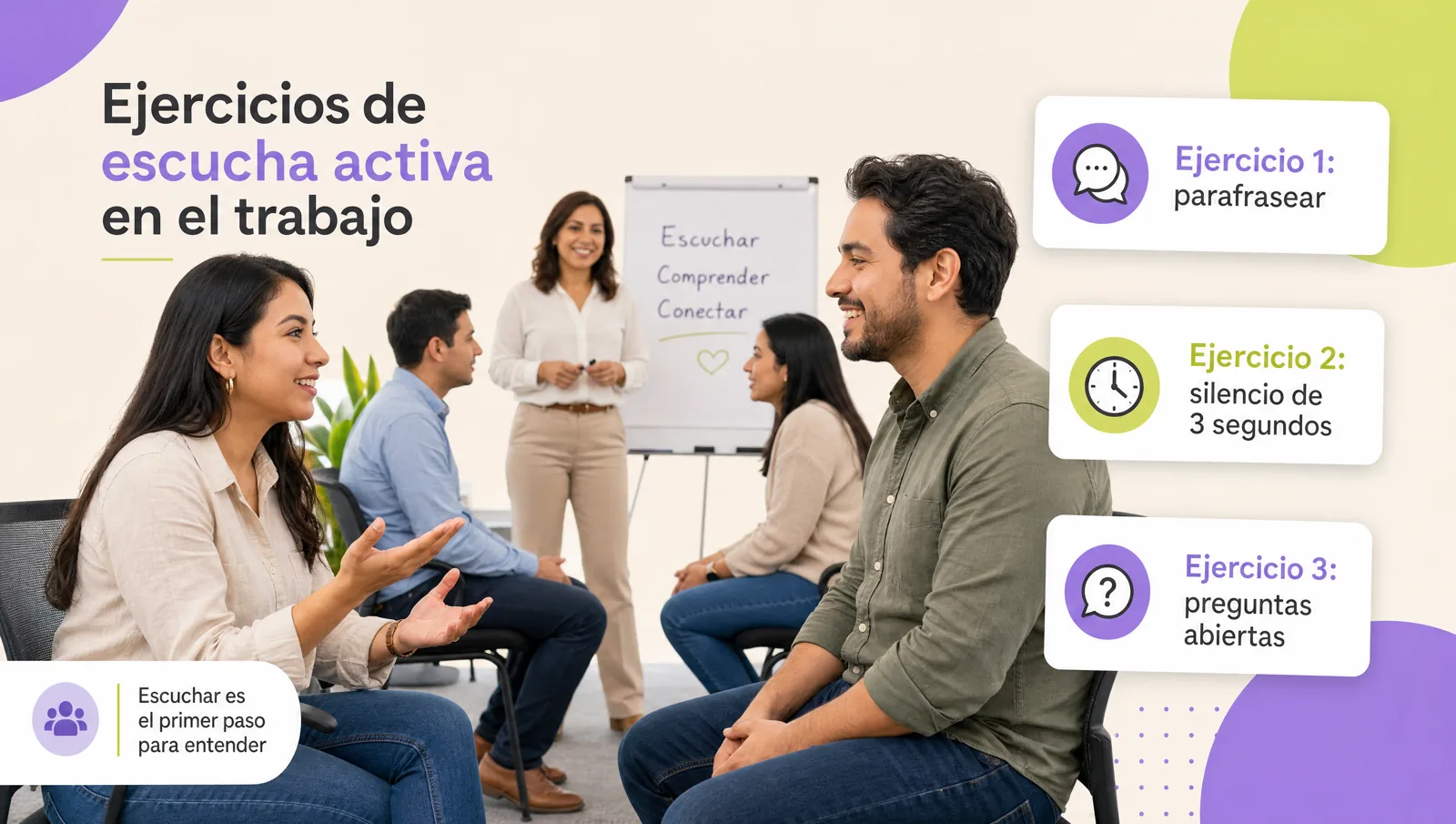
- One-sentence paraphrase. When the other person finishes, restate the core in your own words: "If I understood correctly, what worries you is the date, not the price". They confirm or correct before you give your view. Best for: sales, customer service, managers.
- The open follow-up question. For ten minutes, asking anything that can be answered with yes or no is off limits. Only what, how, when, what else. You discover how much information closed questions were losing. Best for: HR, sales, teachers.
- Three seconds of silence. When the other person stops talking, count to three in silence before replying. Very often they add exactly what mattered and had not dared to say. Best for: managers, healthcare, HR.
- Screen-free listening. A 15-minute 1:1 with the phone face down and the laptop closed. At the end, each person writes down what they noticed differently. It is usually the exercise that surprises managers most. Best for: managers, teachers.
- Non-verbal mirror. In pairs, one person tells a real problem from the week and the other only listens with posture, eye contact and nodding; no talking allowed. Then the narrator says whether they felt heard and why. Best for: customer service, healthcare.
- Naming the emotion. Before proposing a solution, say what you perceive: "It sounds like this has you frustrated". If you are right, tension drops; if not, the other person corrects you and you learn something you did not know. Best for: customer service, HR, healthcare.
- The closing summary. At the end of any conversation longer than five minutes, summarize what was agreed in three points and ask "did I miss anything?". It prevents half of the week's misunderstandings. Best for: sales, managers, HR.
- The meeting reporter. In every meeting, a different person sums up at the end, in one sentence per participant, what each one said. The others correct. By the third round everyone listens differently because they know it may be their turn. Best for: managers, project teams.
- Real complaint in pairs. One person plays an upset customer with a real complaint from the week; the other practices paraphrasing, naming the emotion and summarizing without justifying or interrupting. Then they switch roles. Best for: customer service, sales.
- The full objection. The salesperson does not answer an objection until they have restated it in their own words and asked "what else is holding you back?". The real objection is almost always the second one. Best for: sales, purchasing.
Which exercise to choose by role
Not every role needs all ten. The table proposes a sequence of four per area and the place to practice them without creating extra sessions.
| Role | Recommended exercises | Where to practice |
|---|---|---|
| Sales | 1, 2, 7 and 10 | Prospecting and closing calls |
| Customer service | 1, 5, 6 and 9 | Counter, phone and WhatsApp |
| Managers | 3, 4, 7 and 8 | 1:1 meetings and team meetings |
| Human resources | 2, 3, 6 and 7 | Interviews and exit conversations |
| Teachers and trainers | 2, 4 and 8 | Classroom and tutoring |
| Healthcare staff | 3, 5 and 6 | Consultation and reception |
How to turn the exercises into a team routine
One exercise a week, 15 minutes at the start of a meeting that already exists, for ten weeks; at the end, the team picks the three it keeps. It works better than a standalone workshop because the practice lands on real conversations.
- Visible calendar. The ten weeks with their exercise, posted where everyone sees it.
- The manager practices first. If the manager paraphrases in the meeting, the team does it; if they only ask for it, nobody does.
- One-page log. Which exercise was done, what the team noticed, which real conversation changed. It serves as evidence for HR and for the DC-3 certificate.
- Three-month refresher. The three retained exercises are repeated with a new complaint or objection.
Mistakes that cancel out active listening
The most common are paraphrasing as a formula without having understood, asking questions to steer the other person to your answer, and listening while typing. All three are detected immediately and produce the opposite of the intended effect.
- "I understand your frustration" said by rote, without naming what frustrates that specific person.
- Open questions that are really closed: "Don't you think it would be better to…?".
- Nodding while typing. The other person always notices.
- Summarizing what you wanted to hear instead of what was said.
What we work on in the course
In the active listening course the team practices the ten exercises on its real conversations (complaints, objections, interviews, 1:1s) and leaves with the ten-week sequence scheduled. When the problem is also how the team expresses itself, we complement it with the effective communication course; for counter and support teams, with the customer service course.
Want to bring this to your team?
We practice the ten exercises on your team's real complaints, objections and 1:1s, and leave the ten-week sequence scheduled with a log for HR. Message us on WhatsApp, fill out the contact form or open this site's live chat: we send a proposal with three scope options and a closed price in under 24 business hours, with the DC-3 certificate and Geedle Bot included. The full program is at the active listening course and the catalog at training courses for companies.