Consultative selling vs traditional selling: what changes in the process, the proposal and the margin
Traditional selling presents the product, handles objections and closes; it works at the counter and in simple purchases. In B2B, with long cycles and several decision-makers, it leads to competing on price. Consultative selling reverses the order: it diagnoses before proposing, quantifies the problem and negotiates on value. This guide compares both in the process, the proposal and the margin.

In this article
Two ways of selling, two kinds of purchase
Traditional selling is built for quick, low-risk purchases: the customer already knows what they want, compares options and decides on price, availability or trust. The salesperson presents, argues, handles objections and closes. It works on the sales floor, in telemarketing and for catalog products.
Consultative selling is built for complex purchases: several decision-makers, cycles of weeks or months, and a purchase that must be justified with numbers before a committee. The salesperson does not start with the product but with the customer's problem: diagnoses it, quantifies it and proposes a solution whose value exceeds the price. It is how you sell to companies, government and institutions.
Comparison
| Traditional selling | Consultative selling | |
|---|---|---|
| Starting point | The product or service | The customer's problem |
| First meeting | Presentation and catalog | Diagnostic questions |
| Proposal | Feature list and price | Quantified problem → solution → result |
| Objections | "Handled" with techniques | Prevented in the diagnosis |
| Negotiation | On price (discount) | On value and scope |
| Margin | Eroded at every close | Defended with the cost of the problem |
| Process | Contact → presentation → close | Qualification → diagnosis → proposal → negotiation → close → follow-up |
| Metric | Closes | Conversion by stage and value per account |
What changes in the process
In consultative selling the process has stages with advancement criteria: an opportunity does not move from "qualified" to "diagnosed" until the customer confirmed the problem and its cost; it does not move to "proposal" until it was agreed what will be solved. That changes the CRM: instead of a funnel where everything is "in follow-up", each stage has a definition and its conversion is measured. That is what makes forecasting possible instead of guessing.
What changes in the proposal
A traditional proposal lists features and price. A consultative one starts with the problem using the figures the customer gave in the diagnosis ("every month 40 hours are lost reconciling by hand, equivalent to…"), presents the solution as the way to recover that, shows evidence (cases, references) and presents price as an investment against that cost. When the proposal is written this way, the committee's question stops being "why does it cost so much?" and becomes "when do we start?".
What changes in the margin
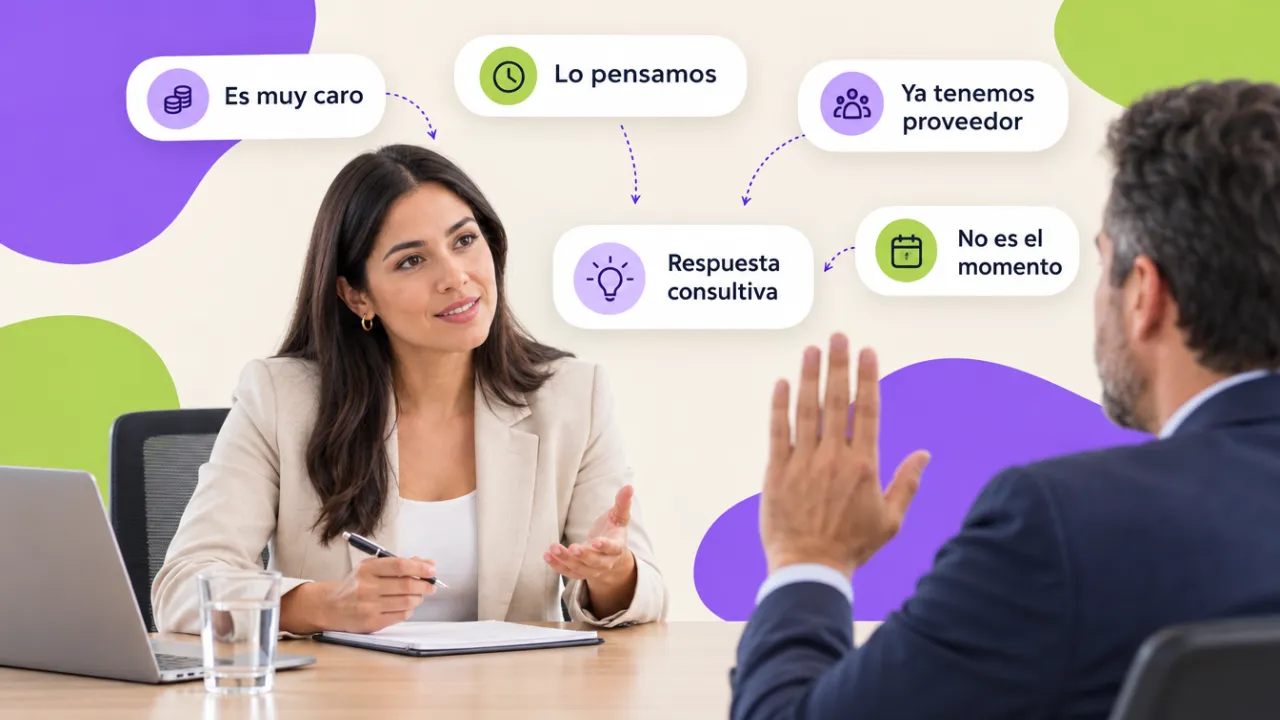
In traditional selling, negotiation happens over a single variable, price, and every close erodes margin. In consultative selling, tradeable variables are negotiated (scope, timing, payment terms, included services) with limits defined in advance: you can give on timing in exchange for volume, not give away price with nothing in return. Handling price objections actually starts in the diagnosis: if the cost of the problem is quantified, "it is too expensive" has an answer.
When each one fits
- Traditional: counter, retail, telemarketing, catalog products with public prices, low-risk purchases. General sales training covers this form.
- Consultative: services, technology, custom manufacturing, logistics, consulting, suppliers to government and universities. Any sale with a committee, a tender or a cycle longer than a month. It is the approach of the B2B consultative selling course.
The most common mistake when switching
Sending the team to "sell consultatively" without changing the process or the CRM. If the metric is still only closes of the month, the salesperson goes back to discounting at the first pressure. The change works when the staged process, the diagnostic script and the negotiation policy are defined together, and management measures conversion by stage.
Want to bring this to your team?
We work with your team's real opportunities and leave the staged process loaded in your CRM, the diagnostic script and the negotiation policy. Message us on WhatsApp, fill out the contact form or open this site's live chat: we send a proposal with three scope options and a closed price in under 24 business hours, with the DC-3 certificate and Geedle Bot included. The full program is at the B2B consultative selling and negotiation course and the catalog at training courses for companies.