Contractor and visitor safety induction: what to include and how to record it
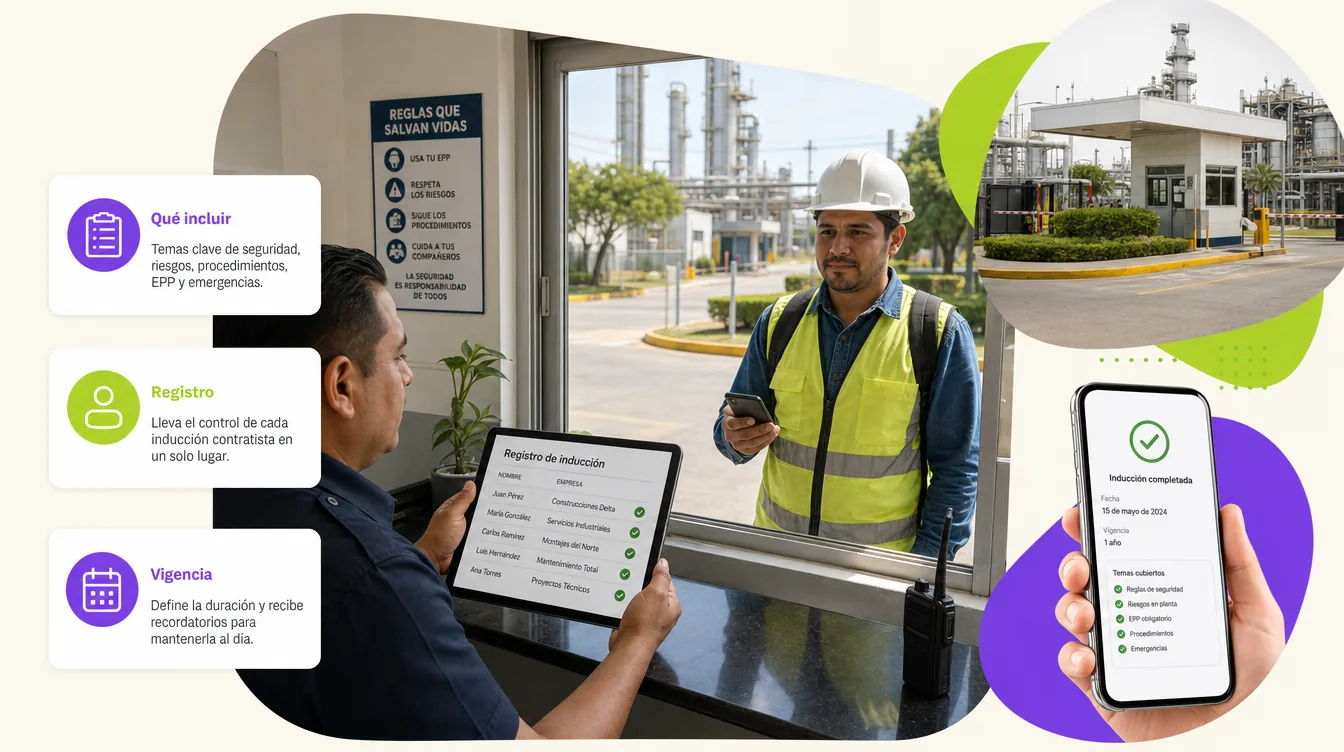
Contractors and visitors are the people who know your plant least and who come in through the most varied entrances and schedules. A short safety induction, the same for everyone and recorded per person, is the difference between a supplier walking through a restricted area and one who knows where the assembly point is. This guide explains what to include, how to record it for audits and how to deliver it in five minutes with a QR code at the gatehouse.
In this article
What the standards require and what customers require
In Mexico, the STPS regulates preventive occupational safety and health services (NOM-030-STPS-2009: diagnosis, safety and health program and evidence of compliance) and the training of workers on the risks of their activity; the preventive-services standard does not mention contractors or visitors by name, but the workplace safety program applies to everyone who enters. ISO 45001, the international occupational health and safety standard, does dedicate a clause to contractors and requires coordinating hazard identification and controls with them. And in practice, the supplier safety manuals of large companies require induction, an access log and daily attendance lists. If your plant sells to those companies, contractor induction is part of being a supplier.
What to include in the induction (5 minutes)
- General plant rules: visible badge, escort where applicable, permitted and restricted zones, no phones in hazard areas, alcohol and drugs.
- Risks of the area they will visit: forklift traffic, hot surfaces, noise, chemicals, moving machinery.
- Mandatory protective equipment by area: helmet, glasses, footwear, vest, hearing protection; who provides it.
- Permits and lockout: for contractors, which jobs require a permit (height, hot work, confined spaces, theectrical) and the lockout-tagout procedure.
- Emergencies: alarm, evacuation routes, assembly point, whom to report an incident to and where the first-aid kit is.
- Conduct and reporting: what to do about an unsafe act or condition and how to report it.
- Confirmation: short assessment and registration with name, company, area, escort and date.
Versions by type of person
| Type of person | What they watch | Indicative length | Suggested validity |
|---|---|---|---|
| Office visitor | General rules, evacuation and assembly point | 3 min | Per visit or 365 days |
| Supplier and carrier | Yard, docks, forklifts, waiting area | 4 min | 90 to 365 days |
| Maintenance contractor | All of the above plus work permits, lockout-tagout and PPE by area | 5 to 7 min | 30 to 90 days |
| Auditor or customer | General rules, visitor PPE, escorted tour | 3 min | Per visit |
Validity is a decision of your management system; what matters is that it is defined, that the system enforces it and that the induction is retaken when the video changes.
How to record it for audits
The record must prove, per person, that they received the current induction before entering: name, ID, company, type of person, area to visit, escort, date and time, assessment result and video version. On paper, that is a signed sheet nobody read and a binder that gets lost; with a QR code, it is an automatic record that security sees on screen before handing over the badge and that industrial safety exports by period, company and area. QR induction for contractors and visitors works like this: the QR code sign at the gatehouse opens the video, the person answers the assessment, fills in the registration and gets a green screen with their name; for anyone without a phone, the gatehouse tablet shows the same induction.
How to make the 5-minute video
- Film it at your plant: your entrances, your signs, your assembly point. A generic video does not teach where anything is.
- Script in 30-to-60-second blocks, one per item on the list above; subtitles always and an English version if you receive foreign visitors.
- A three-to-five-question assessment only answered correctly by someone who watched the video.
- Visible version and date; when rules or areas change, update the video without changing the code.
How it connects with the rest of safety
The contractor who will work on a machine also scans that machine's code and sees the lockout procedure from the QR code training at the workstation system; the routes and assembly point seen at the gatehouse are the ones the plant practices with emergency brigades; and for new employees, the induction is part of digital onboarding. 60-second micro-drills verify that the rules are remembered.
Want to bring this to your team?
A plant usually has the QR induction active at every entrance in a few weeks. Message us on WhatsApp, fill out the contact form or open this site's live chat: we send a proposal with three scope options and a closed price in under 24 business hours, with the DC-3 certificate and Geedle Bot included. The full program is at QR induction for contractors and visitors and the catalog at training courses for companies.