60-second micro-drills before the shift: safety talks people actually remember
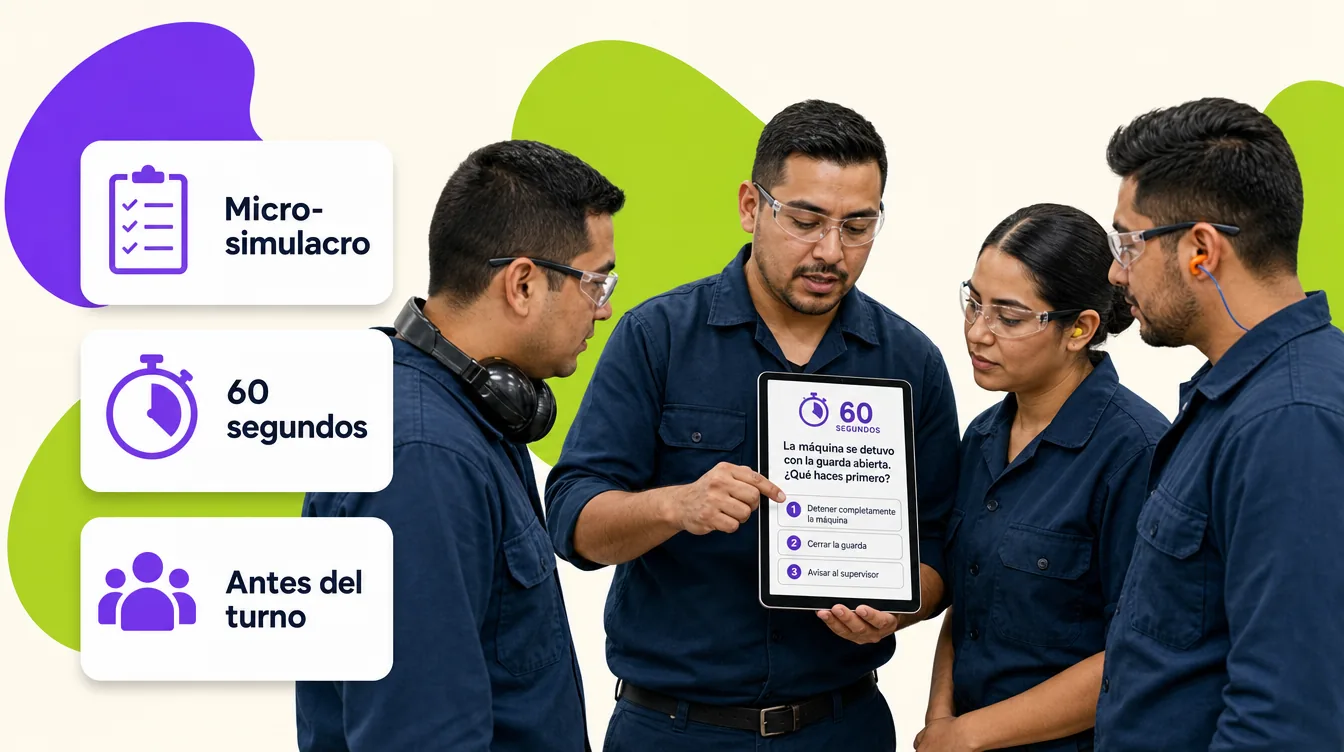
The pre-shift safety talk, the toolbox talk, is the most widespread practice in plants and the least remembered by ten in the morning. A 60-second micro-drill replaces it with a real question from the workstation: "the machine stopped with the guard open, what do you do first?". The person answers on the phone or the area tablet, sees the explanation and the result is recorded per station. This guide explains how to design them, thirty sample questions and how to read the results.
In this article
What a micro-drill is and how it differs from the safety talk
The safety talk (toolbox talk or five-minute talk) is a short pre-shift meeting where the supervisor presents a topic and asks for participation. It works when the topic is specific, when people speak and when attendance is recorded; it fails when it turns into reading a form. The micro-drill reverses the order: first the question, then the explanation. The person faces a situation from their workstation, decides in 60 seconds, sees whether they were right and why, and the system records the answer. It does not replace the real evacuation drill or the extinguisher practice of emergency brigades; it verifies that the rule is remembered on the day it matters.
Anatomy of a 60-second micro-drill
| Seconds | What happens | Example |
|---|---|---|
| 0-10 | A specific workstation situation, in one sentence | The sealer stopped with the guard open. |
| 10-35 | Three options; one correct, two that people actually choose | Restart it / Cut power and lock out / Call maintenance and wait |
| 35-55 | Explanation of why the right one is right and what happens with the others | Without lockout, the machine can start with a hand inside. |
| 55-60 | Record and, if applicable, link to the procedure capsule | Watch the lockout procedure on video (2 min). |
It is launched from the machine's or area board's QR code, from the supervisor's tablet at the start of the shift or by WhatsApp for people on routes; it is the verification piece of the QR code training at the workstation system.
30 questions to start with, by topic
Lockout-tagout
- The machine stopped with the guard open. What do you do first?
- You finished maintenance but someone else's padlock is still on. Can you energize?
- The supervisor asks you to remove the lock of a coworker who already left. What do you answer?
- When do you verify that energy is released: before or after placing the padlock?
- A valve has no lockout point. What do you do?
Personal protective equipment
- Your glasses are scratched and you see poorly. Do you work with or without them?
- You will enter the noise area for five minutes. Do you need hearing protection?
- The glove has a small cut on the palm. Do you use it until the break?
- A visitor enters without a helmet escorted by the manager. What do you do?
- Where is the harness checked: before climbing or once at the top?
Forklifts and traffic
- A pedestrian crosses your route wearing headphones. What do you do?
- The load blocks your forward view. How do you move?
- You will leave the forklift for two minutes. What do you do with the forks and the key?
- A coworker asks to ride on the forks to reach something. What do you answer?
- There is oil on the ramp floor. Do you drive slowly or stop the operation?
Chemicals
- Half a liter of solvent spilled. What do you do first: clean or notify?
- An unlabeled container holds a clear liquid. Do you use it?
- Product got in your eye. How many minutes at the eyewash?
- Where is the safety data sheet for what you use today?
- Do you add acid to water or water to acid?
Emergencies
- The alarm sounds and you are mid-cycle. Do you finish or leave?
- There is smoke in the packing area. What do you do first?
- A coworker faints. Whom do you call and what do you not do?
- What is your assembly point and who takes the head count?
- An incipient fire in an electrical panel. Which extinguisher do you use?
Quality and process
- The material arrived with a different code but looks the same. Do you use it?
- The part passes visual inspection but the gauge reads out of tolerance. What do you ship?
- The format changed and you cannot find the current instruction. What do you do?
- The customer asks to skip a check to save time. What do you answer?
- You spot a defect that repeats every hour. Whom do you notify and how?
How to read the results
- A question with many failures in one area: it is not the people, it is the standard or the practice; review the capsule or schedule guided practice.
- A station that never answers: the code is missing, not visible or the shift has no tablet; fix that before concluding anything.
- Failures that coincide with incidents: the most useful correlation for industrial safety and the safety committee.
- Questions everyone gets right for months: retire them and raise the difficulty; the micro-drill exists to find gaps.
Results add to the capsule lookup log and to the evidence of the STPS training plan; for how to choose the stations to start with, read how to reduce errors and accidents with microcapsules.
Want to bring this to your team?
An initial set of micro-drills is designed with your supervisors in one session and launched with the workstation QR codes. Message us on WhatsApp, fill out the contact form or open this site's live chat: we send a proposal with three scope options and a closed price in under 24 business hours, with the DC-3 certificate and Geedle Bot included. The full program is at QR code training at the workstation and the catalog at training courses for companies.