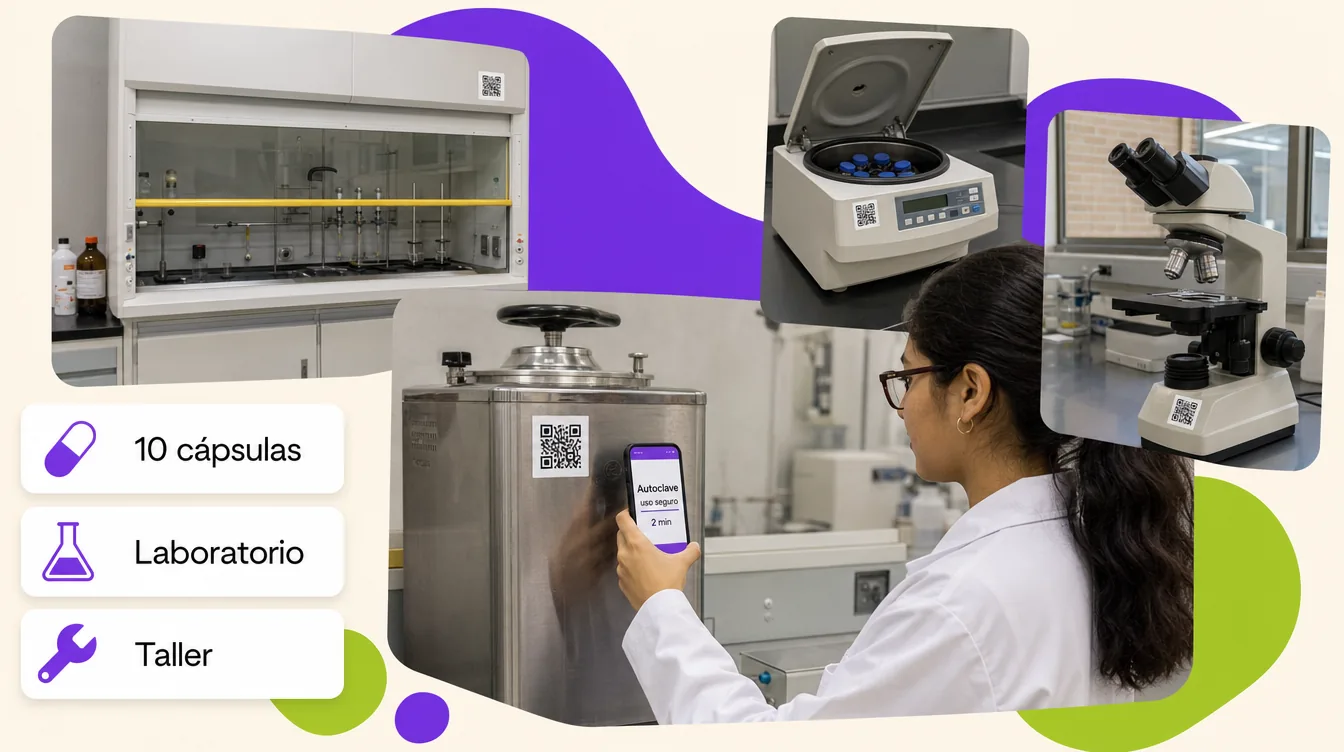
10 QR capsules for university labs and workshops (and how to produce them with your teachers)
The hygiene and safety regulations of Mexican faculties agree on the essentials: nobody works alone in the lab, flammable substances are handled in the fume hood, equipment is used as the person in charge indicates and whoever misuses it is accountable. What no regulation solves is the student remembering it with the equipment switched on. These ten video capsules, opened with a QR code stuck on each piece of equipment, put safe use and guided practice at the exact moment, and save the teacher the same explanation twenty times a semester.
In this article
Why the regulation is not enough
The hygiene and safety regulation is handed out in the first week; the fume hood practical comes in week five and the autoclave one in week ten. In between, the student forgot the start-up order, the teacher explains to thirty people what they will use in teams of three and the lab manager has no way of knowing who read what. A one-to-three-minute capsule on each piece of equipment, with a check question, changes that: it is consulted before using the equipment, assigned as flipped-classroom work and recorded per student and group. It is the educational version of QR capsules for universities and schools.
The ten capsules, by equipment
- Fume hood. When it is mandatory (flammables, volatiles, toxics), how to check airflow before starting, sash height and what is not stored inside. Check: "What do you do if the hood has no airflow?".
- Autoclave. Which material goes in and which does not, how to load without blocking steam, the cycle by material, how to open without burns and what to log.
- Centrifuge. Tube balancing, correct lids and rotor, maximum speed per rotor and what to do if it vibrates or smells burnt.
- Reagent handling and safety data sheets. Where the SDS is, pictograms, transfer, labeling and what to do with a small spill.
- Hazardous and biohazard waste. What goes in each container, how to close and label, and whom to notify when full.
- Lathe and milling machine. Clothing and hair, workpiece clamping, speeds, emergency stop and chip cleaning without hands.
- Welding. Helmet and gloves, ventilation, cable and clamp check, clear area and what to do with a burn.
- Electrical panel and test benches. Energizing and de-energizing in order, absence-of-voltage check and why you never work alone.
- Clinical simulator and teaching medical equipment. Start-up, basic calibration, hand washing before and after and usage log.
- Computer and network lab. Institutional account, backing up work, what not to install and whom to report a failing machine to.
How to produce each capsule with your teachers
| Step | What is done | Who |
|---|---|---|
| 90-second script | Context (10 s), steps with the equipment (60 s), frequent mistake (10 s), check question (10 s) | Teacher and lab technician |
| Filming | Phone on a tripod, horizontal, with the real equipment; close audio and subtitles | Teacher with Geedle support |
| Check | One multiple-choice question only answered correctly by someone who watched the video | Teacher |
| QR code | Reagent- and water-resistant label next to the equipment controls, with text saying what it opens | Lab manager |
| Assignment | Pre-practical activity in Moodle or the institutional platform | Teacher |
The guide to one-point lessons with QR codes explains the format in more detail; the AI tutor for universities answers the questions the capsule does not cover citing the exact minute of the video, and teacher training prepares professors to produce their own.
What students, teachers and the institution gain
- Students: they arrive at the practical knowing what to do, look things up without embarrassment and have a reference on the equipment throughout their degree.
- Teachers: they stop repeating the start-up and spend the session on practice; the log shows who watched the capsule before entering.
- Lab managers: less equipment damaged by misuse and evidence per student, group and equipment for accreditations, civil protection and safety committees.
Common mistakes
- Filming with the equipment off or at a desk: the student needs to see the real equipment.
- Ten-minute capsules: nobody watches them standing in front of the fume hood.
- Codes without a label or version: two semesters later they point to an old video.
- Not recording: without a log there is no evidence for accreditations or to know which equipment raises doubts.
Want to bring this to your team?
Start with the lab with the most incidents or the most damaged equipment. Message us on WhatsApp, fill out the contact form or open this site's live chat: we send a proposal with three scope options and a closed price in under 24 business hours, with the DC-3 certificate and Geedle Bot included. The full program is at QR capsules for universities and schools and the catalog at training courses for companies.