How to evaluate your teachers: class observation and 15-minute feedback that improves the class
Most schools "evaluate" teachers with a yearly survey and an occasional visit that everyone sees coming. Teachers hate it, principals postpone it, and nothing in the classroom changes. Observation works when it is short, frequent, built on a rubric everyone knows and followed by a 15-minute conversation that ends with one agreement. This is the routine we install with school leaders, including the hardest case: the veteran who says nobody is going to observe them.
In this article
- How should a principal evaluate teachers?
- The rubric: five things you can actually see
- Before, during and after
- The 15-minute feedback conversation
- Common mistakes
- The veteran who refuses to be observed
- What to do with the data
- How to calibrate coordinators so two observers see the same class
- For companies and government
- Install the observation cycle with your coordinators
How should a principal evaluate teachers?
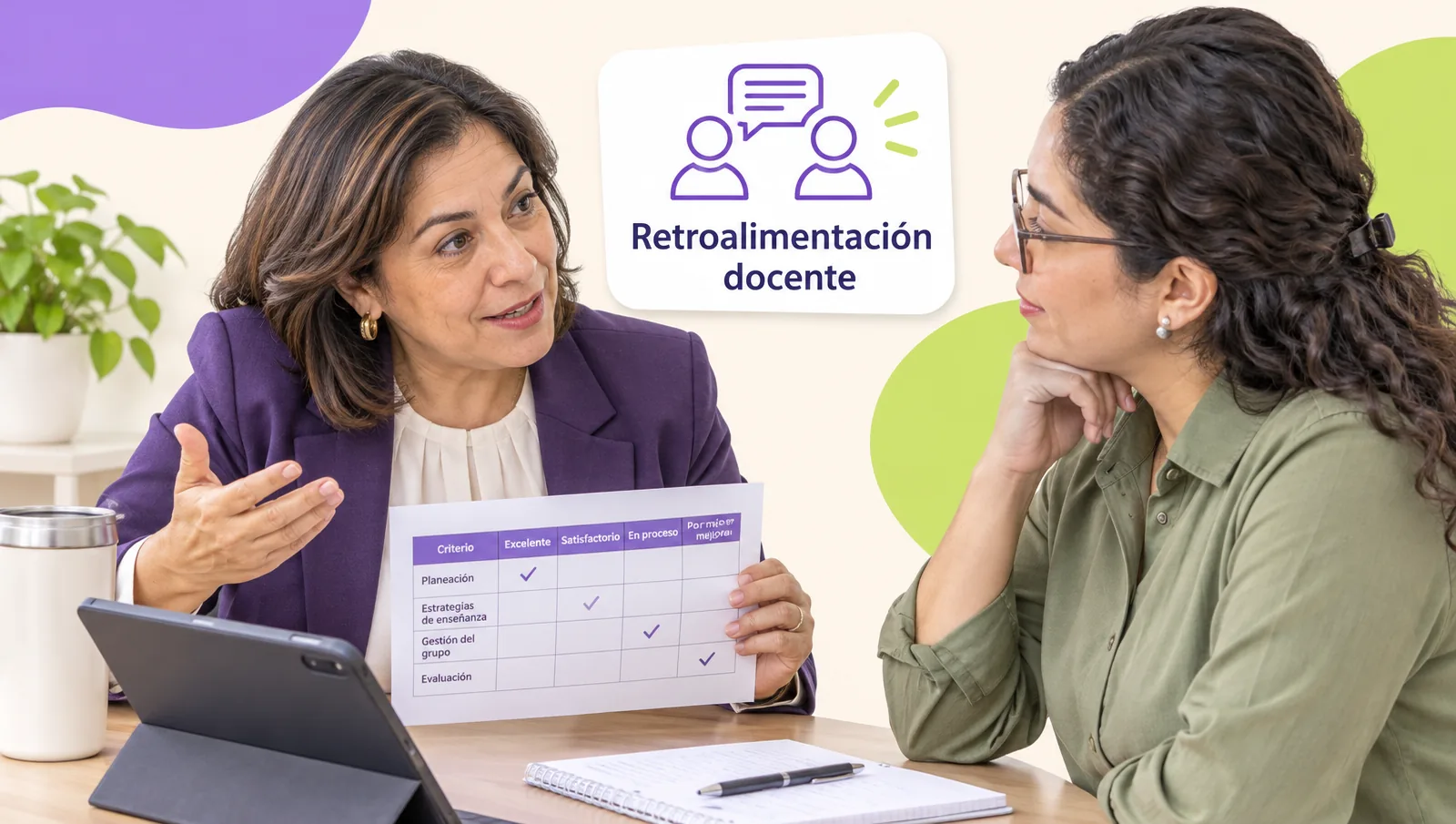
A principal should evaluate teachers with short, frequent class observations (15 to 20 minutes, three or four times a year) against a rubric the teacher knows beforehand, followed within 48 hours by a 15-minute feedback conversation that names one strength with evidence, one thing to change, and one agreement with a date. Student results, surveys and portfolios complement the picture, but the observation and the conversation are what change the class. A yearly surprise visit and a score do not.
The rubric: five things you can actually see
Keep the rubric to five dimensions you can observe in 20 minutes, each with three levels described in plain language, not scores:
- Clear objective: students can say what they are learning today and why.
- Time on task: how many minutes of the 20 the students spend working on the content.
- Participation: who speaks; whether the same four students answer everything.
- Checking for understanding: whether the teacher finds out who got it before moving on.
- Classroom climate: how the teacher handles interruptions and errors.
Share the rubric with the whole staff at the start of the year and observe yourself first, in a video, with the rubric in hand. Teachers accept the instrument when they have seen the principal apply it to their own class.
Before, during and after
| Moment | What the principal does | What the teacher knows |
|---|---|---|
| Before | Announces the two-week window, not the day; reviews the previous agreement | The rubric, the window and the previous agreement |
| During | 15 to 20 minutes, sits at the back, writes evidence (what was said, how many minutes), not opinions | The principal will not intervene |
| After (within 48 h) | 15-minute conversation: strength with evidence, one change, one agreement with date | The notes will be shared, not filed secretly |
| Next observation | Starts by checking the agreement | The cycle is about improvement, not a file |
The 15-minute feedback conversation
Minute 1 to 3: ask the teacher how they felt the class went; listen. Minute 3 to 7: one strength with the evidence you wrote down ("at minute 8 you asked three students to explain the step and two of them got it"). Minute 7 to 12: one thing to change, framed as an observable behavior, with the evidence ("the same four students answered the eleven questions"). Minute 12 to 15: one agreement, concrete, with the date of the next observation. One change, not five; a teacher who leaves with a list of five changes makes none. The script is the same one the school uses with families; see the four-step script.
Common mistakes
- Observing once a year, for a full class, and writing a report nobody reads.
- Giving the feedback a week later, by email, or not at all.
- Opening with the negative; the teacher stops listening.
- Judging the teacher ("you are disorganized") instead of describing the class ("the materials took six minutes to hand out").
- Linking the observation to salary from day one; do that only after a year of a credible cycle.
- Delegating all observations to coordinators without training them on the rubric; two observers of the same class should reach the same level.
The veteran who refuses to be observed
Every school has one: 25 years of experience, good results, and "nobody comes into my classroom". Do not start with them, and do not exempt them. Start with volunteers, observe yourself publicly, build three months of visible, respectful cycles. Then meet the veteran one-on-one: acknowledge the track record with specifics, explain that the cycle is the same for everyone including you, and ask them to help calibrate the rubric by being observed by you and observing a young teacher. Most veterans accept when the instrument is credible and they are given a role. If one still refuses, it becomes a conversation about the agreements of the school, not about teaching, and it is documented. The principal academy rehearses exactly this conversation by voice.
What to do with the data
After one semester you have, per teacher, three observations and three agreements; per school, which dimensions are weak across the staff. That is your teacher training plan for next semester, built on evidence instead of on the catalog of a provider. Teachers who see that the observations fed the training they actually needed stop seeing observation as surveillance.
How to calibrate coordinators so two observers see the same class
If the principal and three coordinators observe, the rubric is only as good as their agreement. Calibrate once a term: the four of you watch the same 15-minute class recording, each fills the rubric alone, and then you compare level by level. Where two observers differ by more than one level, you rewrite that descriptor until it is unambiguous ("students can state the objective when asked" instead of "the objective is clear"). Repeat with a second recording until the differences disappear. Teachers notice very quickly whether an observation depends on who walks in, and a rubric that produces different results from different observers is the fastest way to lose their trust. The calibration session takes 90 minutes and doubles as the best training a coordinator gets all year.
For companies and government
Instructors in corporate universities and public training institutes are observed the same way: short, frequent, rubric known beforehand, one agreement. The soft skills for teachers course and train-the-trainer programs include the rubric and the feedback conversation for facilitators.
Install the observation cycle with your coordinators
The principal academy delivers the five-dimension rubric, the calibration exercise for coordinators, the 15-minute feedback script and the conversation with the resistant veteran, with AI voice practice before the real one. The full service is described at principal academy: delivered at your campus in Mexico or live online, with ready-to-use forms, AI voice practice of the hardest conversations and Geedle Bot answering questions with the exact minute of the recording. If you want to know where to start, answer the free express school assessment in five minutes or request a proposal: we reply within 24 business hours with three scope options and a closed price. The whole program for school leaders is at school leadership training.