Team building activities: 25 ideas for companies (in-person, virtual and hybrid)
A team building activity works when it is chosen for the team's objective and not from the vendor's catalog. Here are 25 ideas in five groups (integrating new areas, communication, trust, problem solving and hybrid or remote teams), each with duration and group size, to put together an in-person, virtual or hybrid day that leaves more than photos.
In this article
- How do you choose a team building activity?
- The 25 team building activities by objective
- Integrating new areas
- Communication
- Trust
- Problem solving
- Hybrid and remote teams
- Summary table: objective, recommended activity and format
- How to build a team building day that delivers results
- Common mistakes when organizing team building activities
- Want to bring this to your team?
How do you choose a team building activity?
By the objective, not by the activity: first define what has to change in the team (two areas talking to each other, meetings that get somewhere, people trusting enough to delegate) and then pick the dynamic that works on it, with the right format and group size.
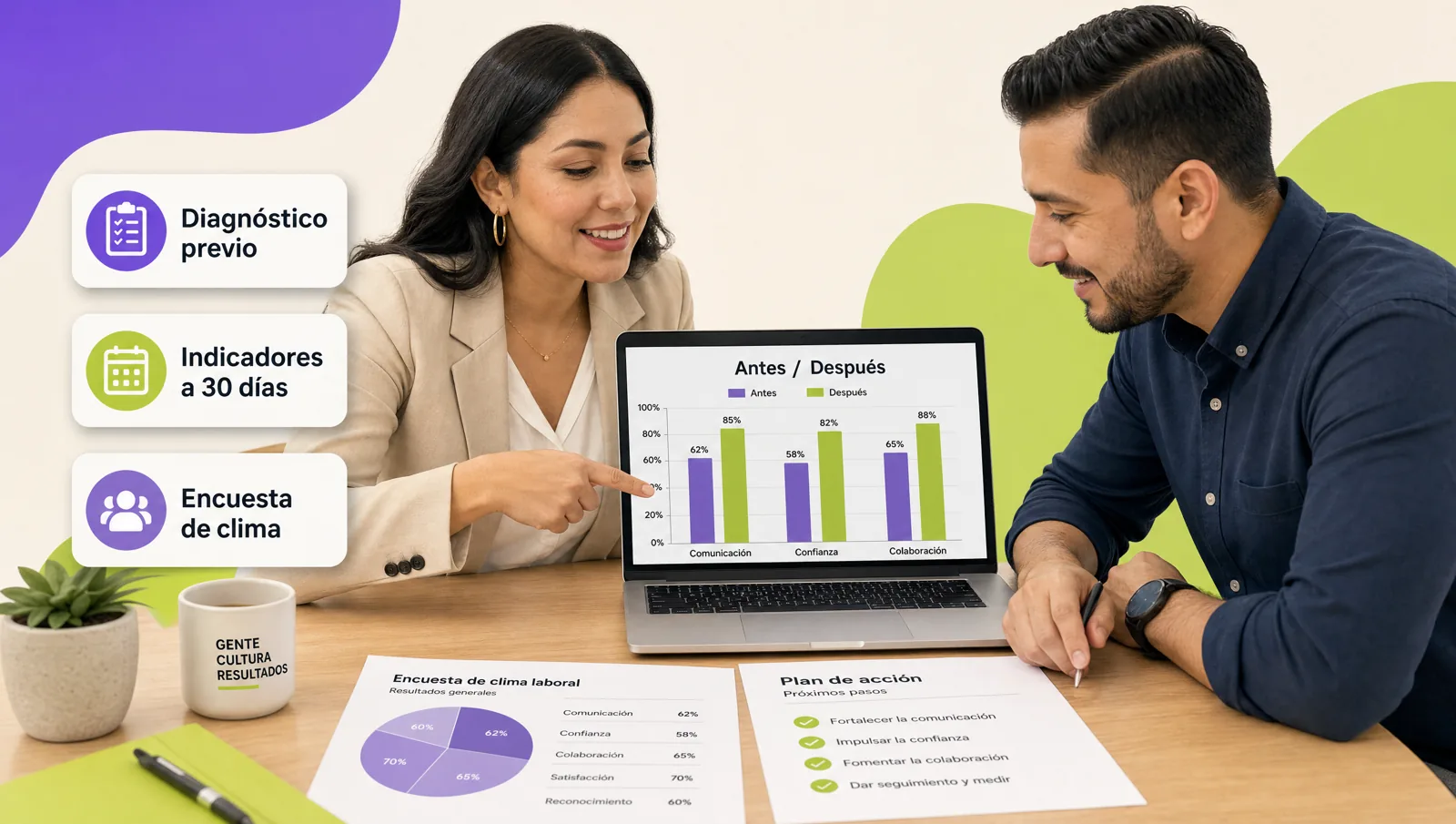
Most event vendors start the other way around: they offer the trendy activity and attach an objective to it. The result is a pleasant day that changes nothing on Monday. At Geedle we start with a short team diagnostic, design gamified dynamics for that objective, close with a workshop that issues a DC-3 certificate and measure at 30 days. The 25 ideas below follow that logic: each group answers one objective and each activity states how long it takes and how many people it suits.
The 25 team building activities by objective
Each activity comes with a short description, duration and recommended group size. Within each group they go from lightest to most demanding; two or three per objective are enough for a full day.
Integrating new areas
- Human map of the company. Each person stands on a floor plan next to the area they work with most, then next to the one they know least, and explains both choices out loud. 30 min · 10-40 people.
- Cross interview. In pairs from different areas, five minutes to find out what the other person does, what gets in their way and what they need from your area; then each one presents their partner. 40 min · 8-30.
- The internal customer. Each area draws on a flip chart who it hands work to and what it gets back; the missing arrows are the conversation of the day. 45 min · 12-40.
- Process rally. Mixed teams move through stations where they complete a real task from another area (assembling an order, closing a ticket) guided by the person who does it daily. 90 min · 15-50.
- Mixed tables. A meal with assigned seats across areas and three non-work questions per table; ideal for closing an integration day. 60 min · 20-80.
Communication
- Dictated drawing. One person describes a figure only they can see and the other draws it without asking questions; in the second round questions are allowed. The difference between the two drawings is the lesson. 20 min · 6-30.
- Instruction chain. A five-step work instruction is passed by word of mouth through six people and compared with the original. 15 min · 8-20.
- Build with separate blueprints. One team has the pieces and another has the plan; they can only communicate through written messages. 45 min · 8-24.
- The one-minute meeting. Each person presents a real topic in 60 seconds and the group repeats what it understood before giving opinions. 30 min · 6-15.
- Tower with roles. A tower is built where only one person may speak, another may touch the pieces and another may see the model. 30 min · 9-30.
Trust
- Recognition circle. Each person names something specific someone else did in the last month that made their work easier. 20 min · 6-20.
- Guided course. One person crosses a circuit blindfolded, guided only by a colleague's voice; then they swap roles. 30 min · 8-24.
- The team's story. The group builds a timeline of the hard moments it got through and who helped whom. 45 min · 8-30.
- Crossed strengths. Each person writes three strengths of their own and the team writes three for that person; the lists are compared. 30 min · 6-16.
- Live delegation. A leader must get a task done without touching anything, only by delegating; the team decides how to organize itself. 40 min · 6-12.
Problem solving
- Escape room with the real problem. The clues are built from a process that fails in the company; solving it forces the team to map it. 60-90 min · teams of 5, up to 30.
- Blind bridge. Two teams each build half a structure without seeing each other and must join them at the end. 45 min · 10-30.
- Five whys in a chain. Mixed teams take a real complaint and ask why five times down to the cause; they present a solution that can be applied within a week. 45 min · 8-30.
- Idea auction. Each team gets a fictional budget and bids on the solutions the others proposed; it shows what each area prioritizes. 40 min · 12-40.
- Crisis simulation. A scenario (a key customer drops, a supplier fails) with information released every ten minutes; at the end the group reviews how it decided. 60 min · 8-20.
Hybrid and remote teams
- Random coffee. Pairs drawn every week for a 15-minute video call with no agenda. 15 min · any size.
- Home scavenger hunt. Each person has 60 seconds to bring an object that meets a prompt to the camera and tell its story. 20 min · 5-25.
- Whiteboard against the clock. Ten minutes to draw on a digital whiteboard how a real process flows; then compare with how it really happens. 30 min · 5-15.
- Company trivia. Questions about customers, history and areas, with teams mixing in-person and remote people. 30 min · 10-60.
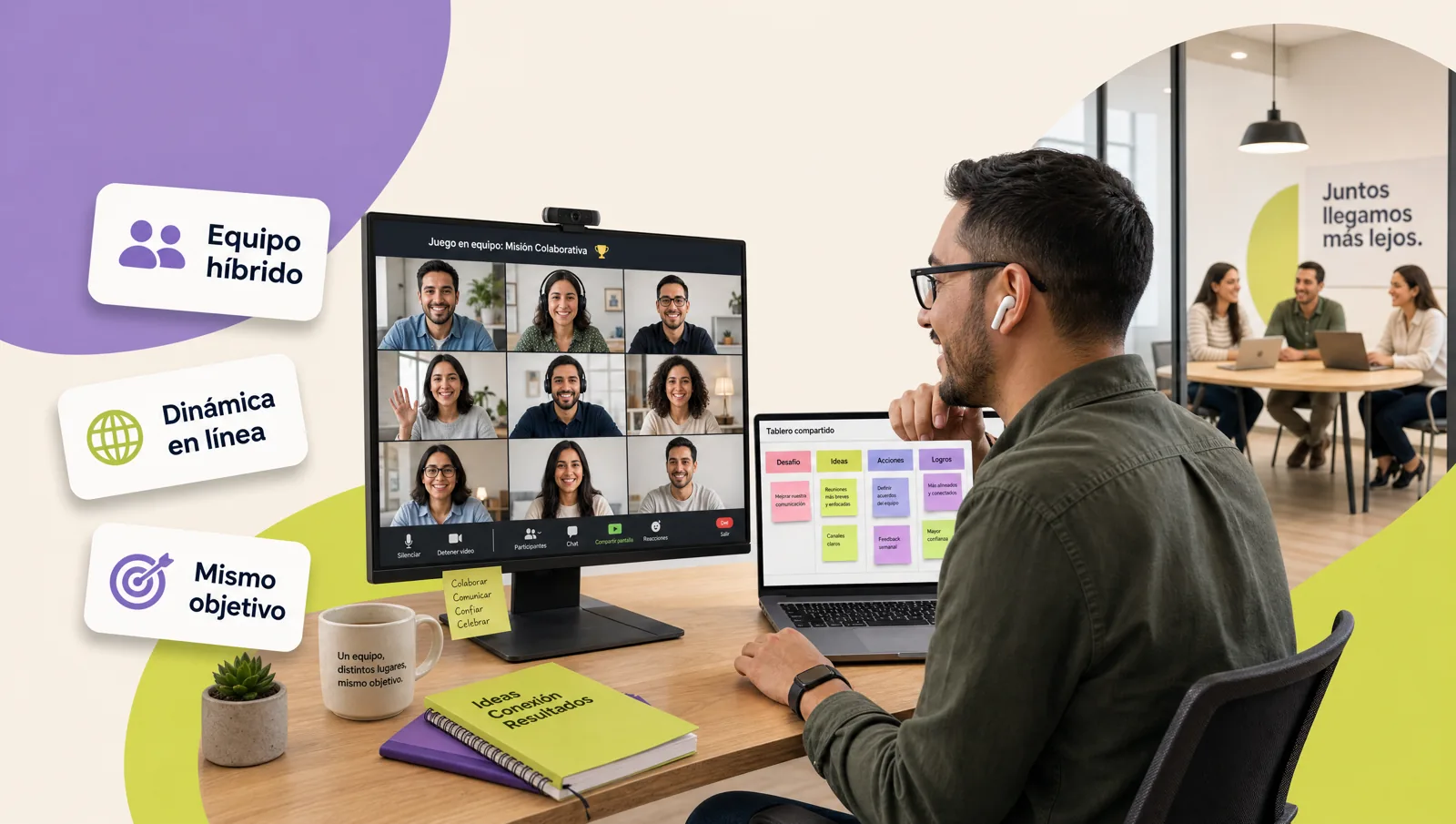
- Hybrid station challenge. In-person people complete physical tasks and remote people solve the clues; nobody moves forward without the other. 60 min · 10-40.
Summary table: objective, recommended activity and format
If you will only pick one activity per objective, the table proposes the one that performs best in each case and the format it works in.
| Objective | Recommended activity | Format |
|---|---|---|
| Integrating new areas | Process rally (4) | In-person |
| Communication | Build with separate blueprints (8) | In-person or virtual |
| Trust | Crossed strengths (14) | In-person, virtual or hybrid |
| Problem solving | Escape room with the real problem (16) | In-person or hybrid |
| Hybrid and remote teams | Hybrid station challenge (25) | Hybrid |
How to build a team building day that delivers results
With a short diagnostic beforehand, two or three activities aimed at the same objective, a closing that turns the experience into working agreements and a measurement at 30 days.
- Ten-question diagnostic for the team one week before: what gets in the way, which area is hard to coordinate with, which conversation gets avoided. It defines the objective and the baseline.
- Two or three activities per objective, not ten loose ones. The gamified dynamics are adapted to the team's real process, not a generic script.
- Workshop closing of 60 to 90 minutes where the team translates what happened in the activity into three agreements with an owner and a date. That part carries a DC-3 certificate.
- Measurement at 30 days against the baseline: meeting participation, response times between areas, escalated conflicts. How to do it is in how to measure team building results.
Common mistakes when organizing team building activities
The most common are choosing the activity for fun rather than for an objective, mixing groups with no reason, not closing with agreements and leaving remote staff watching the day through a screen.
- Scheduling the day on Friday afternoon and calling it voluntary: the people who need it least are the ones who show up.
- Making the same areas compete that already compete in daily operations.
- Skipping the closing: without agreements, the experience stays an anecdote.
- Repeating the same activity every year even though the team's problem has changed.
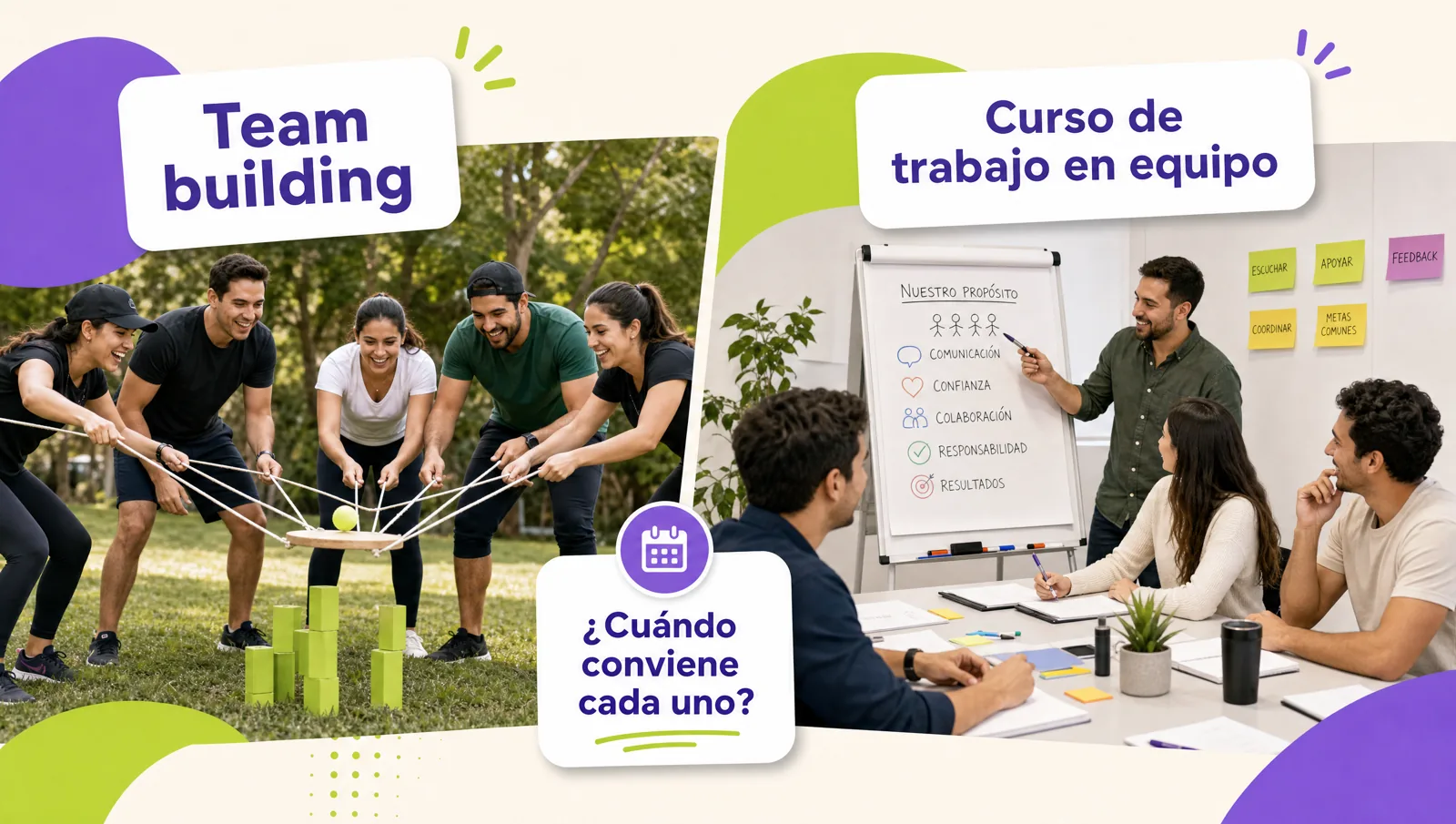
If the team's problem is more about method than relationships, read team building vs teamwork course before the day; when the team works from several cities, the specific dynamics are in team building for hybrid and remote teams.
Want to bring this to your team?
We design the day from a short diagnostic of your team, with gamified dynamics for the objective you choose, a closing workshop with a DC-3 certificate and measurement at 30 days, in-person, virtual or hybrid. Message us on WhatsApp, fill out the contact form or open this site's live chat: we send a proposal with three scope options and a closed price in under 24 business hours, with the DC-3 certificate and Geedle Bot included. The full program is at team building for companies and the catalog at training courses for companies.