How to measure team building results (and not stop at the photo)
The question management asks after a team building day is always the same: did it do any good? If nothing was measured beforehand, the honest answer is "we do not know". Measuring team building does not take software or a full-time consultant: it takes a short diagnostic beforehand, three or four indicators the company already has and a review at 30 days. Here is the full method.
In this article
Can team building results be measured?
Yes, as long as the team is measured before the day. Without a baseline there is nothing to compare; with a short diagnostic and three or four operational indicators, the result shows within 30 days.
What cannot be measured is "motivation" in the abstract or the number of smiles in the photos. What can be measured is behavior: how many people take part in meetings, how long one area takes to answer another, how many conflicts get escalated to the manager, how many people leave. Those behaviors change when the dynamics and the closing workshop were designed for a specific objective, and they do not change when the day was just an event. Measuring is the only way to tell one from the other.
Step 1: the 10-question prior diagnostic
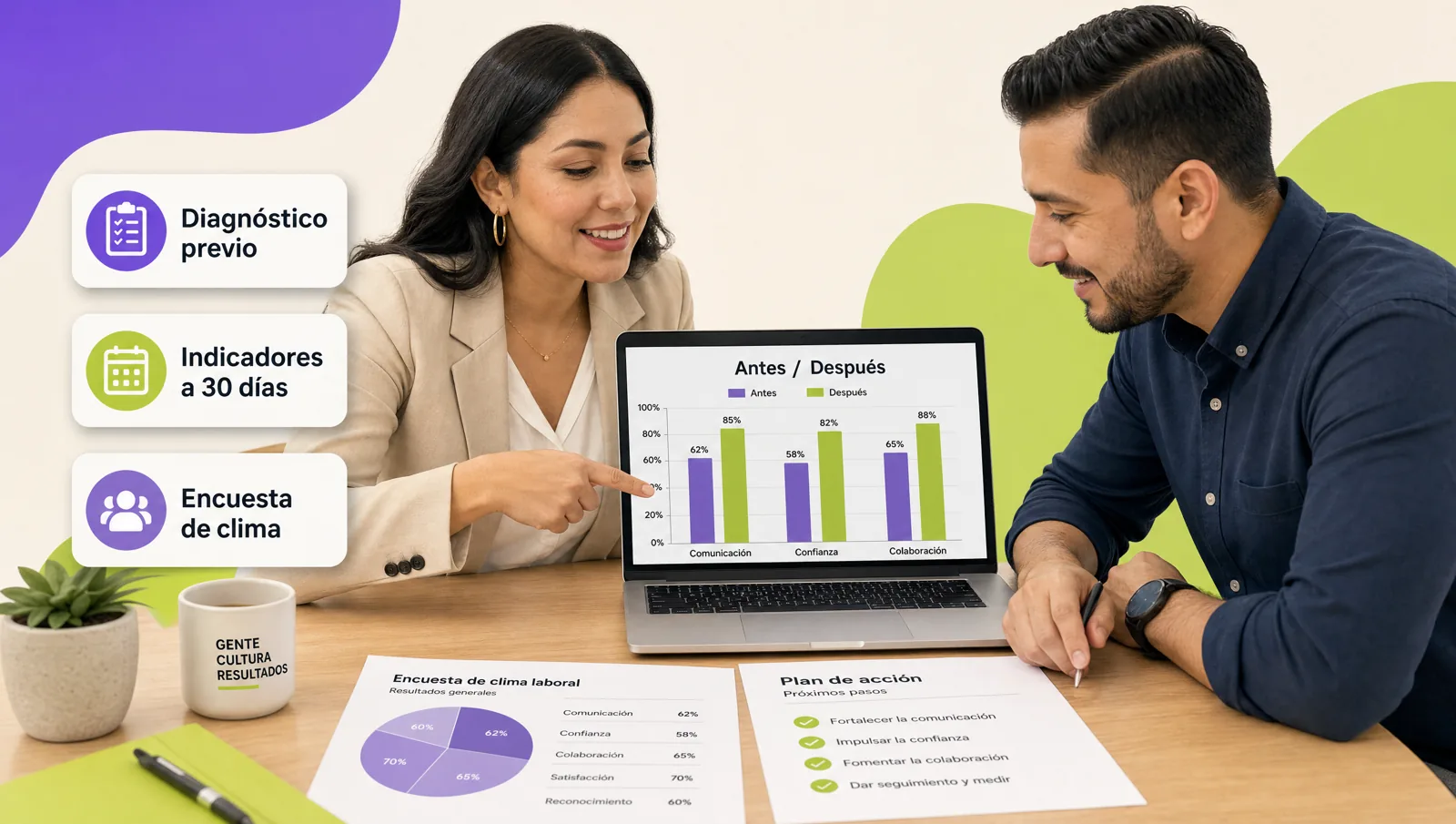
One week before the day, each team member anonymously answers ten questions on a 1 to 5 scale. It takes five minutes and produces the baseline and the objective of the day.
- I know what each person on my team expects from me.
- When I need something from another area, I know who to ask and they answer on time.
- In my team's meetings I can say what I think without consequences.
- The agreements we make get kept.
- When there is a disagreement, we resolve it among ourselves without escalating it.
- I trust my colleagues to do their part.
- I know the work of the areas I coordinate with.
- I get recognition when I do my job well.
- I feel part of this team.
- There is a pending conversation on the team that nobody wants to have.
The three questions with the lowest average point to the objective: if 2 and 7 are low, it is integrating areas; if 3 and 10 are low, communication; if 4 and 6 are low, trust. That is what the team building activities and the content of the closing workshop are chosen from, and the same survey is repeated at 30 days.
Step 2: set the objective and the indicator before hiring
Each objective has an operational indicator that already exists in the company or comes from a simple weekly count. It is agreed in writing before the day, with the current figure, so that afterwards nobody argues about what was going to be measured.
| Objective of the day | 30-day indicator | Where it comes from |
|---|---|---|
| Integrating areas | Response time between areas | Tickets, emails or internal requests with dates |
| Communication | Meeting participation (people who speak / attendees) | Count by the reporter in each meeting |
| Trust | Conflicts escalated to the manager or HR | Area manager log |
| Change or restructuring | Voluntary turnover on the team | Voluntary exits in the period, HR |
| Any | 10-question diagnostic, repeated | Same anonymous survey |
Step 3: the 30-day indicators
Thirty days is long enough to see whether behaviors changed and short enough to attribute it to the day. Four indicators and the repeated survey are reviewed; two out of five moving in the right direction is already evidence.
- Meeting participation. In every team meeting, the reporter notes how many people spoke. A team where two out of ten talk and later five out of ten talk has changed, even if meetings last the same.
- Response times between areas. Take the request date and the reply date in ten cases before and ten cases after. No system needed: a spreadsheet is enough.
- Escalated conflicts. How many disagreements reached the manager or HR in the previous month and how many in the following month. If they drop, the team is resolving them on its own, which was the point of the trust dynamic.
- Voluntary turnover. Compared against the same previous period and followed up to 90 days; it is the slowest indicator and the one management cares about most.
- Closing workshop agreements. The three agreements with an owner and a date that came out of the workshop: how many were kept. It is the most direct indicator and the one almost nobody checks.
Step 4: the climate survey and NOM-035 as the background measurement
For large teams or for a day that is part of an annual program, the background measurement is the workplace climate survey and, in workplaces with more than 50 workers, the organizational environment assessment NOM-035 requires.
The workplace climate survey measures dimensions such as communication, collaboration, leadership and recognition across the whole company, and lets you compare the team that had team building with those that did not. According to the standard, NOM-035 measures domains such as workplace relationships and social support within the leadership and relationships category; a well-designed team building day is one of the control measures that can be documented there, with the workshop and the DC-3 certificate as evidence. The NOM-035 compliance service integrates that measurement if the company already applies it.
What to do with the results
Present them on one page: objective, baseline, 30-day figure, agreements kept and next step. If two or more indicators improved, repeat the format with another objective; if none moved, the problem was not about relationships and the team's method needs a look.
- If participation improved but response times between areas did not, the next step is an internal service agreement, not another day.
- If escalated conflicts dropped, keep the workshop practice (reporter, dated agreements) and measure at 90 days.
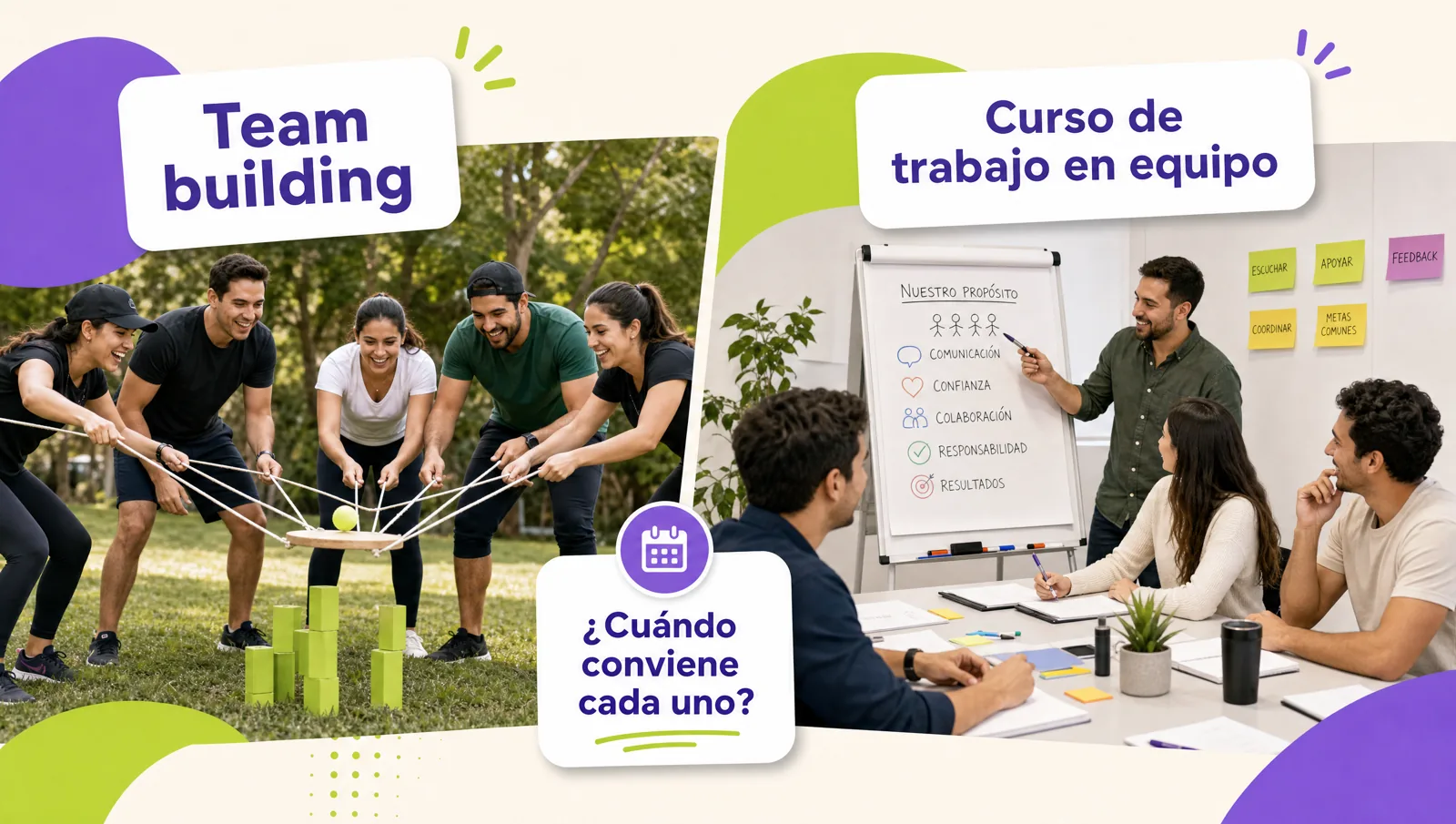
- If nothing changed, the diagnostic probably pointed to method; the comparison is in team building vs teamwork course.
This is how we work at Geedle: a 10-question diagnostic, gamified dynamics for the objective detected, a workshop with a DC-3 certificate and a 30-day review with the indicators the company already has, in-person, virtual or hybrid.
Want to bring this to your team?
We apply the 10-question diagnostic before the day, agree the indicator with you and deliver the 30-day review on one page; the day includes a workshop with a DC-3 certificate. Message us on WhatsApp, fill out the contact form or open this site's live chat: we send a proposal with three scope options and a closed price in under 24 business hours, with the DC-3 certificate and Geedle Bot included. The full program is at team building for companies and the catalog at training courses for companies.