AI agents vs chatbots: differences and when to use each one
A chatbot follows a script; an AI agent understands the question, checks your documents and decides what to do. They look the same in a chat window, but they solve different problems and cost differently. Here are the differences that matter to a company and a simple rule to choose.
In this article
What is a chatbot?
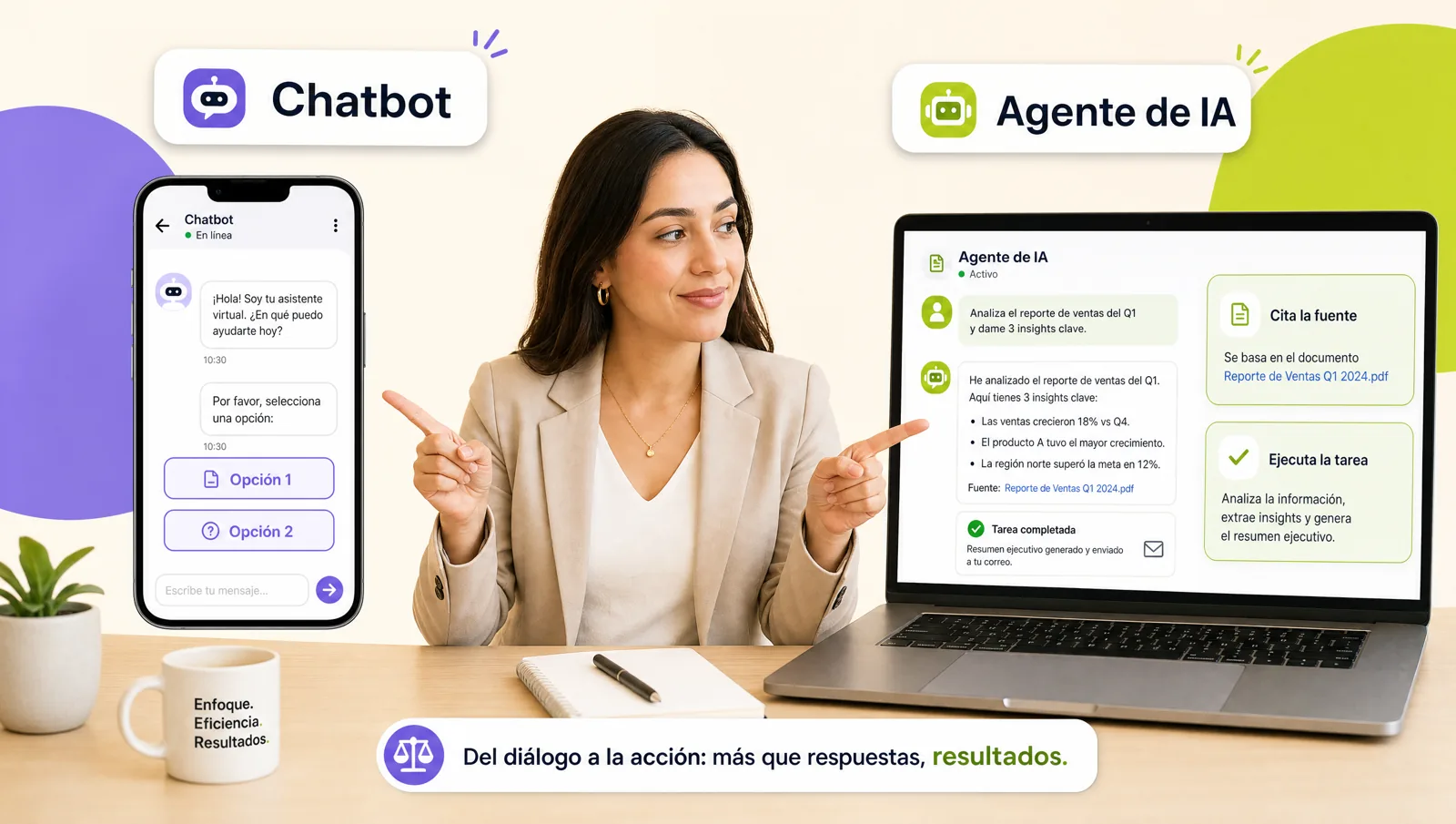
A chatbot is a program that converses by following a guided flow: menus, buttons and predefined replies someone wrote in advance for every possible path. If the user picks "Hours", they get the hours text; if they type something outside the tree, the bot asks them to rephrase or hands off to a human. It is predictable, cheap to run and very good when questions are few and repetitive: order status, opening hours, branch location. Its limit is that it does not understand; it only classifies against what was programmed.
What is an AI agent?
An AI agent is a system that uses a language model to interpret the question, look up the answer in your documents and systems, reason about which steps to follow and execute actions through connected tools. It has no tree of paths: it has a goal, a set of sources and a set of permissions. It can read an 80-page manual to answer a benefits question, query the CRM for the status of a quote, or create a ticket and notify by email. That is how Geedle Bot works with our course participants and how the AI agents for business we implement are built.
What are the key differences?
The underlying difference is that the chatbot executes a script while the agent reasons over sources and tools; everything else follows from that.
| Criterion | Chatbot | AI agent |
|---|---|---|
| Logic | Guided flow: menus and predefined paths | Reasoning over the question and the context |
| Sources | Hand-written texts per path | Company documents and systems (RAG, CRM, ERP) |
| Actions | Show text, hand off to a human | Look up, create records, send emails, schedule |
| New questions | Fails or hands off | Answers if the sources cover it; otherwise says so |
| Maintenance | Edit the tree every time something changes | Update documents and prompt |
| Cost | Low and fixed | Variable by model usage, higher per conversation |
| Best fit | Few, highly repetitive questions, no nuance | Many varied questions with context and actions |
When does a chatbot make sense?
It makes sense when the questions fit on a short list, the answer does not depend on context and the cost per conversation has to be minimal. Clear signs:
- More than 80% of inquiries are the same five or ten questions.
- The answer is identical for any user (hours, location, requirements).
- You need a first-contact channel that captures data and routes to a person.
- You do not have organized documentation yet and want to launch within a week.
When does an AI agent make sense?
It makes sense when the questions are varied, the answer depends on documents or on who is asking, and you want the system to do something beyond replying. Clear signs:
- The support or HR team spends hours answering questions that are in a manual or a policy (the case for an AI-powered HR chatbot).
- The right answer changes by customer, contract or department.
- You want it to schedule, create a ticket or update the CRM in addition to answering.
- Your documents exist and are reasonably up to date.
Can they coexist?
Yes, and it is the most common setup: a chatbot handles the menu questions and, when the user types something off-script, an AI agent takes over the conversation with the connected documents and tools. That keeps cost under control (the model is used only when needed) without sacrificing coverage. Many companies start with the chatbot, measure which questions slip through and use that list to feed the agent.
How do you decide for your company?
Run a one-week test: log every question that reaches support, sales or HR and classify it as "same answer for everyone" or "it depends". If the first column dominates, start with a chatbot; if the second carries weight, build an agent. If you want to build it yourself, the guide on how to build an AI agent without coding explains it step by step, and the AI agents course puts it into practice with your own documents.
Want to bring this to your team?
We diagnose your real inquiries and tell you whether you need a chatbot, an agent or both, with the flow built on n8n. Message us on WhatsApp, fill out the contact form or open this site's live chat: we send a proposal with three scope options and a closed price in under 24 business hours, with the DC-3 certificate and Geedle Bot included. The full program is at the AI agents course and the catalog at training courses for companies.