How much does an AI voice agent cost for your company and what does it include
Almost nobody publishes the price of an AI voice agent, and with reason: the cost depends on the role, the content to connect and, above all, the minutes it will converse. This guide breaks down exactly what you pay for in a voice agent (with or without avatar), which part is usage and which is build, how spending is kept under control and what a proposal should include so you can compare it.
In this article
What does the cost of an AI voice agent depend on?
On three things, in this order: how many minutes it will converse per month, whether it needs an avatar and how much content has to be connected. An agent that gives English lessons to two hundred people costs more to run than one that receives twenty audit interviews a month, even if the build is similar. That is why a serious proposal separates the per-minute cost of the services from the closed price of the build, and why the AI agents with avatar demos cap the free minutes.
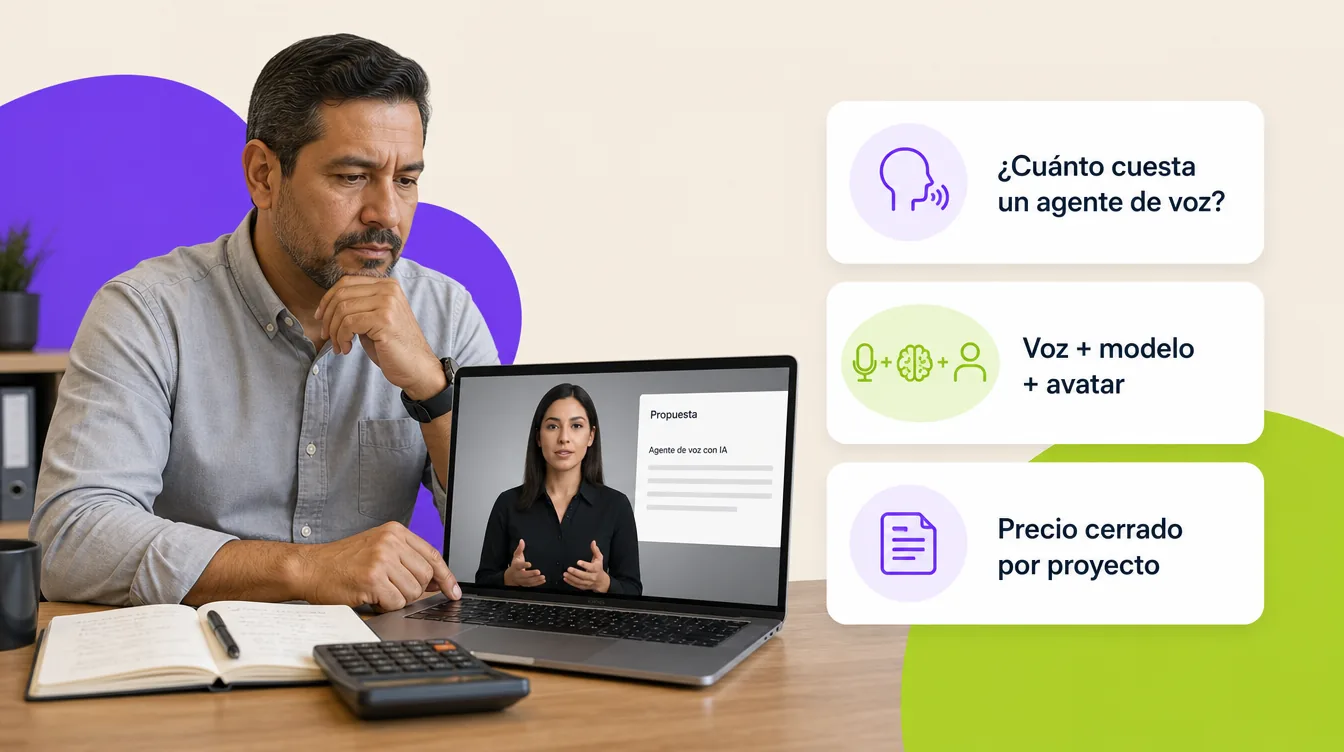
The five cost components of a voice agent
| Component | How it is billed | What makes it go up or down |
|---|---|---|
| Real-time voice and model | Per minute of input and output audio | Model chosen (mini or full), answer length, language |
| Photoreal avatar | Per minute of video, on top of the voice | Whether the conversation needs a face; simultaneous sessions in the plan |
| Room and transport (WebRTC) | Per minute of connected participant | Number of participants and video; almost always the cheapest component |
| Build | Closed price per project | Pedagogical design, documents to connect, integrations (LMS, CRM, email), testing |
| Operation and maintenance | Monthly | Updating content, reviewing transcripts, tuning prompts, reports |
International voice and avatar providers publish their per-minute rates in dollars; they change often and add up, so the real cost per minute is the sum of voice, model, avatar and room, not one provider's rate. In practice, the avatar is the component that weighs most when used, and voice with a "mini" model is enough for most training conversations.
How is a voice agent's spending controlled?
Where the session is issued, not afterwards. The rules we apply to every agent, demos included:
- Free minutes, then details. Two minutes without registration; to continue, name and email. What is not issued costs nothing.
- Cap per day and per connection. A maximum number of sessions per day and per IP address, so a bot or a curious person does not eat the budget.
- Automatic close. The session ends on its own at the maximum (ten minutes in the demos) or if the person stops talking.
- Avatar only where it adds value. If the face does not change the learning, the session goes voice only and costs less; if the avatar plan is full, the session continues with voice and a waveform.
- Monthly limit at each provider. A cap in each service's dashboard as a second safety net.
With these rules the monthly spend becomes predictable: expected sessions × average minutes × cost per minute, plus the operation fee.
What should an AI voice agent proposal include?
- The agent's role and measurable result, in one sentence, with explicit limits.
- The content that is connected: which documents, catalog or rubrics, and who maintains them.
- Three scope options: voice only, voice and avatar, and voice and avatar integrated with the LMS or CRM.
- Cost per minute per service, with the monthly-minutes assumption and the estimated total.
- Closed build price and monthly operation fee, with what each includes.
- Tests with real conversations before publishing, and the indicators that will be reviewed every week.
- Ownership and data: the prompts and content are yours; the conversation does not train models.
If a proposal does not separate usage from build or does not state how many minutes it assumes, it cannot be compared. Our way of working is in AI agents for business, and the pedagogical design of agents that teach, in educational virtual agents.
When is a voice agent worth it and when is a chatbot enough?
If the task is answering frequent questions by text, a chatbot connected to the documents, like the HR chatbot, costs a fraction and solves it. The voice agent, with or without avatar, is justified when the spoken conversation is the learning (languages, interviews, role-play, onboarding) or when the first impression matters (reception, kiosk, candidate portal). We explain the differences in AI voice agents for training and in AI avatars for team training. For teams that want to build their own, the AI agents course covers the architecture and the costs.
Try it, or have us build yours
To quote well we need three facts: the agent's role, the content and the minutes you expect per month. Try the course advisor with avatar first: two free minutes in the browser, no account. If you want one with your content, your voice and your avatar, message us on WhatsApp or fill out the contact form: we reply the same day with a scope and a closed price. The full catalog is at AI agents with avatar.