The 15 most common Spanish spelling mistakes in work emails (and how to fix them)
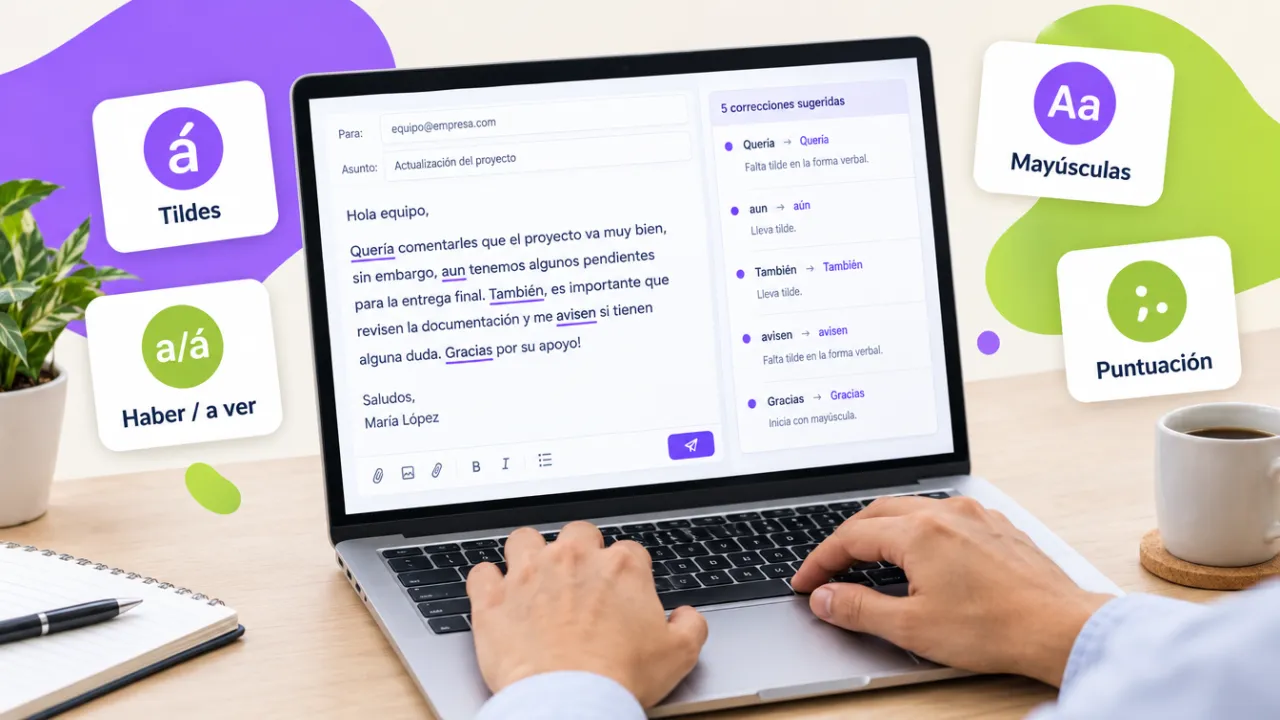
An email with "haber si nos vemos" or "el area de ventas" is still understood, but it changes how the writer and the company they represent are perceived. We review hundreds of real emails in our writing courses and these fifteen mistakes show up in almost every team. For each: the rule in one line and a corrected example, for bilingual teams writing in Spanish.
In this article
Accents that change meaning
- Más / mas. "Más" (more) takes an accent; "mas" (but) does not and is rarely used. Necesitamos más tiempo.
- Sí / si. "Sí" (yes, or the reflexive pronoun) takes an accent; "si" (if) does not. Sí, si confirman hoy, enviamos mañana.
- Aún / aun. "Aún" (still) with an accent; "aun" (even) without. Aún no recibimos el pago, aun con el recordatorio.
- Él / el, tú / tu, mí / mi. Pronoun with accent; article or possessive without. Él revisará tu informe conmigo.
- Qué, cómo, cuándo, dónde. Accented in questions and exclamations, including indirect ones. No sé cuándo llega el proveedor.
Words that get confused
- Haber / a ver. "Haber" is the auxiliary verb; "a ver" means "let's see". A ver si nos vemos; debió haber avisado.
- Hay / ahí / ay. There is / there / ouch. Hay un error ahí.
- Porqué / porque / por qué / por que. Noun (the reason) / because / why / preposition + relative. No sé por qué falló; falló porque no se probó; el porqué está en el reporte.
- Hecho / echo. "Hecho" from hacer (done); "echo" from echar (throw). El informe está hecho.
- Sino / si no. "Sino" contrasts (but rather); "si no" is a negative condition (if not). No es un error, sino una omisión; si no responden, escalamos.
Capitals and punctuation
- Capitalized job titles. Titles go in lowercase in Spanish: el director general, la gerente de ventas. Capitals only for proper names and institutions.
- Capitalized months and days. In Spanish they are lowercase: el lunes 3 de noviembre.
- Comma between subject and verb. "El equipo de compras, revisó el pedido" is wrong: never a comma between subject and verb.
- Accents on capitals. Capitals do take accents: ÁREA, MÉXICO.
- Opening marks. Questions and exclamations take opening marks: ¿Podrías confirmar? ¡Gracias!
How to stop making them
The email spell-checker catches typos, not meaning errors: "haber si" and "a ver si" are correct words to the checker. What works is a personal list of the five mistakes each person repeats, stuck next to the monitor, and a two-minute review routine before sending. That is exactly what gets built in the spelling and professional writing course: each participant leaves with their list, corrected on their own emails.
A two-minute exercise for your team
Take the last five emails each person sent to a customer or another area and mark only the mistakes on this list. In our courses, the average on the first review is three to five mistakes per person, almost always the same ones: diacritic accents, "haber/a ver" and capitalized job titles and months. Repeat the exercise a month after giving each person their personal list. The drop is usually total or close to it; not because people "learn spelling" but because they know exactly what to check before sending.
When a mistake does cost money
A "haber si nos vemos" in an internal email is anecdotal. The same mistake in a commercial proposal, in an official letter to a government agency or in a reply to a customer complaint changes how serious the whole company looks and, in tenders and bids, can weigh on the evaluation. That is why in our courses we start with the texts that leave the organization —proposals, official letters, customer replies— and then move to internal ones.
Want to bring this to your team?
We work with your team's real emails and official letters (anonymized) and each person leaves with a personal list of corrected mistakes. Message us on WhatsApp, fill out the contact form or open this site's live chat: we send a proposal with three scope options and a closed price in under 24 business hours, with the DC-3 certificate and Geedle Bot included. The full program is at the spelling and professional writing course and the catalog at training courses for companies.