Cognitive biases in decision making: the seven that cost companies the most and how to counter them
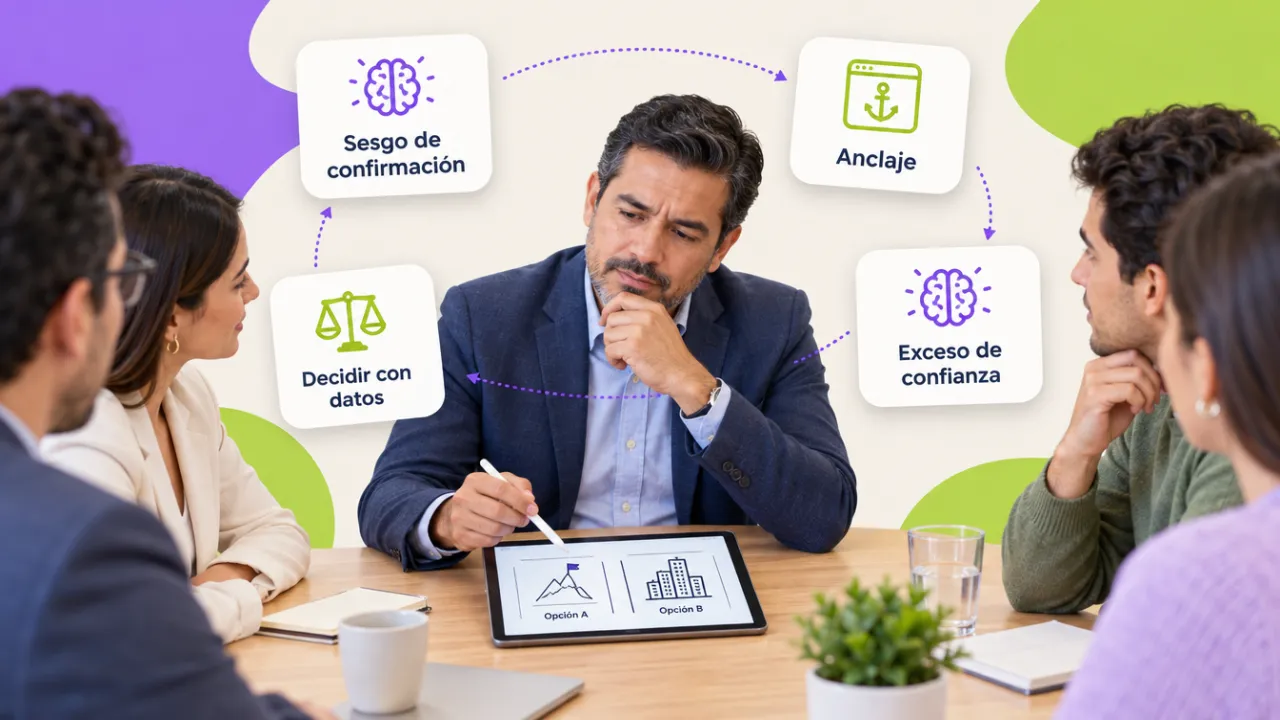
Nobody decides badly on purpose. We decide badly because the mind uses shortcuts that worked for thousands of years and fail in a management meeting: we look for what confirms what we already believed, we anchor on the first figure, we keep investing in what no longer works. These seven biases show up in almost every business decision; for each, how to recognize it and a technique to counter it as a team.
In this article
Why it matters in a company
Biases are not a lack of intelligence or experience; in fact, experience reinforces them. They matter because a company's recurring decisions (hiring, buying, pricing, choosing suppliers, approving projects, diagnosing problems) are made with incomplete information and under time pressure, which is exactly when shortcuts take over. Recognizing them does not remove them, but it allows counterweights.
1. Confirmation bias
What it is: seeking and valuing more the information that confirms what we already believe. What it looks like: a manager convinced the problem is "the team's attitude" finds examples in every meeting and dismisses process data. Counterweight: before deciding, assign someone the explicit task of arguing the opposite, or ask "what data would change my mind?" and go look for it.
2. Anchoring
What it is: the first figure we hear conditions all the following ones. What it looks like: a supplier opens with a high price and the negotiation ends "with a discount" still above market value; or last year's budget becomes the starting point without checking whether it made sense. Counterweight: set your own data-based reference before hearing the other side's; for budgets, build from zero once a year.
3. Availability
What it is: judging as more likely what we recall easily, usually the recent or the striking. What it looks like: after one loud customer complaint, all of management believes "service is bad", even though the month's CSAT went up. Counterweight: look at the full data series, not the last case; ask "how many times did this happen in the last six months?".
4. Overconfidence
What it is: overestimating the precision of our estimates. What it looks like: projects that "will surely finish in March" and finish in July; sales forecasts with no range. Counterweight: always ask for a range (best case, worst case, most likely) and review past estimates against what happened.
5. Sunk cost
What it is: continuing to invest in something because we already invested a lot, even when it no longer pays. What it looks like: a system nobody uses but "we already paid three years of license"; a supplier that fails but "we have been with them a long time". Counterweight: decide as if starting today: "if we did not have this, would we buy it now at this price?".
6. Groupthink
What it is: in a team, pressure for consensus silences doubts. What it looks like: everyone nods in the meeting and criticizes the decision in the hallway. Counterweight: collect opinions in writing before discussing, ask the most junior person first, and have the leader speak last.
7. Outcome bias
What it is: judging a decision by how it turned out rather than how it was made. What it looks like: the bet that worked by luck gets rewarded and the right decision that went wrong gets punished. Counterweight: review important decisions separating process (what we knew, what we considered) from outcome.
Summary and techniques
| Bias | Question that disarms it | Team technique |
|---|---|---|
| Confirmation | What data would change my mind? | Assigned devil's advocate |
| Anchoring | What is my data-based reference? | Own reference before negotiating |
| Availability | How many times in six months? | Look at the full series |
| Overconfidence | What is the range? | Estimate with three scenarios |
| Sunk cost | Would we buy it today? | Decide from zero |
| Groupthink | Who disagrees? | Written opinions before discussing |
| Outcome | Was the decision good, or the outcome? | Review process and outcome separately |
And with artificial intelligence
Generative AI tools add a new bias: accepting an answer because it is well written and sounds confident. The technique is the same as with any source: verify the facts, ask for sources and ask what data would contradict it. Training that way of thinking as a team, with the area's real problems, is the goal of the critical thinking and problem solving course; root cause analysis is its other half.
Want to bring this to your team?
Each team leaves with its bias map, written decision criteria for its recurring decisions and a real problem solved with the method. Message us on WhatsApp, fill out the contact form or open this site's live chat: we send a proposal with three scope options and a closed price in under 24 business hours, with the DC-3 certificate and Geedle Bot included. The full program is at the critical thinking and problem solving course and the catalog at training courses for companies.