ISO 9001:2026 transition audit: how to prepare it in 30 days
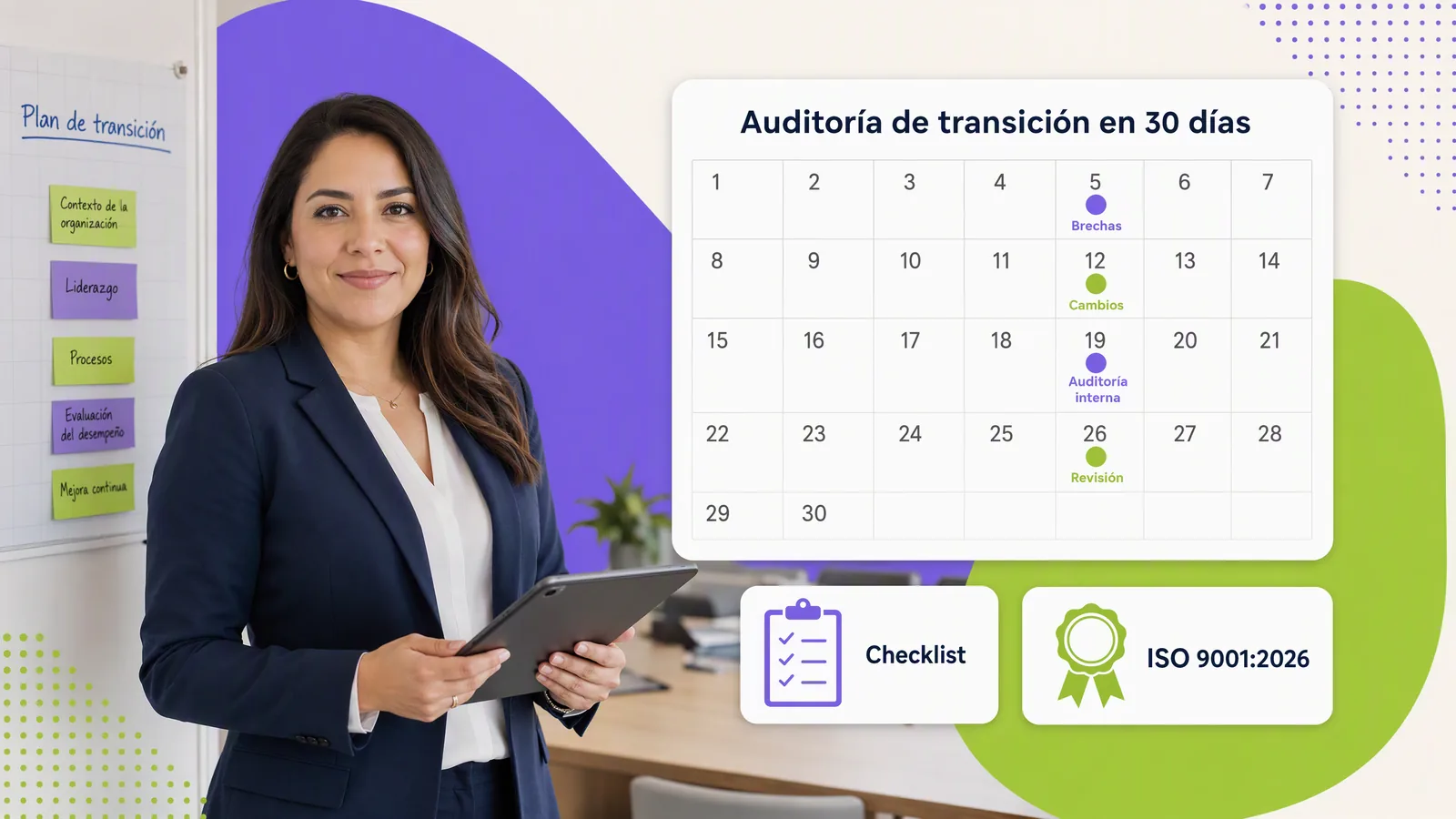
If your 2027 surveillance audit is around the corner and you want to use it for the ISO 9001:2026 transition, thirty well-ordered days of work are enough in an SME with an up-to-date system. This is the week-by-week plan, with what the auditor will review and the mistakes that generate the most findings.
In this article
- What does the auditor review in the ISO 9001:2026 transition audit?
- Before starting: two calls
- Week 1: gaps and documentation
- Week 2: quality culture, ethics and changes
- Week 3: internal audit against the new edition
- Week 4: management review and closure
- The five mistakes that generate the most findings
- Where do you start? Get the free assessment
What does the auditor review in the ISO 9001:2026 transition audit?
Under the mandatory Global ACI document, the transition audit must review, as a minimum, the changed requirements of ISO 9001:2026 versus 2015, the changes in the organization's context and management system, and the effectiveness of the updated system. It can take place at surveillance, at recertification or in a special audit. In other words: it does not re-audit the whole system, only what changed and what you changed. That is the good news and the reason thirty days are enough.
Before starting: two calls
- To your certification body: confirm it has transitioned its accreditation to the 2026 edition (deadline 30 September 2027), in which audit it will run your transition and whether it adds days.
- To your top management: quality culture and ethical behaviour (5.1.1) are the only change the system manager cannot make alone. Book a session with top management in week 2.
Week 1: gaps and documentation
- Gap analysis against ISO 9001:2026 clause by clause; in most companies the gaps are 5.1.1, 5.2.1, 6.1, 6.3, 7.3 and 9.3.2.
- Update the documented information that cites renumbered clauses (6.1.1 to 6.1.3) and the quality policy (5.2.1 e: context and strategic direction).
- Separate the risk register from the opportunity register, each with its own actions.
Week 2: quality culture, ethics and changes
- Session with top management: how quality culture and ethical behaviour are promoted and what evidence shows it (communications, decisions on quality problems, recognition for those who report failures).
- Update onboarding and training to include quality culture and ethical principles (7.3 e), with records.
- Add effectiveness monitoring, communication and review of results (6.3 e, f, g) to the management of change procedure and apply it to a real change to have evidence.
Week 3: internal audit against the new edition
- Schedule the ISO 9001 internal audit with 2026 criteria and an explicit objective: verify the changed requirements.
- Updated internal auditors: a one-day update course with DC-3 records is enough if they were already auditors.
- Record findings with root cause and an action plan with dates.
Week 4: management review and closure
- Management review with the new inputs (9.3.2 c: changes in the needs and expectations of interested parties) and minutes with decisions.
- Close or advance the internal audit findings; whatever stays open, with a plan and an owner.
- Prepare a one-page summary for the auditor: what changed in the standard, what you changed and where the evidence is.
The five mistakes that generate the most findings
| Mistake | What the standard asks | How to avoid it |
|---|---|---|
| A “culture manual” with no practice | Promote quality culture and demonstrate it (5.1.1) | Small, repeatable evidence: communications, decisions, recognition |
| Risks and opportunities in one matrix | Separate actions for risks (6.1.2) and opportunities (6.1.3) | Two registers with actions, owners and dates |
| Management of change only in engineering | System changes with monitoring, communication and review (6.3) | Apply the procedure to a system change before the audit |
| Internal audit against the 2015 edition | Evaluate conformity with the current edition (9.2) | 2026 criteria and the objective of verifying what changed |
| Management review without interested parties | Include their changes as an input (9.3.2 c) | A fixed agenda item with the interested-parties register |
The full phased plan, with official dates, is at ISO 9001:2026 transition; the changes, in ISO 9001:2026 changes clause by clause; and if you also hold the environmental system, the ISO 14001:2026 transition plan is coordinated in the same audit. Download the transition checklist on the service page.
Where do you start? Get the free assessment
If you would rather have an external auditor run the internal audit against the 2026 edition and leave the system ready, that is our service. Answer eight questions in the free ISO systems assessment and get your level and what to do first; or message us on WhatsApp or through the contact form. No cost, no commitment. We have already taken a trailer transport company to ISO 9001:2026 certification: read the case study.