How to write a professional email: structure, tone and a checklist
Most work emails are written the way they are thought: in the order it occurred to the writer, with the important detail at the end and a request the reader has to guess. A professional email is written the other way around: what the reader needs comes first. This guide gives the structure, the tone for each reader and a two-minute checklist.
In this article
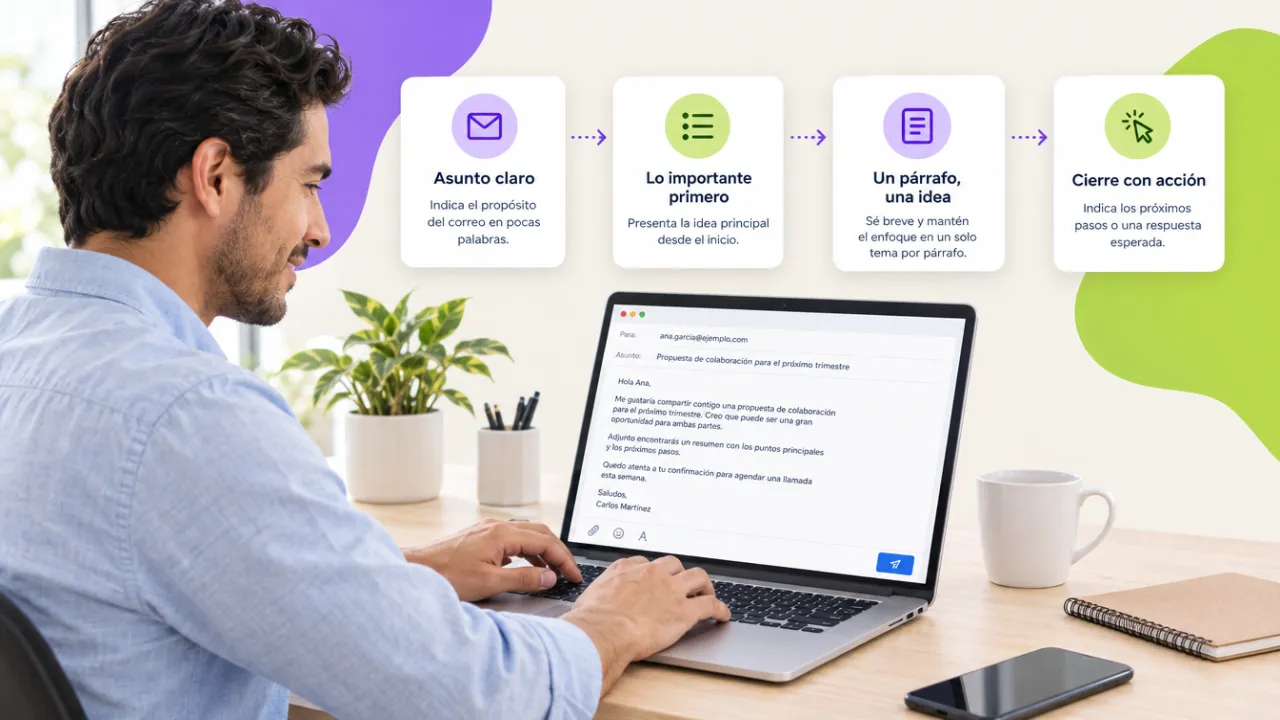
The subject line is the email
Many people decide whether —and when— to open an email by its subject. "Question", "Info" or "Re: Re: Re:" say nothing. A professional subject says what and, if it applies, by when: Quote 2026-118: confirm quantities before Friday. If there is a pending action, it goes in the subject.
The first line carries the point
After the greeting, the first sentence must answer "why are you writing to me?". It is not rude; it is respect for the reader's time. Hi Laura: I need your sign-off on the attached proposal before Thursday to send it to the client. Context, history and details come after, for whoever wants to read them.
One paragraph per idea, and short paragraphs
A twelve-line paragraph is not read: it is scanned. Split each idea into its own three- or four-line paragraph, use bullets only when there is a real list (three or more items of the same kind) and bold the date or figure the reader cannot miss, not half a sentence.
The closing says what happens next
Every work email ends with a clear action: who does what and by when. I will wait for your confirmation on Thursday; if you prefer, we can cover it on the 10 a.m. call. "At your service" is not a closing: it is a farewell that leaves the ball in the air.
Tone by reader
| Reader | Tone | Opening example |
|---|---|---|
| Colleague in your area | Direct and friendly | Hi Mario: can you send me today's inventory? |
| Boss or management | Concise, with the decision you need | Good morning: I need your approval for… |
| Customer | Clear, kind, no internal jargon | Dear Ms. Ruiz: thank you for your message. I confirm that… |
| Upset customer | Acknowledge, solve, do not justify | I am sorry for the delay. Today we will… |
| Authority or agency | Formal, with references | In reply to your official letter number… |
Replying to long threads
When you reach "Re: Re: Re:", do not reply at the bottom of everything: summarize in two lines where the topic stands, answer what you are asked and, if the topic changed, change the subject line. If the thread goes past four replies, it is a call.
Checklist before sending
- Does the subject say what and by when?
- Does the first line say why I am writing?
- Does each paragraph hold a single idea?
- Does the closing say who does what and when?
- Did I check diacritic accents, "haber/a ver" and capitalized titles? (the 15 most common mistakes)
- Did I read it aloud once?
Two minutes. That is what separates an email answered today from one left "for later". In the spelling and professional writing course each team builds its email templates with this structure, on their own messages.
Three emails rewritten
Before: "Hi, I am writing because the other day we talked about the quote and I wanted to see if you had been able to review it because the client keeps asking and honestly I do not know what to tell them, hope you can help". After: "Hi Ana: can you confirm today before 2 whether quote 2026-118 is approved? The client expects it tomorrow. Thanks".
Before: "Good day, report attached". After: "Good morning: attached is the September sales report. The key point: the north region fell 12% due to two store closures; the rest grew 4%. I suggest we review it Thursday in the management meeting".
Before: "We regret the inconvenience and are working to provide you with better service". After: "Dear Ms. Ruiz: you are right, Tuesday's delivery did not arrive. It ships again today with tracking 4471 and arrives tomorrow before 12; I will confirm by WhatsApp once delivered. I am sorry for the delay".
In all three cases the change is the same: the point first, one idea per paragraph and an action with a date.
Want to bring this to your team?
We work with your team's real emails and leave templates per area: quote, follow-up, complaint reply and official letter. Message us on WhatsApp, fill out the contact form or open this site's live chat: we send a proposal with three scope options and a closed price in under 24 business hours, with the DC-3 certificate and Geedle Bot included. The full program is at the spelling and professional writing course and the catalog at training courses for companies.