Assessments that resist ChatGPT: seven designs that measure learning even when students use AI
AI-text detectors do not work reliably and punish those who write well. The way out is not more surveillance but assessing differently: designs where using ChatGPT does not solve the task, or where its use is part of what is assessed. High-school and university teachers we have trained apply these seven designs; each one with its example.
In this article
- Why detectors are not the answer
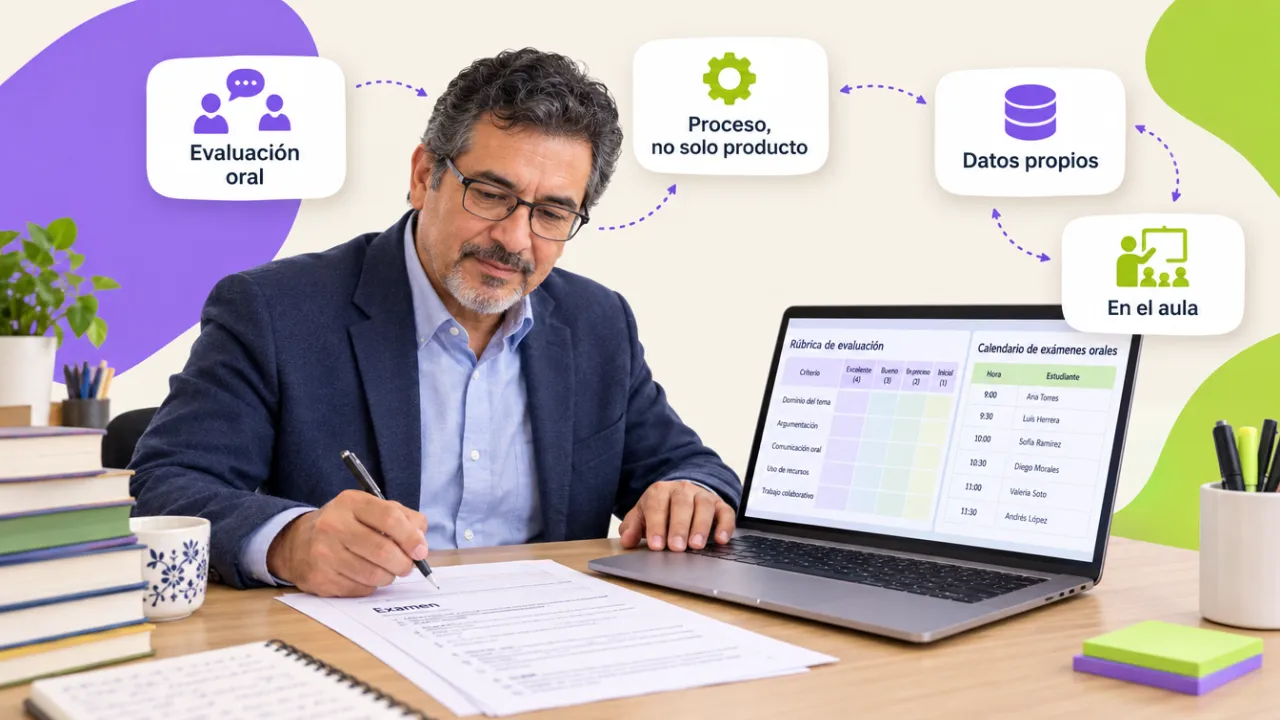
- 1. Assess the process, not just the product
- 2. Oral or short defense
- 3. Own data and contexts
- 4. In-class work with limited time
- 5. Local and current application
- 6. Critique the AI's answer
- 7. Portfolio with reflection
- How to combine them without doubling the teacher's work
- A full example: a high-school history essay
- Want to bring this to your team?
Why detectors are not the answer
Tools that promise to detect AI text produce false positives (they accuse students who wrote alone, especially those who write correctly) and false negatives (a lightly edited text passes). Basing an academic sanction on them is indefensible. The effort pays off more in assessment design, which the teacher does control.
1. Assess the process, not just the product
Ask for the plan, the draft with comments and the final version, on different dates. An essay that appears complete with no drafts is a signal; a visible process is almost impossible to fabricate and also teaches writing. Rubrics with a "process" criterion make it explicit.
2. Oral or short defense
Five minutes of questions about the submitted work ("why did you choose this source?", "what would you change?") immediately reveal whether there was understanding. In large groups, sampled or team defenses keep the load manageable.
3. Own data and contexts
Analyze the sales of the store in your neighborhood, interview a relative, measure something at home, apply the model to the case we saw in class on Tuesday. AI does not have that data; the student does. It is the most natural design in applied subjects.
4. In-class work with limited time
Part of the assessment is done in class, by hand or on controlled devices, building on what was prepared at home. It does not remove AI from preparation (and it does not need to), but it ensures the final synthesis is the student's.
5. Local and current application
Tasks anchored in what happened this week in the community, at the company where they intern or in a recent local news story. Models generate the generic well and the specific and recent poorly.
6. Critique the AI's answer
Hand out an AI-generated answer and ask the student to verify it, point out errors or omissions and improve it with sources. It turns the tool into an object of study and trains exactly the skill the market asks for: judging what AI produces.
7. Portfolio with reflection
A collection of work across the course with a final reflection on what they learned, what was hard and how they used (or did not use) AI. Honest reflection on use is more formative than prohibition.
How to combine them without doubling the teacher's work
| Design | Teacher load | Best for… |
|---|---|---|
| Visible process | Medium (reviewing drafts) | Essays and projects |
| Short oral | Medium (sampled) | Any subject |
| Own data | Low | Applied subjects |
| In class | Low | Synthesis and exams |
| Local application | Low | Social sciences, business |
| Critiquing AI | Low | All; trains critical thinking |
| Portfolio | High at closing | Long courses |
Two or three designs combined per course are enough. In the AI in education course each teacher redesigns a real assessment from their subject with these criteria, and the critical thinking course reinforces design 6 with students.
A full example: a high-school history essay
Original assessment: "Write an 800-word essay on the causes of Independence". ChatGPT solves it in thirty seconds. Redesign with three of the seven designs: (1) visible process: outline due Monday, draft with two local sources due Wednesday and final version Friday, each with its own rubric; (2) local application: one of the sources must be an archive, monument or testimony from the student's municipality; (3) short defense: three two-minute questions in class about the essay's decisions. Extra load for the teacher: reading the outline (five minutes per student) and sampled defenses. Result: AI use in the draft is allowed and declared, and the grade measures understanding, not generated writing.
Want to bring this to your team?
We work with each subject's real assessments and leave every teacher with at least one redesigned and an AI usage policy. Message us on WhatsApp, fill out the contact form or open this site's live chat: we send a proposal with three scope options and a closed price in under 24 business hours, with the DC-3 certificate and Geedle Bot included. The full program is at the AI in education course and the catalog at training courses for companies.