Artificial intelligence for developers: what to learn in 2026
Artificial intelligence changed how we write software faster than curricula can change. A developer in 2026 needs to master coding assistants and agentic IDEs, write prompts that produce useful code, integrate language models through RAG and APIs, test and review what the AI generates, take care of security and licensing, and help the team adopt all of this without losing quality. This guide organizes those skills and ties them to real use cases.
In this article
What should a developer learn about artificial intelligence in 2026?
A developer in 2026 needs six artificial intelligence skills: using coding assistants and agentic IDEs with judgment, writing prompts and context that produce correct code, integrating language models into applications through APIs and RAG, testing and reviewing generated code as if a new colleague had written it, understanding security and licensing risks, and bringing all of that to the team as shared practice. None replaces knowing how to program; all of them multiply what a good programmer produces.
The order matters. Those who start by integrating APIs without having learned to review generated code end up with systems nobody understands. That is why the artificial intelligence for developers course follows the sequence of this guide: the daily tool first, then integration, team adoption last.
Coding assistants and agentic IDEs
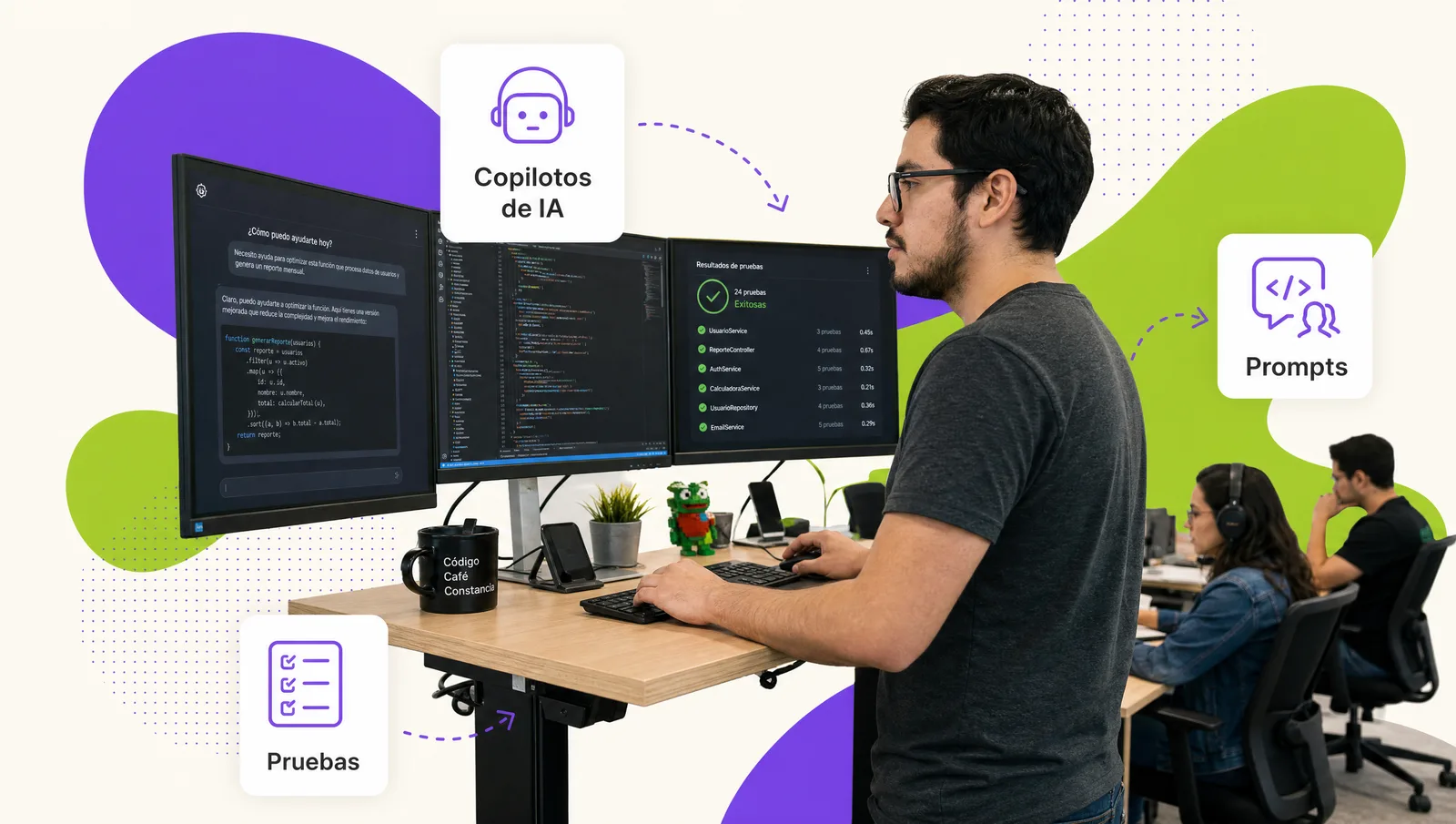
Smart autocomplete was the first wave; the second is agents that read the whole repository, plan a task, edit several files, run tests, and fix until they pass. Tools such as GitHub Copilot, Cursor, or Claude Code work this way from the editor or the terminal. What you need to learn is not the button but the flow: describe the task with acceptance criteria, limit which files it may touch, review the diff before accepting, and know when an agent is going in circles and you need to step in. A developer who masters this stops writing boilerplate and spends the time on design, review, and decisions.
Prompt engineering for code
A good prompt for code is a short specification: what the function does, its inputs and outputs, the language and version, which project conventions it follows, which edge cases it must cover, and which tests must pass. Context weighs as much as the instruction: attaching the related file, the database schema, or the full error message changes the result dramatically. It also pays to learn to ask for explanations ("explain why you chose this approach"), alternatives ("give me two implementations and their trade-offs"), and reviews ("find bugs in this code"), and to maintain project instruction files the assistant reads in every session.
RAG and language model APIs
Integrating AI into an application means calling a model's API (OpenAI, Anthropic, Google, self-hosted open models) and controlling cost, latency, and response format. RAG (retrieval-augmented generation) is the pattern that lets the model answer with your company's data: documents are chunked, converted to vectors, stored in a vector database and, for each question, the relevant chunks are retrieved and included in the prompt. It is exactly what Geedle Bot does with each course's materials and recordings to answer participants and link to the exact minute. What to learn: chunking, embeddings, answer-quality evaluation, structured outputs (JSON), tool calling, and handling hallucinations.
Testing and reviewing generated code
AI-generated code gets reviewed like that of a colleague who just joined: it compiles and passes tests, but may not understand the domain. Three practices keep it under control. First, tests before code: write or request the tests first and let the agent iterate until they pass. Second, diff review on every change, never accepting whole blocks blindly. Third, ask the AI to critique its own code in a second pass focused on bugs, performance, and readability. Real productivity is not generating more lines but shortening the time between idea and correct code.
Security and licensing
Assistants can suggest code with known vulnerabilities (SQL injection, secrets in the repository, outdated dependencies) with the same confidence as secure code. You need to learn to run static analysis and dependency scanning on generated code, never paste secrets or personal data into prompts, configure which data the tool may send to the provider, and check the license of code it reproduces. For a company these rules become a written policy; for the developer, a habit.
Team adoption
- Agree on tools and configuration (which assistant, which model, which data may leave) so not everyone uses whatever they found.
- Maintain a project instruction file with conventions, architecture, and commands that every agent reads.
- Review generated code with the same rigor as human code: pull request, tests, static analysis.
- Measure cycle time, production defects, and test coverage before and after, not just a "feeling of speed".
- Share prompts and workflows that work in an internal repository; knowing how to use AI is as valuable as the code.
- Train the whole team at once so practices are shared from the first sprint.
Table: skill versus use case
| Skill | Typical use case | What changes in daily work |
|---|---|---|
| Agentic IDE | Refactor a module, migrate a framework version, generate tests | Less boilerplate; more review and design |
| Prompts for code | New functions, scripts, SQL queries, regular expressions | Useful first result, fewer iterations |
| LLM APIs | Classify tickets, summarize documents, extract data from PDFs | Features that needed complex rules are solved with a prompt |
| RAG | Assistant over internal documentation, support bot, course agent | The AI answers with company data, with citations |
| Testing and review | All generated code | Stable quality even as speed rises |
| Security and licensing | Repositories with sensitive data, commercial software | Clear policy and fewer audit surprises |
If your company wants to go beyond training and automate entire processes with agents, the AI process automation service starts from the same skill set. The developer course is delivered live virtual or self-paced, with a DC-3 certificate and access to Geedle Bot to resolve questions about the material 24/7.
Want a quote for a course for your team?
If your development team already uses AI in its own way, now is the time to give it method and a shared practice. Tell us what you need: message us on WhatsApp, fill out the contact form or open this site's live chat. We send a proposal with three scope options in under 24 business hours, with the DC-3 certificate and access to Geedle Bot included. The full catalog is at training courses for companies.