How to build your company's annual training plan: needs analysis, legal obligations, calendar, and KPIs
The annual training plan is the document that turns company needs into courses with dates, budget, and evidence. We explain how to build it step by step: training needs analysis, legal obligations (Article 153-A of the Federal Labor Law, DC-3 certificates, and NOM-035), the mix of soft and technical skills, delivery formats, a quarterly calendar with example courses, the budget logic, and the indicators that prove results.
In this article
- What is the annual training plan, and why start with the needs analysis?
- Legal obligations the plan must cover
- The mix: soft and technical skills
- Delivery formats: choose by course, not by habit
- Quarterly calendar with example courses
- The budget logic
- KPIs that prove the plan worked
- Want a quote for a course for your team?
What is the annual training plan, and why start with the needs analysis?
The annual training plan is the calendar of courses the company will deliver during the year, with participants, format, budget, and compliance evidence. It is built from the training needs analysis (TNA): the exercise of comparing what each role should be able to do with what it does today, and of collecting what managers, audits, customers, and employees themselves ask for. Without it, the plan fills up with last year's courses or whatever the current vendor offers, and nobody can later explain why they were delivered.
The needs analysis does not require an outside consultant. Three cross-checked sources are enough: a short survey of department heads about the gaps they see in their teams, the findings from last year's audits, customer complaints, and incidents, and the job profiles with their competencies. From that cross-check come the needs ranked by impact and urgency, which are the raw material for the rest of the plan. Geedle's training course catalog is organized precisely to close those gaps by skill type.
Legal obligations the plan must cover
In Mexico the annual plan is not optional. Article 153-A of the Federal Labor Law establishes that the employer must provide training to all workers, and the law provides for plans and programs drawn up with the participation of the joint training, skills, and productivity commission. The evidence for each course delivered is the DC-3 certificate, the STPS form that attests to the job competencies or skills the worker acquired; the plan should state which courses generate it and how it is kept.
Added to these obligations is NOM-035-STPS-2018, which requires workplaces to identify, analyze, and prevent psychosocial risk factors and to promote a favorable organizational environment. The standard implies awareness and training actions, and the annual plan is the natural place to schedule them. If your company is ISO 9001 certified or wants to be, auditors will also ask for evidence of staff competence; including internal auditor training in the plan avoids a year-end scramble. The delivery formats we use to cover these obligations are at corporate training.
The mix: soft and technical skills
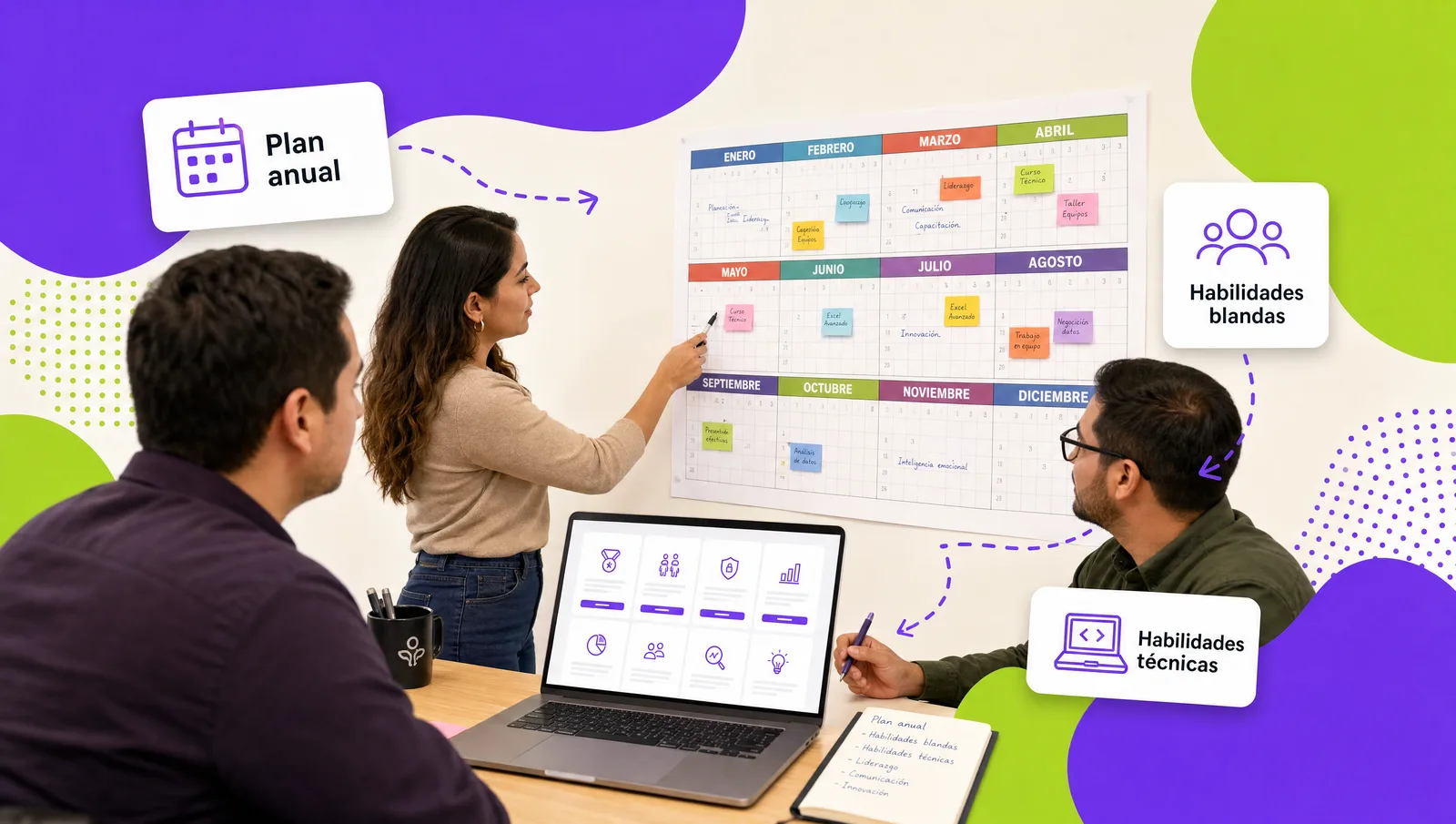
A balanced plan combines both families because they solve different problems. Soft skills (leadership, effective communication, teamwork, emotional intelligence, conflict resolution, customer service, stress management) tackle turnover, climate, complaints, and weak supervision. Technical skills (Excel, Power BI, cybersecurity, artificial intelligence, Moodle, instructional design, 5S, first aid, ISO 9001 internal auditor) tackle productivity, errors, tool adoption, and compliance. As a practical rule, middle managers usually need a heavier soft-skills load and operational and specialized roles a heavier technical load, but the needs analysis decides. You can explore both catalogs at soft skills courses and technical skills courses.
Delivery formats: choose by course, not by habit
- In person: for hands-on practice with equipment, first aid, leadership dynamics where the group matters. The most expensive because of travel and rooms; use it where physical practice is irreplaceable.
- Live virtual: instructor-led sessions over video conferencing, recorded. Ideal for teams across several sites and for topics that need Q&A.
- Self-paced (e-learning): SCORM courses each person takes at their own pace on the platform. Perfect for onboarding, regulatory topics, and anything repeated all year.
- Gamified: any of the above with avatars, coins, and an incentive store. Raises completion of mandatory courses.
- Blended: self-paced theory plus in-person or live practice. Cuts classroom hours without losing the practice.
Quarterly calendar with example courses
The calendar spreads the load so no quarter overwhelms departments or the budget. The courses below are examples of distribution; yours come from the needs analysis.
| Quarter | Focus | Example courses | Suggested format |
|---|---|---|---|
| First (Jan-Mar) | Compliance and foundations | Onboarding and refreshers, NOM-035, cybersecurity for employees, 5S | Gamified self-paced; NOM-035 live virtual |
| Second (Apr-Jun) | Middle managers | Leadership, effective communication, time management, Excel for business | Live virtual with recording; Excel blended |
| Third (Jul-Sep) | Operations and safety | First aid, teamwork, customer service, Power BI for supervisors | First aid in person; the rest virtual |
| Fourth (Oct-Dec) | Improvement and close | ISO 9001 internal auditor, emotional intelligence, stress management, AI for whichever department asks | Live virtual; AI self-paced with a Q&A session |
The budget logic
The budget is built bottom-up: for each course on the calendar, number of participants, format, hours, internal or external instructor, materials, travel, and certificates. Then it is totaled and compared with the ceiling leadership authorizes; if it does not fit, cut by needs-analysis priority, not alphabetically. Three decisions lower cost without lowering coverage: move courses repeated all year to self-paced, group sites into live virtual sessions, and request proposals with several scope options for every external course. Also reserve a line for needs that appear mid-year: a new customer, an audit, a system change.
KPIs that prove the plan worked
- Coverage: share of the workforce that received at least one course from the plan.
- Calendar compliance: courses delivered on the planned date versus those scheduled.
- Completion: participants who finished versus those enrolled, by course and department.
- DC-3 certificates issued: number and share relative to participants who passed.
- Learning: difference between pre- and post-assessment.
- Application: the direct manager's assessment at 60 or 90 days of the change observed on the job.
- Business impact: the indicator that motivated the course (turnover, complaints, incidents, errors, process time) before and after.
With an e-learning platform those indicators come straight out of the system; without one, decide now who captures them and where. And so participants are not left with questions between sessions, every Geedle course includes access to Geedle Bot, an AI agent that answers from the course materials and links to the exact minute of the recording.
Want a quote for a course for your team?
If you already have your needs analysis or want help building it, we quote the courses for the full plan or by quarter. Tell us what you need: message us on WhatsApp, fill out the contact form or open this site's live chat. We send a proposal with three scope options in under 24 business hours, with the DC-3 certificate and access to Geedle Bot included. The full catalog is at training courses for companies.