Artificial intelligence in education: a practical guide for teachers and trainers
Artificial intelligence is already in the classroom whether teachers use it or not: students do. This practical guide explains how to use it with judgment to plan lessons, build rubrics, give individual feedback, design assessments that resist copying, protect academic integrity, ethics, and privacy, which tools work well in Spanish, and how an AI agent trained on a course's content changes how students are supported.
In this article
- How is artificial intelligence used in education today?
- Lesson planning and learning sequences
- Rubrics and feedback
- Assessment that resists copying
- Academic integrity, ethics, and privacy
- Tools that work well in Spanish
- Table: teacher tasks and how AI helps
- Geedle Bot: an AI agent for every course
- Want a quote for a course for your team?
How is artificial intelligence used in education today?
Artificial intelligence in education is used today on five fronts: planning lessons and learning sequences, building rubrics and materials, giving individual feedback at scale, designing assessments and analyzing results, and supporting students outside class hours with agents that answer about the course content. On all of them AI is the teacher's assistant, not a replacement: it proposes, drafts, and organizes, and the person decides, corrects, and adds the context of their group.
The initial resistance of many teachers and trainers is understandable: they fear AI will do the student's work. That concern is real and we address it below, but the answer is not to ban but to redesign. Geedle's artificial intelligence in education course follows exactly this path with hands-on practice on the participants' own subjects.
Lesson planning and learning sequences
This is the use with the best effort-to-result ratio. With a prompt that includes the grade level, the learning objective, the time available, classroom resources, and the group profile, a language model proposes a sequence with opening, development, closing, and formative assessment, and adjusts it when you ask for more collaborative activities, less reading, or an adaptation for students who are behind. The teacher keeps the pedagogical judgment; the AI saves the blank page. Always ask for several versions and state the approach (project-based learning, flipped classroom, case method) so the proposal is not generic.
Rubrics and feedback
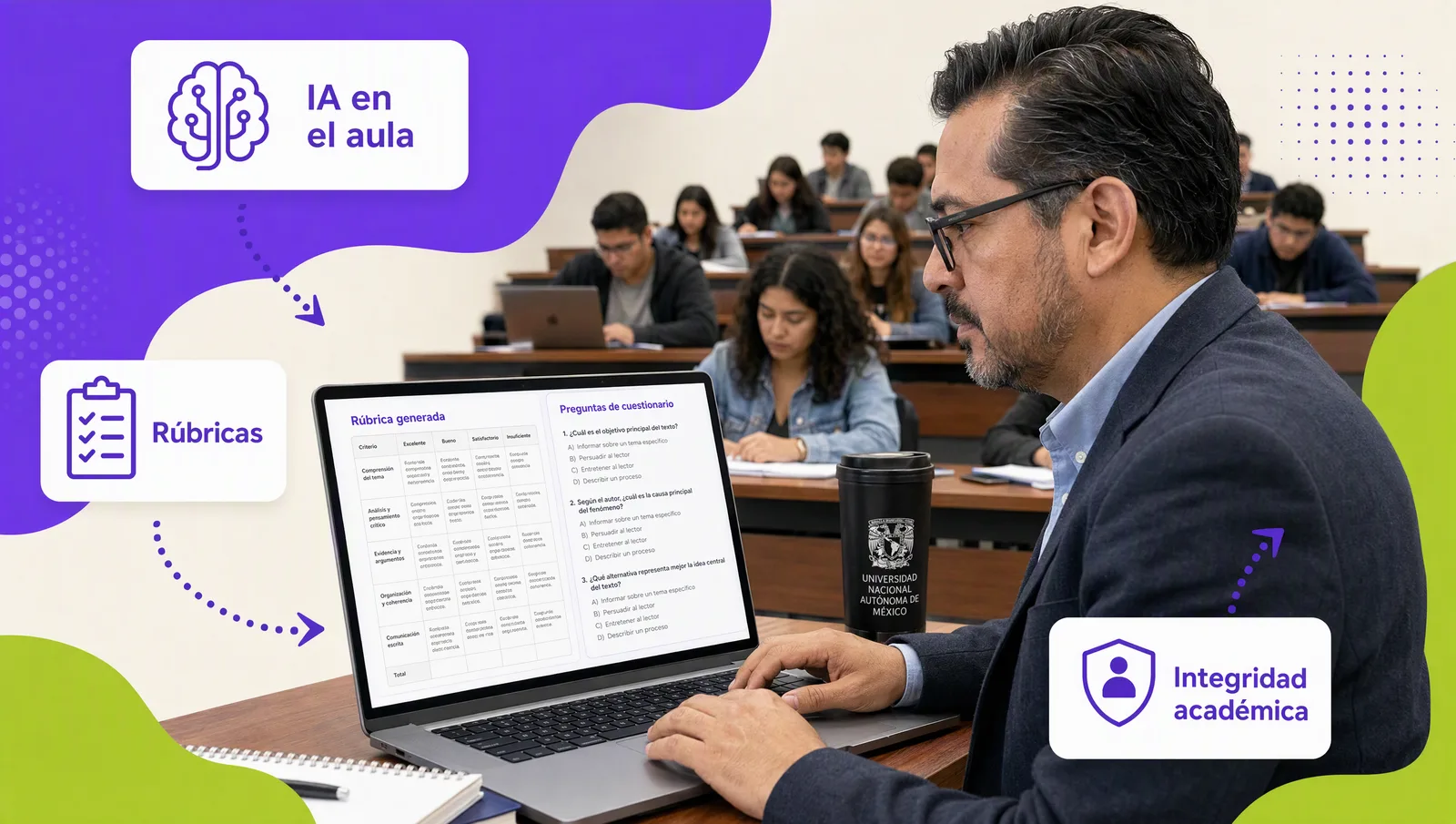
Rubrics are tedious to write and AI produces them well: criteria, performance levels, and observable descriptors from the objective and the product the student will submit. The valuable part comes next: with the rubric defined, AI can draft individual feedback for each piece of work, pointing out strengths, areas for improvement, and the concrete next step, which the teacher reviews and personalizes. What used to be a two-line comment for thirty students becomes useful feedback for each one. The rule: the AI drafts, the teacher signs.
Assessment that resists copying
If a chatbot can solve an assignment in ten seconds, the problem is the assignment. Assessments that resist copying share traits: they ask students to connect content with their own experience or local context, require a visible process (drafts, log, versions), include a short oral defense or presentation, are completed in class with resources in view, or ask students to use AI explicitly and critique its output. The last one is the most formative: it teaches evaluating sources, spotting errors, and arguing, which is exactly what the workplace will demand of them.
Academic integrity, ethics, and privacy
- A clear written policy. Which AI uses are allowed in each type of activity, how they are declared, and what happens if they are not. Ambiguity causes more violations than permissiveness.
- Detectors with caution. Tools that promise to detect AI-generated text produce false positives and can harm students who write formally or in a second language. They must never be the only evidence.
- Student data out of prompts. Never paste names, grades, or sensitive information into tools that may use the data for training; anonymize or use institutional tools with a privacy agreement.
- Bias and errors. Models reproduce biases and are confidently wrong. Review everything handed to students, especially figures, dates, and citations.
- Transparency with the group. Telling them when and how you used AI in materials and feedback models the behavior you expect from them.
- Equity of access. If an activity requires AI, make sure everyone has access to an equivalent tool.
Tools that work well in Spanish
The large language models (the assistants from OpenAI, Anthropic, Google, and Microsoft) respond well in Mexican Spanish and understand references to the national educational context when you give them in the prompt. For visual materials, Canva includes assisted generation of presentations and designs; for interactive content inside an LMS, H5P lets you build activities the AI helps draft. What matters is not the tool but the habit of giving context in Spanish, asking for the language level that fits the group, and reviewing regionalisms and cultural references. For teachers and trainers at institutions, our teacher training program integrates these tools with pedagogy, not as a course about buttons.
Table: teacher tasks and how AI helps
| Task | How AI helps | What the teacher keeps |
|---|---|---|
| Plan a unit | Proposes sequence, activities, and formative assessment from the objective | The pedagogical approach and adaptation to the group |
| Write a rubric | Generates criteria, levels, and observable descriptors | Weighting and validation with colleagues |
| Give feedback on 30 assignments | Individual draft with strengths, improvements, and next step | Review, tone, and the relationship with each student |
| Create support material | Summaries, examples, glossaries, versions by reading level | Fact and source checking |
| Design an assessment | Question bank, cases, variants to prevent copying | The decision of what and how to assess |
| Answer questions outside class | An agent trained on the course answers 24/7 and cites the source | Attention to deep conceptual questions |
Geedle Bot: an AI agent for every course
The last front, supporting students outside class, is where general-purpose AI falls short: it answers with what it knows from the internet, not with what the teacher said. Geedle Bot is an agent trained on each course's materials and recordings. When a participant asks, it answers with the course content and, if the answer is in a recorded session, links to the exact minute and second so they can watch it in context. For the teacher it means fewer repeated questions and a report of which topics generate the most doubts; for the student, support at the hour they study. It is a concrete example of what artificial intelligence in education looks like when it is designed for the classroom and not the other way around.
Want a quote for a course for your team?
If your institution or your team of trainers wants to use AI with judgment and not for fashion, this course is the starting point. Tell us what you need: message us on WhatsApp, fill out the contact form or open this site's live chat. We send a proposal with three scope options in under 24 business hours, with the DC-3 certificate and access to Geedle Bot included. The full catalog is at training courses for companies.