How to choose the best e-learning platform for companies (2026 guide)
Choosing an e-learning platform for your company is not about comparing LMS logos: it is deciding how you will train, document, and certify your workforce for years to come. This guide explains what a corporate e-learning platform is, the eight criteria that separate a good choice from an expensive one, a comparison of the three platform types available today, the mistakes that repeat most often, and a checklist to run before signing.
In this article
- What is an e-learning platform for companies?
- The 8 criteria for choosing the best e-learning platform
- 1. Users and licensing model
- 2. SCORM and xAPI compatibility
- 3. Evidence for the DC-3 and audits
- 4. HR integration and SSO
- 5. Mobile and microlearning
- 6. Gamification
- 7. AI agent for participants
- 8. Support, updates, and exit
- Comparison: the three types of e-learning platform
- Common mistakes when choosing an e-learning platform
- Checklist before you sign
- Want to see the e-learning platform running under your brand?
What is an e-learning platform for companies?
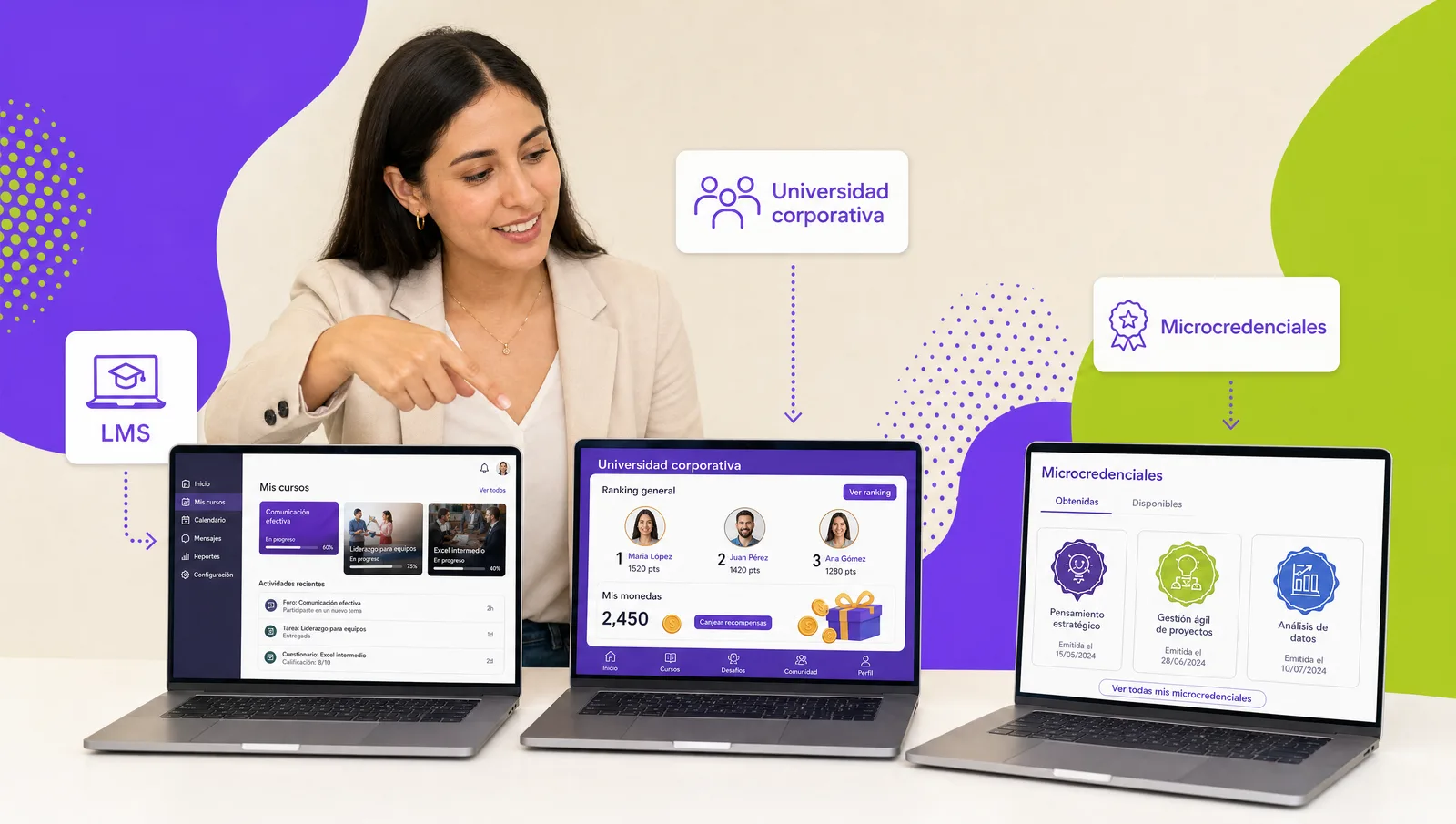
An e-learning platform for companies is the system where the organization publishes its courses, enrolls employees, tracks their progress, and produces evidence that training took place. In Mexico that last point matters: Article 153-A of the Federal Labor Law requires employers to provide training, and the DC-3 certificate filed with the STPS is the document that proves it. The platform is therefore not just a video library: it is the backbone of onboarding, regulatory compliance, skills development and, increasingly, the corporate university.
Technically we are talking about an LMS (Learning Management System) configured for one company: its brand, its departments and roles, its enrollment rules, and its reports. It can be a commercial subscription LMS, an open-source platform such as Moodle implemented to measure, or a content-catalog platform. The difference between the three is the heart of this guide; ours is fully described at e-learning platform for companies.
The 8 criteria for choosing the best e-learning platform
The eight criteria below are the ones that, in practice, decide whether the platform gets used or abandoned within six months. None is technical for its own sake: each answers a question HR, Finance, or an auditor will ask you.
1. Users and licensing model
How many people will log in this year, and how many in three years? If the platform charges per user, cost grows with headcount and penalizes including frontline staff, interns, or distributors. A model with no per-user license flips the logic: the more people you train, the lower the cost per person.
2. SCORM and xAPI compatibility
Your current courses and the ones you buy from vendors almost always come as SCORM 1.2 or 2004; newer ones as xAPI. If the platform does not play and fully record them, switching content vendors will force you to rebuild everything. Ask to see one of your own SCORM packages running in the demo.
3. Evidence for the DC-3 and audits
The platform must store who took which course, when, with what score and for how long, and issue the DC-3 certificate with the participant, company, and instructor data. If the certificate has to be filled in by hand in another system, the evidence drifts out of sync.
4. HR integration and SSO
Hires, exits, and role changes should flow from your payroll or HR system, and employees should log in with the same password they use across the company (SSO with Microsoft, Google, or another provider). Without this, someone manages users by hand forever.
5. Mobile and microlearning
A large share of your workforce will learn from a phone, on shifts and on the floor. The platform needs an app or a truly responsive design, offline download, and short courses that can be completed in minutes.
6. Gamification
Avatars, coins, rankings by department, and an incentive store turn mandatory training into something people finish. Check that gamification is configurable by you and not a fixed set of badges.
7. AI agent for participants
An agent trained on each course's materials and recordings answers questions 24/7 and points to the exact minute of the recording where the answer lives. It cuts tickets to the training team and improves completion. At Geedle that agent is Geedle Bot.
8. Support, updates, and exit
Who updates the platform, when does support answer, and in what format do you get your data if you decide to leave? The answers to those three questions must be in writing in the proposal.
Comparison: the three types of e-learning platform
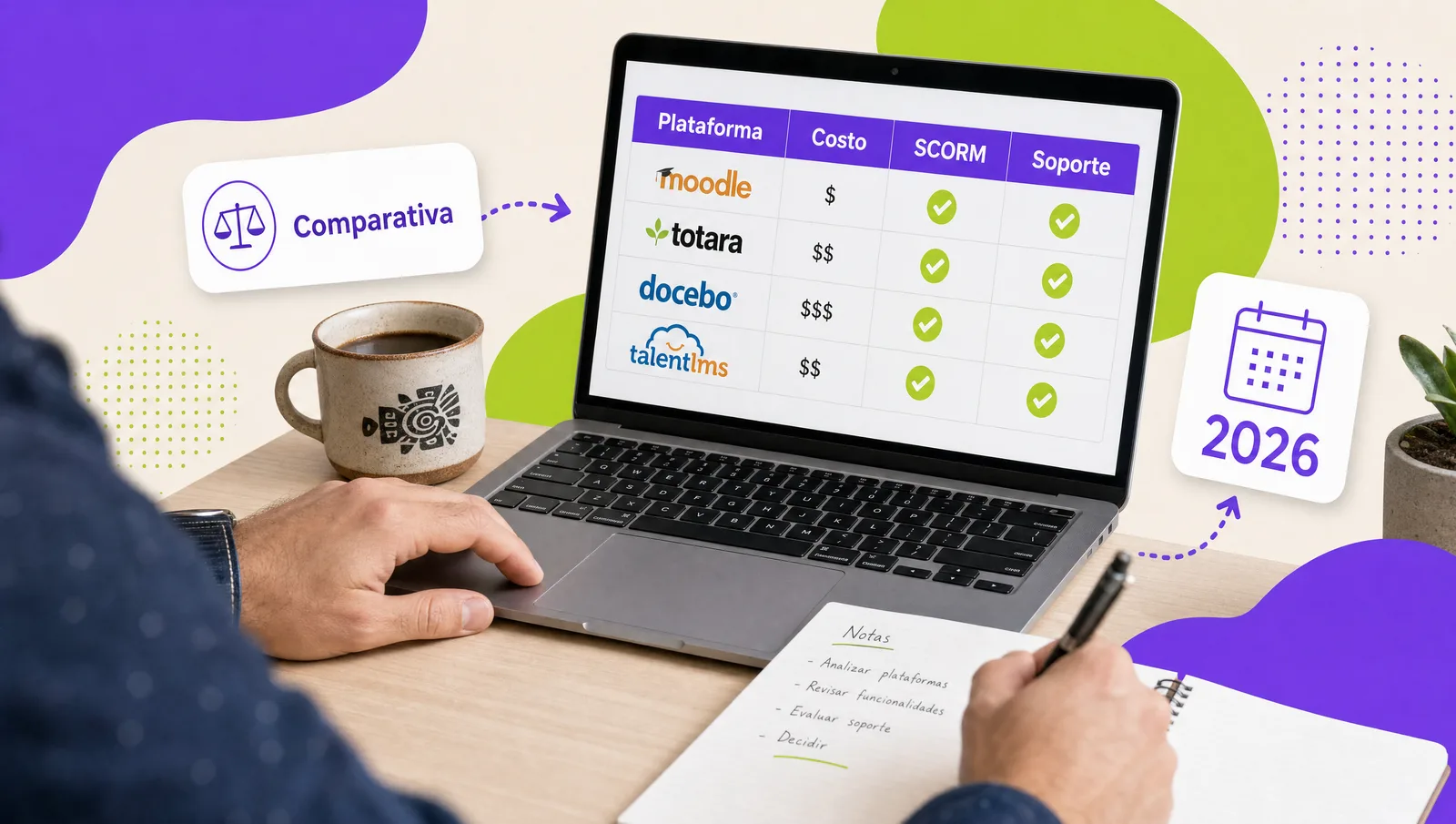
The platforms you will evaluate fall into three families. The table sums up how each behaves against the criteria above.
| Criterion | Commercial subscription LMS | Moodle implemented to measure | Content-catalog platform |
|---|---|---|---|
| Cost model | Fee per active user or per bundle | Fixed implementation and hosting cost; no per-user license | Per-user subscription to the catalog |
| SCORM / xAPI | Usually yes, with limits by plan | Yes, native, unlimited packages | Rarely accepts your own courses |
| DC-3 evidence | Depends on the vendor; sometimes manual | Configurable with the STPS fields | Almost never |
| HR and SSO | On higher tiers | Custom integration with your system | Limited |
| Branding and customization | Logo and colors | Domain, theme, structure, and your own plugins | Minimal |
| Gamification | Pre-designed badges | Avatars, coins, store, and configurable rules | Catalog points |
| Time to launch | Days | 2 to 8 weeks depending on scope | Days |
| Best for | Small teams with generic courses | Companies with their own courses, compliance, and growth | Supplementing with third-party courses |
If your company produces or buys its own courses, needs DC-3 certificates, and expects to grow, a custom implementation wins on control and on mid-term cost. That service is detailed at LMS implementation and the rest of the offering at e-learning services.
Common mistakes when choosing an e-learning platform
- Comparing on first-year price. The per-user fee looks cheap with 80 people and stops being cheap with 800. Project three years with your real headcount.
- Not testing with your own courses. Every demo looks good with the vendor's content. Upload your SCORM, your video, and your quiz before deciding.
- Leaving the DC-3 for later. If the certificate does not come out of the platform, someone ends up typing into a spreadsheet and the evidence stops matching.
- Ignoring the administrators. The training team lives in the platform every day, not the committee that chose it. Involve them in the evaluation.
- Forgetting the exit plan. Ask how you export users, grades, and certificates if you change vendors.
- Buying features, not adoption. The best platform is the one people actually finish using; gamification, mobile, and an AI agent weigh more than a hundred features nobody opens.
Checklist before you sign
- I have today's user count and the three-year projection, and I know how cost scales.
- I saw one of my SCORM courses run and record a grade in the demo.
- The DC-3 certificate comes out of the platform with the STPS fields.
- There is a clear path for HR-driven hires and exits and for SSO.
- I tested the full experience from a phone under real conditions.
- Gamification and the AI agent are included or quoted, not "on the roadmap".
- The proposal states implementation time, support hours, and data-export format.
- I received at least three scope options to compare, not a single closed figure.
Want to see the e-learning platform running under your brand?
You have the criteria; the next step is seeing how they behave with your courses and your workforce. Book a 30-minute demo: message us on WhatsApp, fill out the contact form or open this site's live chat. We show you the LMS in your colors, a SCORM course with gamification, and the DC-3 certificate it generates, no cost and no commitment. The whole platform is described at e-learning platform for companies.