


More safety simulators
Combine this scenario with the fire extinguisher and evacuation simulator for your brigade and the lockout-tagout simulator for maintenance.

Platforms
Course production
Online course production
From content to SCORM, in your city
Instructional design for courses
Objectives, script and storyboard
Course content design
Writing, scripts and graphic design
Gamified courses
End-to-end SCORM production
Interactive videos
Decisions and assessment in video
Learning objects
Interactive micro-content
Moodle Plugins
Artificial intelligence
ISO 9001 — Quality
ISO 14001 — Environmental
ISO 45001 — Safety
ISO services
Formats
Learn
A 360° CPR simulator that runs in your browser: someone collapses in the office and you follow the chain of survival in order (safe scene, check, call 911, compressions at 100-120 per minute and AED). The rhythm meter tells you if you are too slow or too fast. This is how first-aid brigades and all staff train before the manikin session.
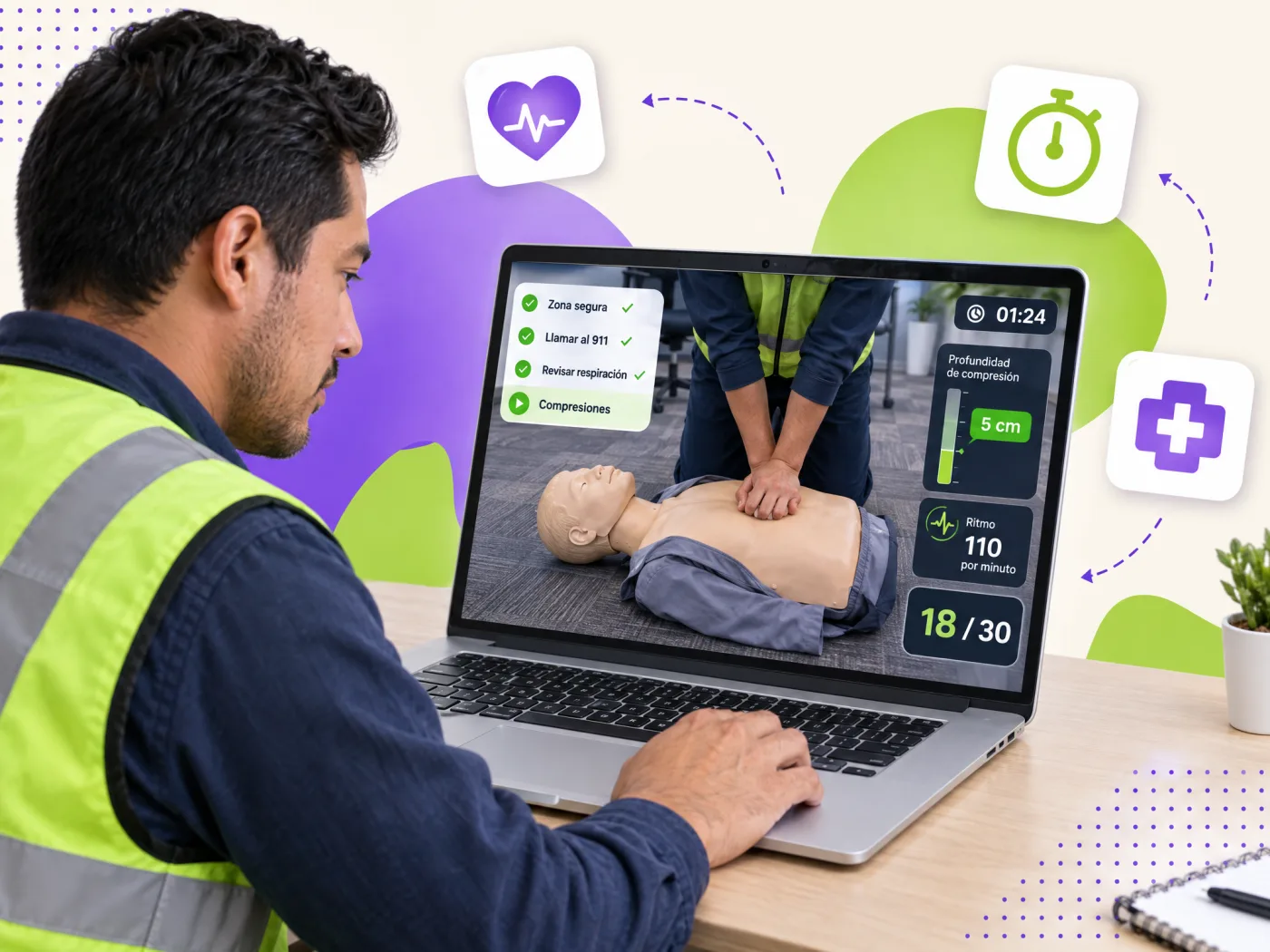
One 360° scene, six steps in the order of the chain of survival, one critical decision and a rhythm meter for compressions.
A CPR simulator is an interactive scenario where a person practices the response to a medical emergency (here, a cardiac arrest in the office) following the chain of survival: secure the scene, check responsiveness, call for help and an AED, assess breathing, compress and defibrillate. In our 360° version every step is a point in the scene and compressions are practiced with a rhythm meter that demands 100 to 120 per minute, as international resuscitation guidelines indicate. The simulator does not replace manikin practice, where depth is learned; it prepares it, so that on the day of the in-person course the responder already knows what to do and in which order.
The chain of survival sequence, in the order that saves lives.
Cables, liquids, fire or electrical risk: the rescuer checks before approaching. A step that gets skipped in real life out of haste.
Tap the shoulders and speak loudly. No response means the emergency is activated immediately.
Point at specific people: who calls 911 and who brings the AED. If alone, speakerphone while starting.
Ten seconds watching the chest. Agonal gasps are not normal breathing: CPR starts.
30 compressions at 100-120 per minute with an on-screen meter; out-of-range rhythm is recorded as an error.
Turn on, place pads, nobody touches during analysis, shock if prompted and resume CPR.
Because the most common problem in a real emergency is not compression technique but sequence: not securing the scene, not calling 911 in time, not sending for the AED, waiting for "someone who knows". The simulator trains that sequence as many times as needed, for all staff and not only the brigade, without gathering people in a classroom. Then manikin practice focuses on what truly needs hands: depth, recoil and breaths. And every person leaves evidence: order of steps, decision facing agonal breathing, compression rate and time.
The sequence follows the chain of survival from international resuscitation guidelines (American Heart Association and ILCOR): recognition, emergency activation, high-quality CPR with 5-6 cm compressions at 100-120 per minute and early defibrillation with an AED. We adapt the texts to your company protocol, your internal emergency number and the real location of your AEDs and first-aid kits.
We take 360° photos of your areas (offices, production floor, cafeteria, parking), locate your real AEDs, kits and emergency phones, and add the scenarios your brigade needs: choking, bleeding, burns, falls. Delivered as a SCORM or xAPI package for your LMS, it serves as brigade training evidence for civil protection and audits.
Evidence for the brigade, for civil protection and for your LMS.
Whether they secured the scene before approaching and called for help before compressing.
What they did when seeing agonal gasps: compress, wait or give water.
Compressions per minute during the 30 compressions and how many were out of range.
Whether they used the AED as soon as it arrived and in the right order.
Out-of-sequence steps, wrong decisions and total response time.
Every action as an "actor-verb-object" statement for your platform's LRS.
Quote the simulator with your areas, your AEDs and your protocol. Three scope options with a closed price.
The manikin is still necessary; the simulator makes sure you reach it knowing the sequence.
| Traditional course | Course with Geedle simulator | |
|---|---|---|
| Chain sequence | Explained and practiced once in class | Practiced as many times as needed, on any device |
| Compression rate | Corrected on the manikin | On-screen meter before the manikin; record per person |
| Reach | The brigade | All staff, with the brigade in hands-on practice |
| Evidence | Attendance list | Sequence, decisions, rate and time (SCORM/xAPI) |
| Annual refresher | Another full course | Simulator refresher and a short manikin session |
Five phases with a deliverable you approve in each one.
360° photos and video of the area, the current procedure and an interview with the expert.
Deliverable: technical scriptTarget behavior, critical decisions, frequent mistakes and the feedback for each one.
Deliverable: storyboard and decision treePanoramas with hotspots, or the machine modeled when its movement must be simulated.
Deliverable: navigable scenarioSteps, interlocks, checklist, score and the xAPI events that will reach your LMS.
Deliverable: working simulatorSCORM or xAPI tested on your platform and a pilot with real staff before launch.
Deliverable: published package and reportCombine this scenario with the fire extinguisher and evacuation simulator for your brigade and the lockout-tagout simulator for maintenance.
The simulator prepares the in-person practice; see our corporate training and gamified training.
See the full catalog at training simulators and 360° virtual tours.
Every scenario runs in the browser and is delivered as SCORM or xAPI.
Tell us how many people, which areas and whether you already have a brigade and an AED. We reply the same day.