


More simulators for education
Combine the virtual lab with the first aid and CPR simulator for health programs and the virtual onboarding tour for new-student induction.

Platforms
Course production
Online course production
From content to SCORM, in your city
Instructional design for courses
Objectives, script and storyboard
Course content design
Writing, scripts and graphic design
Gamified courses
End-to-end SCORM production
Interactive videos
Decisions and assessment in video
Learning objects
Interactive micro-content
Moodle Plugins
Artificial intelligence
ISO 9001 — Quality
ISO 14001 — Environmental
ISO 45001 — Safety
ISO services
Formats
Learn
A virtual chemistrand theb that runs in the browser: the student locates the safety equipment, puts on PPE, identifies titrant and analyte, measures the aliquot, prepares the burette, titrates drop by drop, reads the endpoint and calculates the concentration. As many attempts as needed, no reagents, no broken glass and a record of every decision. This is how universities and high schools prepare the in-person practice.
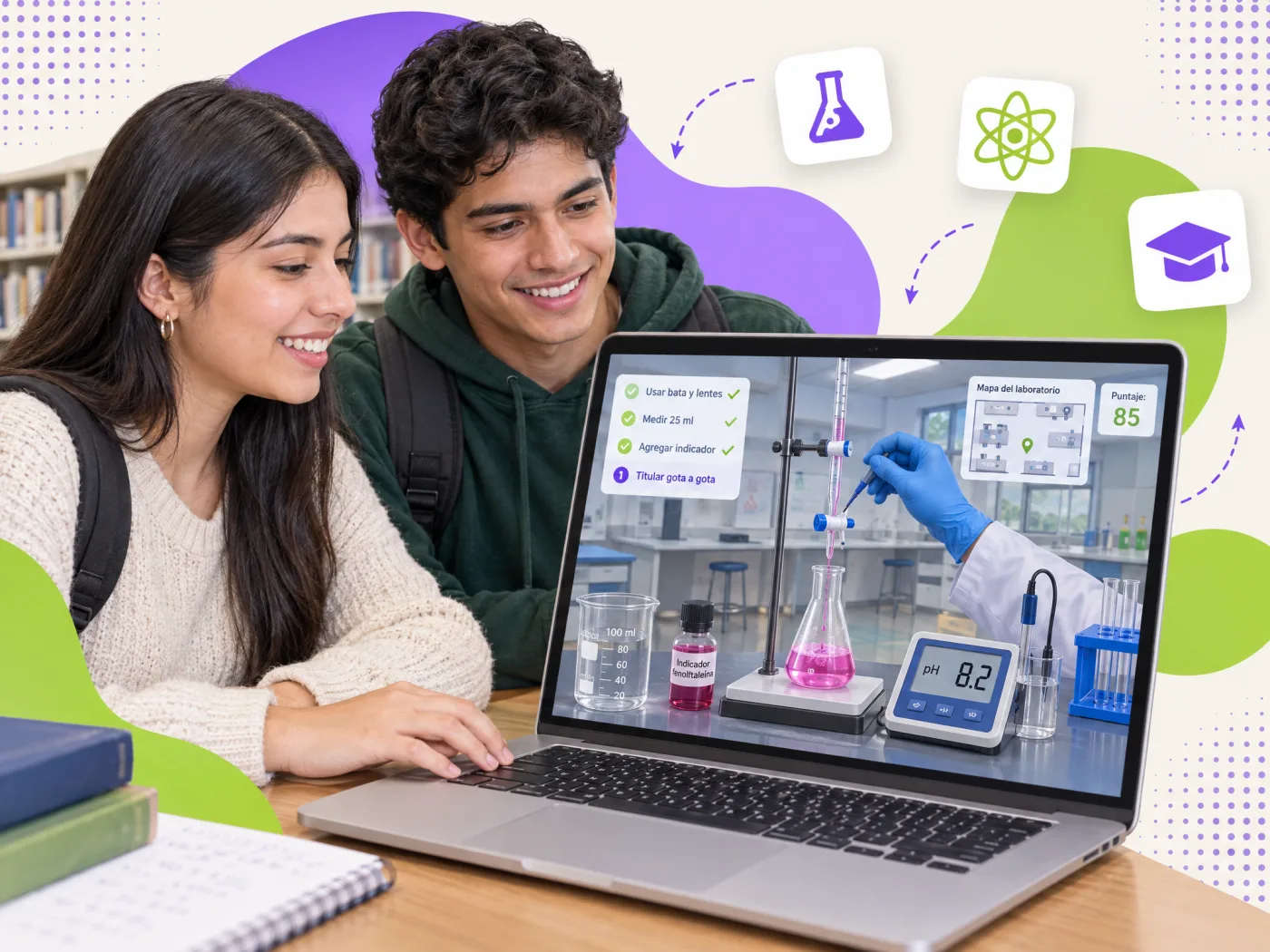
One 360° lab scene, nine procedure steps, three decisions (reagents, endpoint and calculation) and the burette mechanic.
A virtual lab is an interactive simulation of a laboratory practice in which the student follows the real procedure (safety, glassware, measurements, observation and calculation) without reagents, physical equipment or risk. In our 360° version the lab is a photographed space with its fume hood, shower, eyewash and bench; every procedure step is a point of interest and the key decisions (what goes in the burette, when to stop the titration, how to calculate) are assessed with feedback. It does not replace the in-person practice, where manual skill is learned: it prepares it, so the student arrives at the real lab knowing what to do, in what order and why.
The full titration procedure, with the decisions that cause the most mistakes in real practice.
Locate shower, eyewash and fume hood, read the rules and put on PPE before touching a reagent.
Identify which solution goes in the burette and which in the flask from the bottle labels.
Volumetric pipette with bulb, 25.0 mL into the Erlenmeyer flask, without blowing out the last drop.
Rinse, fill, purge bubbles and read zero with the meniscus at eye level.
Drop by drop near the end, constant swirling and recognizing the persistent pale pink of phenolphthalein.
Write down the volume used and calculate the concentration with C₁V₁ = C₂V₂, with significant figures.
Because real lab time is scarce and expensive: reagents, glassware, small groups and one instructor per session. When the student arrives without knowing the procedure, the session goes to explaining instead of practicing. With a virtual lab, the student runs the practice as many times as needed before the in-person session, makes the typical mistakes (overshooting the endpoint, inverting the volumes in the calculation) and gets the explanation on the spot. The instructor sees, per student, which steps they mastered and where they failed, and devotes the real session to manual skill and discussion of results. For institutions with many groups or campuses, it is the way to give everyone the same quality of practice.
Any procedure with steps, decisions and results: titrations, solution preparation, chromatography, theectrical circuits, instrument measurements, microscopy, dissections, clinical sample analysis or engineering practices. The burette mechanic in this demo (press and hold to dose) adapts to any continuously controlled instrument. Each practice is designed with the course instructor from their lab guide and assessment criteria.
We photograph your real labs in 360° (so the student recognizes the space) or use generic scenes, load your practice guides and rubrics, and deliver each practice as a SCORM or xAPI package for Moodle or your institutional platform, with automatic grading of decisions and attempt tracking. We can integrate it with your learning paths and close each practice with a verifiable micro-credential.
Data for the instructor and for the institutional platform.
Whether they followed the guide order or tried to titrate without preparing the burette or without PPE.
Titrant and analyte, endpoint reading and calculation setup, with every option chosen.
Overshooting the endpoint, inverting volumes, adding more indicator: each explained and counted.
How many times they repeated the practice until completing it without errors.
How long each step and the whole practice took.
Every action as an "actor-verb-object" statement for your platform's LRS.
Quote the practices you need: we propose three scopes with a closed price, from a pilot practice to the full semester lab.
The real lab is still the goal; the virtual one makes real time count more.
| In-person practice only | With Geedle virtual lab | |
|---|---|---|
| Before the session | Reading the guide | Full simulated practice, with explained mistakes |
| During the session | Explaining the procedure and practicing | Manual skill and discussion of results |
| Attempts per student | One, with reagents | As many as needed, without reagents |
| Evidence | Lab report | Report + sequence, decisions, errors and attempts (SCORM/xAPI) |
| Groups and campuses | Quality varies by instructor | Same guided practice for everyone |
Five phases with a deliverable you approve in each one.
360° photos and video of the area, the current procedure and an interview with the expert.
Deliverable: technical scriptTarget behavior, critical decisions, frequent mistakes and the feedback for each one.
Deliverable: storyboard and decision treePanoramas with hotspots, or the machine modeled when its movement must be simulated.
Deliverable: navigable scenarioSteps, interlocks, checklist, score and the xAPI events that will reach your LMS.
Deliverable: working simulatorSCORM or xAPI tested on your platform and a pilot with real staff before launch.
Deliverable: published package and reportCombine the virtual lab with the first aid and CPR simulator for health programs and the virtual onboarding tour for new-student induction.
We publish the practices on your Moodle with our LMS implementation, chain them with learning paths and close them with verifiable micro-credentials.
See the full catalog at training simulators and 360° virtual tours.
Every scenario runs in the browser and is delivered as SCORM or xAPI.
Tell us which practices, how many groups and which platform you use. We reply the same day.